
Hrvatska radiotelevizija, or Croatian Radiotelevision, is Croatia's public broadcasting company. It operates several radio and television channels, over a domestic transmitter network as well as satellite. HRT is divided into three joint companies – Croatian Radio, Croatian Television and Music Production, which includes three orchestras and a choir.

Minefields in Croatia cover 258.00 square kilometres of territory. As of 2020, the minefields are located in 45 cities and municipalities within 8 counties. These areas are thought to contain approximately 17,285 land mines, in addition to unexploded ordnance left over from the Croatian War of Independence. Land mines were used extensively during the war by all sides in the conflict; about 1.5 million were deployed. They were intended to strengthen defensive positions lacking sufficient weapons or manpower, but played a limited role in the fighting.

Lošinj Airport is a privately owned public airport 3.2 nautical miles (5.9 km) from Mali Lošinj on the island of Lošinj, Croatia. It is registered for domestic and international traffic.
Alen Vitasović is a Croatian pop singer and songwriter. Born in Pula, many of his songs are about his native Istria and mostly written in Chakavian dialect.

Massimo Moreno Savić, also known simply as Massimo, was a Croatian pop singer.

The order of battle of the Croatian Special Police Units in 1991–1995 included up to 30 individual special forces units subordinated to the Ministry of the Interior. The special police was created around the Ministry of the Interior's existing airborne special forces unit following an open revolt of the Croatian Serbs against the Government of Croatia in August 1990. It further developed with the increasing involvement of the Yugoslav People's Army in the conflict, supporting the Croatian Serbs. The conflict escalated into the Croatian War of Independence in 1991. The special police took part in the first clashes of the war in Pakrac and at the Plitvice Lakes. As Croatia had no army, the 3,000-strong special forces became the country's most effective fighting force.

The Church of St. George in Tovarnik is a Serbian Orthodox church in eastern Croatia built in 1799. Together with the Orthodox church in Ilok and Church of the Holy Venerable Mother Parascheva, it is under the spiritual jurisdiction of the Eparchy of Srem with the seat in Sremski Karlovci, contrary to most of the other Serbian Orthodox churches in eastern Croatia that are under the Eparchy of Osječko polje and Baranja.
Elis Lovrić is a Croatian contemporary folk singer-songwriter and actress. In early 2017 she released her third studio album, Merika.

The Vrsar airport bombing was a Yugoslav Air Force strike on the Crljenka airport near Vrsar—an air sports airport in the Istrian peninsula. The airstrike occurred on 21 December 1991, possibly as an attempt to stop the training of Croatian pilots, who had deserted the Yugoslav Air Force and were being trained in Vrsar. Other than being a training facility, the airport had a significant logistical value. However, since an attack was expected only on the strategically more important Pula Airport the airport had little defences, and the Croatians were caught unaware, with the alarm sounding ten minutes after the attack. Two people were killed in the raid, while the airport was damaged.

The Vrsar Crljenka Airport is an airport for general aviation in Croatia. It is located about 2 km southeast of Vrsar.
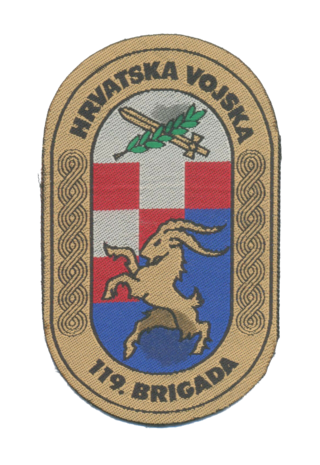
The 119th Brigade, was a Croatian Army guards brigade formed on 7 September 1991 in Pula, western Croatia, with personnel from the former Territorial Defense Brigade Joakim Rakovac. It is, together with the 1st Home Guard Battalion Pula and the 154th Brigade HV, one of the military units from Istria drafted for the Croatian War of Independence. During the Croatian War of Independence, the 119th Brigade primarily operated in the areas of Glibodol, Saborsko, Plitvice, Rakovica, Tržačka Raštela, as well as Slavonia and Dubrovnik.
Igor Štoković was a Croatian economist, musician and politician.

Luciano Delbianco was a Croatian electrical engineer, musician and politician who served two nonconsecutive terms as Mayor of Pula.
Radovan Juričić was a Croatian politician.

Zvane (Ivan) Črnja was a prominent Croatian poet, prose writer, essayist, culturologist, screenwriter, playwright and filmologist, journalist, publicist, polemicist and publisher. He's considered one of the most important names that Istria gave to Croatia in the 20th century. His aliases include: Osip Suri, Barba Zvane, and Filus.
Daniel Načinović is a Croatian poet, prose writer, essayist, journalist, and translator.

Boris Domagoj Biletić is a Croatian poet, literary critic, essayist, publicist and translator. Biletić is the vice-president of the Croatian Writers' Association. He was awarded the Order of Danica Hrvatska with the figure of Marko Marulić in 1996 for his contribution to Croatian culture.
Luka Juričić is a Croatian actor, director and author. Juričić debuted alongside fellow Pula actress Jadranka Đokić in Šverceri hlapić (1999) which he also directed. His television roles include Blagoje in Zauvijek susjedi (2008), and Srećko in Dome, slatki dome (2010). Juričić also starred in some films, including Will Not End Here (2008). He is the author of the Croatian TV series Dar mar, which debuted on Nova TV in 2020. Juričić is best known for his theater work. He has starred in such productions as Dok nas smrt ne rastavi and the award-winning Neboder ("Skyscraper").


