Related Research Articles
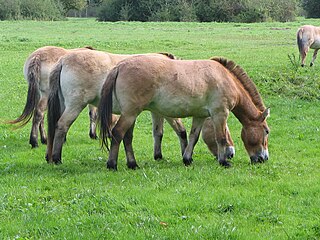
Equidae is the taxonomic family of horses and related animals, including the extant horses, donkeys, and zebras, and many other species known only from fossils. All extant species are in the genus Equus, which originated in North America. Equidae belongs to the order Perissodactyla, which includes the extant tapirs and rhinoceros, and several extinct families.

Weasels are mammals of the genus Mustela of the family Mustelidae. The genus Mustela includes the least weasels, polecats, stoats, ferrets and mink. Members of this genus are small, active predators, with long and slender bodies and short legs. The family Mustelidae, or mustelids, is often referred to as the "weasel family". In the UK, the term "weasel" usually refers to the smallest species, the least weasel (M. nivalis), the smallest carnivoran species.
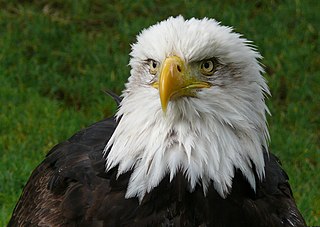
Eagle is the common name for many large birds of prey of the family Accipitridae. Eagles belong to several groups of genera, some of which are closely related. Most of the 60 species of eagle are from Eurasia and Africa. Outside this area, just 14 species can be found—2 in North America, 9 in Central and South America, and 3 in Australia.

Genus /ˈdʒiː.nəs/ is a taxonomic rank used in the biological classification of living and fossil organisms as well as viruses. In the hierarchy of biological classification, genus comes above species and below family. In binomial nomenclature, the genus name forms the first part of the binomial species name for each species within the genus.

In taxonomy, binomial nomenclature, also called binominal nomenclature or binary nomenclature, is a formal system of naming species of living things by giving each a name composed of two parts, both of which use Latin grammatical forms, although they can be based on words from other languages. Such a name is called a binomial name, a binomen, binominal name or a scientific name; more informally it is also called a Latin name.

Nightjars are medium-sized nocturnal or crepuscular birds in the family Caprimulgidae and order Caprimulgiformes, characterised by long wings, short legs, and very short bills. They are sometimes called goatsuckers, due to the ancient folk tale that they sucked the milk from goats, or bugeaters, their primary source of food being insects. Some New World species are called nighthawks. The English word "nightjar" originally referred to the European nightjar.

The lagomorphs are the members of the taxonomic order Lagomorpha, of which there are two living families: the Leporidae and the Ochotonidae (pikas). The name of the order is derived from the Ancient Greek lagos + morphē. There are 110 recent species of lagomorph of which 109 are extant, including 34 species of pika, 42 species of rabbit, and 33 species of hare.

Bovines comprise a diverse group of 10 genera of medium to large-sized ungulates, including domestic cattle, bison, African buffalo, water buffalos, and the four-horned and spiral-horned antelopes. The evolutionary relationship between the members of the group is still debated, and their classification into loose tribes rather than formal subgroups reflects this uncertainty. General characteristics include cloven hooves and usually at least one of the sexes of a species having true horns. The largest extant bovine is the gaur.

Anseriformes is an order of birds also known as waterfowl that comprises about 180 living species of birds in three families: Anhimidae, Anseranatidae, and Anatidae, the largest family, which includes over 170 species of waterfowl, among them the ducks, geese, and swans. Most modern species in the order are highly adapted for an aquatic existence at the water surface. With the exception of screamers, males have penises, a trait that has been lost in the Neoaves. Due to their aquatic nature, most species are web-footed.

Starlings are small to medium-sized passerine birds in the family Sturnidae. The name "Sturnidae" comes from the Latin word for starling, sturnus. Many Asian species, particularly the larger ones, are called mynas, and many African species are known as glossy starlings because of their iridescent plumage. Starlings are native to Europe, Asia and Africa, as well as northern Australia and the islands of the tropical Pacific. Several European and Asian species have been introduced to these areas as well as North America, Hawaii and New Zealand, where they generally compete for habitats with native birds and are considered to be invasive species. The starling species familiar to most people in Europe and North America is the common starling, and throughout much of Asia and the Pacific, the common myna is indeed common.

Old World monkey is the common English name for a family of primates known taxonomically as the Cercopithecidae. Twenty-four genera and 138 species are recognized, making it the largest primate family. Old World monkey genera include baboons, red colobus and macaques. Common names for other Old World monkeys include the talapoin, guenon, colobus, douc, vervet, gelada, mangabey, langur, mandrill, surili (Presbytis), patas, and proboscis monkey. Phylogenetically, they are more closely related to apes than to New World monkeys. They diverged from a common ancestor of New World monkeys around 45 to 55 million years ago.
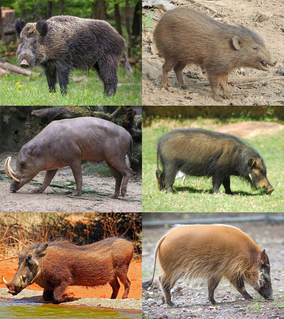
Suidae is a family of artiodactyl mammals which are commonly called pigs, hogs, or boars. In addition to numerous fossil species, 18 extant species are currently recognized, classified into between four and eight genera. Within this family, the genus Sus includes the domestic pig, Sus scrofa domesticus or Sus domesticus, and many species of wild pig from Europe to the Pacific. Other genera include babirusas and warthogs. All suids, or swine, are native to the Old World, ranging from Asia to Europe and Africa.
In biology, a monotypic taxon is a taxonomic group (taxon) that contains only one immediately subordinate taxon. A monotypic species is one that does not include subspecies or smaller, infraspecific taxa. In the case of genera, the term "unispecific" or "monospecific" is sometimes preferred. In botanical nomenclature, a monotypic genus is a genus in the special case where a genus and a single species are simultaneously described. In contrast an oligotypic taxon contains more than one but only a very few subordinate taxa.

In zoological nomenclature, a type species is the species name with which the name of a genus or subgenus is considered to be permanently taxonomically associated, i.e., the species that contains the biological type specimen(s). A similar concept is used for suprageneric groups and called a type genus.

A botanical name is a formal scientific name conforming to the International Code of Nomenclature for algae, fungi, and plants (ICN) and, if it concerns a plant cultigen, the additional cultivar or Group epithets must conform to the International Code of Nomenclature for Cultivated Plants (ICNCP). The code of nomenclature covers "all organisms traditionally treated as algae, fungi, or plants, whether fossil or non-fossil, including blue-green algae (Cyanobacteria), chytrids, oomycetes, slime moulds and photosynthetic protists with their taxonomically related non-photosynthetic groups ."
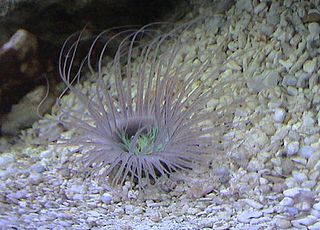
Tube-dwelling anemones or ceriantharians look very similar to sea anemones but belong to an entirely different subclass of anthozoans. They are solitary, living buried in soft sediments. Tube anemones live inside and can withdraw into tubes, which are composed of a fibrous material made from secreted mucus and threads of nematocyst-like organelles known as ptychocysts. Within the tubes of these ceriantharians, more than one polyp is present, which is an exceptional trait because species that create tube systems usually contain only one polyp per tube. Ceriantharians were formerly classified in the taxon Ceriantipatharia along with the black corals but have since been moved to their own subclass, Ceriantharia.

In biological classification, taxonomic rank is the relative level of a group of organisms in a taxonomic hierarchy. Examples of taxonomic ranks are species, genus, family, order, class, phylum, kingdom, domain, etc.
Rachelia extrusus, the blue-flash skipper, is a butterfly of the family Hesperiidae. It is found along the coast of New Guinea and Cape York in the far north of Australia.
Rachelia is a monotypic genus of flowering plants belonging to the family Asteraceae. It just contains one species, Rachelia glariaJ.M.Ward & Breitw. It is also in Tribe Gnaphalieae.
References
 | This Hesperiidae-related article is a stub. You can help Wikipedia by expanding it. |