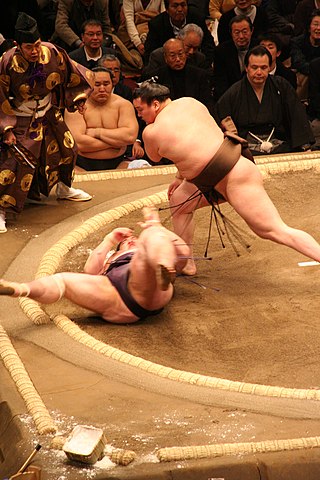
| Raiden Tameemon | |
|---|---|
| 雷電爲右衞門 | |
| | |
| Personal information | |
| Born | Seki Tarōkichi January 1767 Tōmi, Nagano, Japan |
| Died | February 11, 1825 (aged 58) |
| Height | 197 cm (6 ft 5.6 in) |
| Weight | 169 kg (373 lb) |
| Career | |
| Stable | Urakaze (Isenoumi) |
| Record | 254–10–41 |
| Debut | November 1790 |
| Highest rank | Ōzeki (March 1795) |
| Retired | February 1811 |
| Championships | 28 (Makuuchi, unofficial) |
| * Up to date as of June 2013. | |
Raiden Tameemon (雷電爲右衞門), born Seki Tarōkichi (January 1767 – 11 February, 1825), was a Japanese sumo wrestler from Tōmi, Nagano Prefecture. He is considered one of the greatest rikishi in history, although he was never promoted to yokozuna . To date, he holds the record for best top division win ratio of all time.
Raiden was born to a farming family in a village in rural Shinano Province. He is said to have possessed great physical strength even in childhood. His father Hanemon, who enjoyed sumo as much as sake, allowed 14-year-old Raiden to attend sumo classes at Nagaze (today called Murokocho), the neighboring village. When Raiden was 17, the Urakaze-beya stablemaster noticed him when he came through the area while on jungyō (regional tour) with his wrestlers. He was especially impressed with the young man's physique, which was extraordinary at the time. Young Raiden was 1.97 meters (6 ft 5.6 in) tall, which was three head lengths taller than most of his contemporaries. He also had matching long arms and large hands; a handprint at the Shofukuji temple near Okayama, which is said to be of Raiden's hand, measures 24 cm (9.4 in) from the wrist to the tip of the middle finger. When Raiden trained as a wrestler, he developed a weight of 169 kg (373 lb). [1]
When Urakaze Kazuki invited him to Edo and started training him, it turned out that Raiden possessed not only the body of a giant (by 18th-century Japanese standards), but also a talent for sumo wrestling. He was especially talented in oshi-sumo techniques and was able to move at a high speed considering his size. Soon Raiden left his stable and unofficially joined Isenoumi-beya, where yokozuna Tanikaze became his coach. [2]
In 1789, the shikona (wrestler name) "Raiden", which means "thunder bolt", appeared in the banzuke ranking, although Raiden did not have his debut until fall 1790. Raiden was ranked as a sekiwake , as was common practice then. He had the best record in the basho (tournament) without a defeat. After Tanikaze's death, Raiden was promoted to ōzeki in March 1795, a rank he retained for nearly 17 years. Between November 1793 and April 1800, Raiden finished with the best record in all tournaments he participated in, ahead of the other great fighters of his time, Tanikaze and Onogawa. [1] After 1800, he remained dominant, and sumo officials even disallowed him to use his favorite techniques in order to keep his matches interesting. [2] [3]
Of the 35 tournaments in which he participated (there were only two basho a year at the time), Raiden had the best record in no fewer than 28. In seven of those, he won without suffering a single defeat or draw. In total, he achieved 254 victories and only ten defeats, a winning percentage of 96.2, an all-time record. [4] His longest winning streaks were eleven consecutive tournaments, or 44 bouts. Raiden's championships are, however, regarded as unofficial by the Japan Sumo Association, as before the current yūshō system was established in 1909, there was no prize given for individual performances in tournaments.
Finally, in spring 1811, Raiden retired from sumo at the age of 43. He became chairman of the sumo association of Izumo Province (in today's Shimane Prefecture), where his sponsor daimyō resided. In 1816, he moved to Edo and finished his diary Shokoku Sumo Hikae-cho ("journal of sumo in various regions"), which describes his time as an active wrestler since 1789.
After his death, he was buried in Akasaka in Edo. Two locks of his hair are buried in other graves which are located in his home village and in Matsue in Shimane.
When Raiden was still an active wrestler, his home village's residents built monuments honoring his parents. Raiden himself contributed a sake barrel made of stone in memory of his father. Since his death, Raiden has appeared not only as subject of a number of statues, but also on postage stamps, beer labels, anime and manga.
Despite his dominance at the time, Raiden never was promoted to yokozuna , the highest rank in sumo. The exact reason for this remains a mystery in the history of the sport.
Journalist Masahiko Nomi theorized that the 19th Yoshida Oikaze granted yokozuna licences to only two wrestlers, Tanikaze and Onogawa, and not intended to honor any more in the future. Decades later, the 20th Yoshida Oikaze attempted to defeat the Gojo family, which wanted to promote Kashiwado and Tamagaki to yokozuna, by awarding a yokozuna licence to Ōnomatsu Midorinosuke. [5] Ōnomatsu became the first new yokozuna in nearly 40 years.
Another theory has suggested that the reason for the snub may have been due to clan politics. Raiden's sponsor, Daimyo Matsudaira Harusato, was a descendant of Yūki Hideyasu, a son of Tokugawa Ieyasu. The Yoshida family, who held the privilege of awarding the yokozuna licenses, supported the Hosokawa clan, who had a history of supporting Ishida Mitsunari.
Yokozuna was not formally recognized as rank on the banzuke until the beginning of the 20th century. When Jinmaku Kyūgorō erected the yokozuna memorial monument at Tomioka Hachiman Shrine in 1900, he included Raiden's name as a "peerless rikishi", [6] in spite of his never having been officially promoted. [7]
| - | Spring | Winter | ||||
|---|---|---|---|---|---|---|
| 1790 | x | WestSekiwake 8–0–2 2h Unofficial | ||||
| 1791 | WestSekiwake 6–1–2 1nr | WestSekiwake 8–0–1 1h | ||||
| 1792 | Not enrolled | WestSekiwake 2–0–1 | ||||
| 1793 | WestSekiwake 8–1 | WestSekiwake 8–0–1 1h Unofficial | ||||
| 1794 | WestKomusubi 6–0–2 1d 1h Unofficial | WestSekiwake 8–0–1 1h Unofficial | ||||
| 1795 | WestŌzeki 5–0 Unofficial | Not enrolled | ||||
| 1796 | Not enrolled | WestŌzeki 9–0–1 Unofficial | ||||
| 1797 | WestŌzeki 8–1–1 Unofficial | WestŌzeki 10–0 Unofficial | ||||
| 1798 | WestŌzeki 8–0–1 1nr Unofficial | WestŌzeki 9–0–1 Unofficial | ||||
| 1799 | WestŌzeki 6–0–1 Unofficial | WestŌzeki 9–0–1 Unofficial | ||||
| 1800 | Not enrolled | WestŌzeki 6–1–2 1h | ||||
| 1801 | WestŌzeki 6–0–3 1h Unofficial | Not enrolled | ||||
| 1802 | Not enrolled | WestŌzeki 8–0–2 Unofficial | ||||
| 1803 | WestŌzeki 5–0 2h Unofficial | WestŌzeki 9–0–1 Unofficial | ||||
| 1804 | Not enrolled | WestŌzeki 8–1–1 Unofficial | ||||
| 1805 | WestŌzeki 10–0 Unofficial | WestŌzeki 9–1 Unofficial | ||||
| 1806 | WestŌzeki 3–1–1 | WestŌzeki 9–0 1h Unofficial | ||||
| 1807 | WestŌzeki 8–0–1 1h Unofficial | WestŌzeki 8–0 1h 1nr Unofficial | ||||
| 1808 | WestŌzeki 7–0–2 1nr Unofficial | WestŌzeki 9–1 Unofficial | ||||
| 1809 | WestŌzeki 8–0–1 1h Unofficial | WestŌzeki 7–1–2 Unofficial | ||||
| 1810 | WestŌzeki 9–0 1nr Unofficial | WestŌzeki 7–1–1 1d Unofficial | ||||
| 1811 | WestŌzeki Retired 0–0–10 | x | ||||
| Record given as win-loss-absent Top Division Champion Retired Lower Divisions Key: d=Draw(s) (引分); h=Hold(s) (預り); nr=no result recorded Yokozuna (not ranked as such on banzuke until 1890) Ōzeki — Sekiwake — Komusubi — Maegashira | ||||||
*Championships for the best record in a tournament were not recognized or awarded before the 1909 summer tournament and the above unofficial championships are historically conferred. For more information see yūshō.
Makuuchi (幕内), or makunouchi (幕の内), is the top division of the six divisions of professional sumo. Its size is fixed at 42 wrestlers (rikishi), ordered into five ranks according to their ability as defined by their performance in previous tournaments.
Tanikaze Kajinosuke was a Japanese sumo wrestler from the Edo period. Officially recognized as the fourth yokozuna, he was however effectively the first, as he was the first to be awarded the title during his lifetime. He achieved great fame and, though championships from this period are unofficial, he achieved the equivalent of 21 tournament championships. He was also the coach of Raiden Tameemon.
Kaiō Hiroyuki is a former professional sumo wrestler from Nōgata, Fukuoka, Japan.
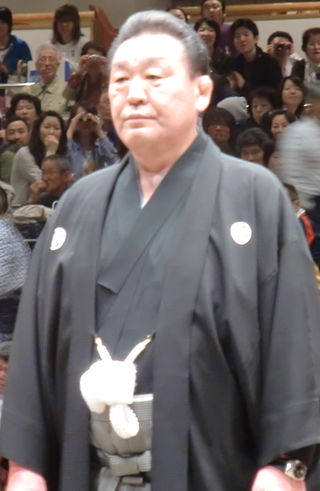
Mienoumi Tsuyoshi is a Japanese former professional sumo wrestler from Matsusaka, Mie. He was the 57th yokozuna of the sport. After retiring he founded the Musashigawa stable and was a chairman of the Japan Sumo Association. He was the first rikishi in history who was demoted from the rank of Ozeki but still managed the promotion to Yokozuna.
Jinmaku Kyūgorō was a Japanese professional sumo wrestler from Itō, Izumo Province. He was the sport's 12th yokozuna.
Onogawa Kisaburō was a Japanese sumo wrestler from Ōtsu, Ōmi Province. He was the sport's 5th yokozuna. Along with Tanikaze, Onogawa was the first to be given a yokozuna licence during his lifetime. He is described as a leading figure of sumo during the Kansei era.
Ōnomatsu Midorinosuke was a Japanese sumo wrestler from Noto Province. He was the sport's 6th yokozuna. He trained ōzeki Tsurugizan Taniemon.
Inazuma Raigorō was a Japanese sumo wrestler from Awazaki, Hitachi Province. He was the sport's 7th yokozuna.

Shiranui Dakuemon was a Japanese sumo wrestler from Uto, Higo Province. He was the sport's 8th yokozuna, and is the only yokozuna in history to have been demoted.

Sakaigawa Namiemon was a Japanese professional sumo wrestler from Katsushika District, Shimōsa Province. He was the sport's 14th yokozuna. Nicknamed "Tanikaze of the Meiji era", he's the only officially recognized yokozuna of the "yokozuna abuse era" following the fall of the Tokugawa shogunate.
Umegatani Tōtarō I was a Japanese professional sumo wrestler from the town of Haki, Chikuzen Province, now Shiwa, Fukuoka Prefecture. He was the sport's 15th yokozuna. He was generally regarded as the strongest wrestler to emerge since the era of Tanikaze and Raiden.

Kashiwado Risuke was a sumo wrestler from Goshogawara, Aomori, Japan.
The following are the events in professional sumo during 2009.
The following are the events in professional sumo during 2010.
The following are the events in professional sumo during 2012.
The following were the events in professional sumo during 2017.
Raiden Shin'emon was a Japanese professional sumo wrestler from Hakui, Ishikawa Prefecture. He made his debut in April 1864 and wrestled for Chiganoura stable. He reached the makuuchi division in April 1870 and reached the rank of ōzeki in 1877. He was nicknamed "Noto's Raiden" (能登雷電) since he is the last wrestler to use the Raiden shikona, or ring name. He retired in May, 1881 and died in 1886.
Iōzan Moriemon was a Japanese sumo wrestler from Monou District, Mutsu Province. His highest rank was ōzeki. He is the seventh wrestler from Miyagi Prefecture to have been promoted to this rank and the first since Hidenoyama in 1841, 15 years earlier. He is also the last wrestler to hold that title until the promotion of Ōtohira in 1893, 37 years later.
The House of Yoshida Tsukasa (吉田司家), also commonly called Yoshida family, is a Japanese aristocratic family who was once responsible for the organization of professional sumo in feudal Japan, controlling rikishi and gyōji throughout the country, making sure that sumo etiquette was strictly observed, and granting the rank of yokozuna and tate-gyōji through a license system.
Kotōzan Bun'emon was a Japanese professional sumo wrestler from Kanzaki District, Ōmi Province. His highest rank was ōzeki. He is the second wrestler from Shiga Prefecture to have been promoted to this rank, having been promoted after Onogawa in 1790, 46 years earlier. As of February 1836, he is also the last wrestler from that prefecture to have achieved this feat.