
The Miocene is the first geological epoch of the Neogene Period and extends from about 23.03 to 5.333 million years ago (Ma). The Miocene was named by Scottish geologist Charles Lyell; the name comes from the Greek words μείων and καινός and means "less recent" because it has 18% fewer modern marine invertebrates than the Pliocene has. The Miocene followed the Oligocene and preceded the Pliocene.
The Neogene is a geologic period and system that spans 20.45 million years from the end of the Paleogene Period 23.03 million years ago (Mya) to the beginning of the present Quaternary Period 2.58 million years ago. The Neogene is sub-divided into two epochs, the earlier Miocene and the later Pliocene. Some geologists assert that the Neogene cannot be clearly delineated from the modern geological period, the Quaternary. The term "Neogene" was coined in 1853 by the Austrian palaeontologist Moritz Hörnes (1815–1868). The earlier term Tertiary Period was used to define the span of time now covered by Paleogene and Neogene and, despite no longer being recognized as a formal stratigraphic term, "Tertiary" still sometimes remains in informal use.

Virginia, officially the Commonwealth of Virginia, is a state in the Southeastern and Mid-Atlantic regions of the United States between the Atlantic Coast and the Appalachian Mountains. The state's capital is Richmond and its most populous city is Virginia Beach. Its most populous subdivision is Fairfax County, part of Northern Virginia, where slightly over a third of Virginia's population of 8.7 million live.

Gannets are seabirds comprising the genus Morus in the family Sulidae, closely related to boobies, commonly named 'gugas' in Scotland.
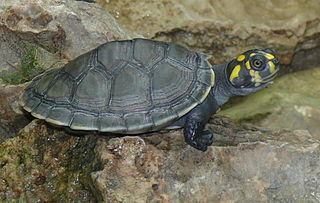
Podocnemididae is a family of pleurodire (side-necked) turtles, once widely distributed. Most of its 41 genera and 57 species are now extinct. Seven of its eight surviving species are native to South America: the genus Peltocephalus, with two species, only one of which is extant ; and the genus Podocnemis, with six living species of South American side-necked river turtles and four extinct. There is also one genus native to Madagascar: Erymnochelys, the Madagascan big-headed turtle, whose single species E. madagascariensis.

The Molidae comprise the family of the molas or ocean sunfishes, unusual fish whose bodies come to an end just behind the dorsal and anal fins, giving them a "half-fish" appearance. They are also the largest of the ray-finned bony fish, with the southern sunfish, Mola alexandrini, recorded at 4.6 m (15 ft) in length and 2,744 kg (6,049 lb) in weight.
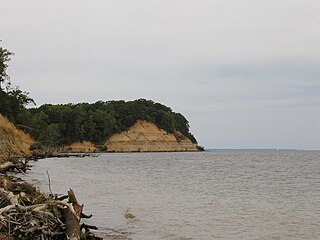
Calvert Cliffs State Park is a public recreation area in Lusby, Calvert County, Maryland, that protects a portion of the cliffs that extend for 24 miles along the eastern flank of the Calvert Peninsula on the west side of Chesapeake Bay from Chesapeake Beach southward to Drum Point. The state park is known for the abundance of mainly Middle Miocene sub-epoch fossils that can be found on the shoreline.

Chrysemys is a genus of turtles in the family Emydidae. They are found throughout most of North America.
Kentriodon is an extinct genus of toothed whale related to modern-day dolphins. Fossils have been found in North America, Europe and Japan. Several species have been described.
Squalus grahami, the eastern longnose spurdog, is a dogfish of the family Squalidae, found off northern Queensland, at depths between 220 and 500 m. Its length is up to 64 cm. Its reproduction is ovoviviparous.

Graham's frog – also known as the diskless-fingered odorous frog – is a species of frog in the family Ranidae. It is found in China and Vietnam. Presumably it is also found in Myanmar in areas adjacent to its Chinese distribution area.

The Rio Grande darter is a small species of ray-finned fish, a darter from the subfamily Etheostomatinae, part of the family Percidae which includes the perches, ruffs and pike-perches. It is endemic to the lower Rio Grande drainage of the United States and Mexico. It inhabits riffles over substrates of gravel or rubble. This species can reach a length of 6 cm (2.4 in), though most only reach about 3 cm (1.2 in). The Rio Grande darter was first formally described as Oligocephalus grahami in 1859 by the French zoologist Charles Frédéric Girard (1822-1895) with the type locality given as the Devils River in Texas. The specific name honors the American soldier and topographer James Duncan Graham (1795-1865), who led the expedition on which the type was collected by John H. Clark.

Ontocetus is an extinct genus of walrus, an aquatic carnivoran of the family Odobenidae, endemic to coastal regions of the southern North Sea and the southeastern coastal regions of the U.S. during the Miocene-Pleistocene. It lived from 13.6 mya—300,000 years ago, existing for approximately 13.3 million years.

Ranzania is a monotypic genus of perennial herbs in the family Berberidaceae. The only species is Ranzania japonica. It is native to woodlands in the mountains of Honshu, Japan. This genus is named in honor of Ono Ranzan, who has been called "the Japanese Linnaeus". Fleshy stems of Ranzania form small colonies from an underground rhizome. Each stem bears two trifoliate compound leaves, and between the leaves is a single or more commonly a small cluster of drooping cup-shaped mauve flowers. These develop into an upright cluster of white berries. The haploid chromosome number is n=7.

David Crockett Graham was a polymath American Baptist minister and missionary, educator, author, archaeologist, anthropologist, naturalist and field collector in the Province of Sichuan during the Chinese Republican Era, from 1911 to 1948. He was a 32nd degree Mason, and a past master of the Szechwan Lodge No. 112. From 1921 to 1942, Graham collected and sent to the Smithsonian Institution nearly 400,000 zoological specimens, including more than 230 new species and 9 new genera, of which 29 were named after him. From 1932 to 1942 he was curator of the Museum of Art, Archaeology and Ethnology at the West China Union University, which still stands as part of Sichuan University, in Chengdu. There, he taught comparative religions at the Theological College, and archaeology and anthropology at the University. He wrote extensively and spent his retirement years, from 1950 to 1961, in Englewood, Colorado compiling his writings and research into three books that were published by the Smithsonian Institution. A fourth manuscript lay in the Whitman College and Northwest Archives until it was discovered by Hartmut Walravens, who edited it and published it in 2018. McKhann refers to Graham as "One of a handful of Western missionaries whose scientific work was respected by other scientists—and of even fewer scientists whose religious work was respected by other missionaries."

Scaldicetus is an extinct genus of highly predatory macroraptorial sperm whale. Although widely used for a number of extinct physeterids with primitive dental morphology consisting of enameled teeth, Scaldicetus as generally recognized appears to be a wastebasket taxon filled with more-or-less unrelated primitive sperm whales.
Ceratitis grahami is a species of insect in the family Tephritidae. It is known from Ghana, from the East Guinean Forest ecoregion.

The Calvert Formation is a geologic formation in Maryland, Virginia, and Delaware. It preserves fossils dating back to the early to middle Miocene epoch of the Neogene period. It is one of the three formations which make up the Calvert Cliffs, all of which are part of the Chesapeake Group.
Epiplatys grahami is a species of killifish in the family Nothobranchiidae. It is an African rivuline that is native to the fresh water habitats from south-eastern Benin and through southern Nigeria and Cameroon to north-western Equatorial Guinea. This species reaches a length of 7.0 cm (2.8 in).

