Rihannsu is a series of five Star Trek novels by author Diane Duane, including one (The Romulan Way) written with Peter Morwood. Rihannsu is the name that Romulans use for their race in Duane's series of books and the name of their language. Rihannsu has never been considered part of Star Trek canon.
Star Trek is an American space opera media franchise based on the science fiction television series created by Gene Roddenberry. The first television series, simply called Star Trek and now referred to as "The Original Series", debuted in 1966 and aired for three seasons on the television network NBC. It followed the interstellar adventures of Captain James T. Kirk and his crew aboard the starship USS Enterprise, a space exploration vessel, built by the United Federation of Planets in the twenty-third century. The Star Trek canon of the franchise includes The Original Series, an animated series, five spin-off television series, the film franchise, and further adaptations in several media.
Diane Duane is an American science fiction and fantasy author. Her works include the Young Wizards young adult fantasy series and the Rihannsu Star Trek novels.
Peter Morwood is primarily a fantasy novelist and screenwriter, though he has also written works of science fiction. His best-known works include the Horse Lords series and the Tales of Old Russia series.
The series consists of five books:
My Enemy, My Ally is a Star Trek: The Original Series novel written by Diane Duane.
The International Standard Book Number (ISBN) is a numeric commercial book identifier which is intended to be unique. Publishers purchase ISBNs from an affiliate of the International ISBN Agency.
Another book, Spock's World , makes reference to some of the events in The Romulan Way from the Vulcan point of view. Duane's Mirror Universe novel Dark Mirror also refers to the Rihannsu. The 2006 omnibus Rihannsu: The Bloodwing Voyages reprints the first four Rihannsu novels, with minor timeline and character rank tweaks for consistency with other novels. [1]
Spock's World is a 1989 novel by Diane Duane, set in the fictional Star Trek universe. The plot revolves around a movement on the planet Vulcan to secede from the United Federation of Planets. The book alternates chapters that advance the main plotline with chapters that relate important scenes from Vulcan's history, and much of the book explores underlying themes in Vulcan philosophy and culture, especially the idea of cthia, a Vulcan philosophical concept translated in the book as "reality-truth — seeing things the way they really are, instead of the way we would like to see them".
Vulcans are a fictional extraterrestrial humanoid species in the Star Trek franchise who originate from the planet Vulcan. In the various Star Trek television series and movies, they are noted for their attempt to live by logic and reason with as little interference from emotion as possible. They were the first extraterrestrial species in the Star Trek universe to observe first contact protocol with humans.
The Mirror Universe is a parallel universe in which the plots of several Star Trek television episodes take place. It resembles the fictional universe in which the Star Trek television series takes place, but is separate from the main universe. The Mirror Universe has been visited in one episode of Star Trek: The Original Series, five episodes of Star Trek: Deep Space Nine, a two-part episode of Star Trek: Enterprise and a storyline in Star Trek: Discovery, as well as several non-canon Star Trek tie-in works. It is named after "Mirror, Mirror", the original series episode in which it first appeared.
These books, as with most of the other Trek novels, are not considered canon. [2]
The Star Trek canon is the set of all canonical material in the Star Trek universe. The official Star Trek website defines canon as comprising the television series Star Trek: The Original Series, Star Trek: The Animated Series, Star Trek: The Next Generation, Star Trek: Deep Space Nine, Star Trek: Voyager, Star Trek: Enterprise, Star Trek: Discovery, and the films in the franchise. Editorials on the Star Trek website acknowledged that this definition is not set in stone, but that the notion of canon in Star Trek is fluid, open to interpretation and debate.
"Rihannsu" is also the name for the Romulan language invented by Duane. [3]
The main Rihannsu character in the series is Ael i-Mhiessan t'Rllaillieu. Her sense of honor and duty leads her, paradoxically, to violate her oaths to her government and crew, first helping Captain Kirk and the crew of the Enterprise to destroy a secret research facility, and then stealing the most precious artifact of her people, the Sword from the Empty Chair, using it as a symbol to lead a rebellion against the government, which she comes to feel has betrayed the ideals of the Empire.
James Tiberius "Jim" Kirk is a fictional character in the Star Trek franchise. Kirk first appears in Star Trek: The Original Series and has been portrayed in numerous films, books, comics, webisodes, and video games. As the captain of the starship USS Enterprise, Kirk leads his crew as they explore new worlds, new civilizations, and "boldly go where no man has gone before". Often, the characters of Spock and Leonard McCoy act as his logical and emotional sounding boards, respectively.

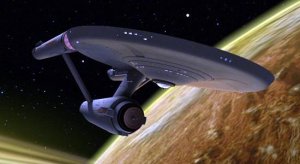
Enterprise or USS Enterprise is the name of several fictional spacecraft, some of which are the main craft and setting for various television series and films in the Star Trek science fiction franchise. The most notable were Captain James T. Kirk's USS Enterprise (NCC-1701) from the original 1960s television series, and Captain Jean-Luc Picard's USS Enterprise (NCC-1701-D) from Star Trek: The Next Generation.
Rihannsu is a fictional language invented by author Diane Duane which is spoken by the Rihannsu (Romulans) in Duane's Star Trek novels. In The Romulan Way, as the inhabitants of the planet Vulcan turn to the philosophy of Surak en masse, the followers of S'task decide that they can no longer remain on Vulcan. As part of their exodus, they intentionally invent a new culture and a new language, based on Old High Vulcan and "aged" in a different direction. This language, described as sounding somewhat like Latin and Welsh, came to be known as Rihannsu.
Duane's creation of the Rihannsu was generally well received by fans, with some going so far as to lobby Paramount to accept them as canonical. [4] However, Gene Roddenberry himself is said to have taken issue with the depiction, particularly Duane and Morwood's assertion in The Romulan Way that 'they [the Rihannsu] were never "Romulans."' [5]
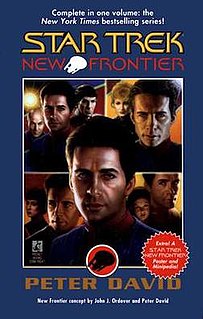
Star Trek: New Frontier is a series of interlinked novels written by Peter David, published by Pocket Books 1997 to 2015. New Frontier is the first Star Trek tie-in fiction property not to be based on a television series. The series was created by John J. Ordover.
Star Trek: Klingon Empire is series of interlinked novels set aboard the fictional battlecruiser I.K.S. Gorkon, published by Pocket Books from 2003 to 2008. The novels were written by Keith DeCandido. Originally published as Star Trek: I.K.S. Gorkon.
Star Trek: Challenger is a spin-off series of Star Trek novels published by Pocket Books in the United States as part of Pocket’s line. Based on the titular TV series created by Gene Roddenberry, the series was created by Pocket editor John J. Ordover and writer Diane Carey, and was a continuation of the six-book storyline, Star Trek: New Earth. The sixth and final New Earth book was subtitled Challenger, and served as a springboard for Star Trek: Challenger. It was published on August 1, 2000.
Mission to Horatius is a novel based on the American science fiction television series Star Trek: The Original Series. It was published in 1968 by Whitman, and was the first original novel based on the series; the first novel for adult audiences, Spock Must Die!, was not published until February 1970. Mission to Horatius details the adventures of the crew of the U.S.S. Enterprise investigating where a distress signal had originated, resulting in them engaging with several different human colonies.
The Price of the Phoenix by Sondra Marshak and Myrna Culbreath, is an original novel based upon the 1960s television series Star Trek. It was first published by Bantam Books in 1977, and reissued by Corgi and Titan Books in the UK.
"The Survivor" is the sixth episode of the first season of the American animated science fiction television series Star Trek: The Animated Series. It first aired on NBC on October 13, 1973, and was written by James Schmerer and was directed by Hal Sutherland. Schmerer pitched an idea for an episode to producer D.C. Fontana called "The Chameleon", and together with the series creator Gene Roddenberry, it was developed into the final script.
Star Trek: New Earth is a series of interlinked novels inspired by Gene Roddenberry's original pitch for Star Trek: "Wagon train to the stars." Created by John J. Ordover, the novels follow the crew of the Enterprise as they lead a colonial expedition into deep space, and their difficulties at keeping the peace in a hostile region. The novels are occur during the second-five year mission—between the episode "Turnabout Intruder" and Star Trek: The Motion Picture. The novels were published by Pocket Books, and were released June – August 2000.
Web of the Romulans is a Star Trek: The Original Series novel written by M. S. Murdock. The subplot where the Enterprise falls in love with Captain James T. Kirk was taken from a story that Murdock had originally written for a Star Trek fanzine.
Jean-Luc Picard is a fictional character in the Star Trek franchise, most often seen as the Captain of the starship USS Enterprise-D. He appears in the television series Star Trek: The Next Generation (TNG), the feature films Star Trek Generations (1994), Star Trek: First Contact (1996), Star Trek: Insurrection (1998), and Star Trek: Nemesis (2002), and is planned to feature as the central character in an as yet untitled forthcoming Star Trek show currently in development. He is portrayed by actor Patrick Stewart.
Killing Time is a Star Trek: The Original Series novel written by Della Van Hise and published by Pocket Books in 1985. The original manuscript had Kirk/Spock slash fiction elements, and these were requested to be removed by Paramount. However, they were not removed, and 250,000 copies were printed. These romantic undertones between Spock and James T. Kirk were brought to the attention of the office of the creator of Star Trek, Gene Roddenberry, who made Pocket Books recall the first edition. This edition subsequently became a collector's item, with more than fifty changes made to a revised version.
The Romulan Way is a Star Trek: The Original Series novel written by Diane Duane and Peter Morwood, and the second novel in the Rihannsu series.
"World Enough and Time" is the third episode of the American science fiction web television series Star Trek: New Voyages. It was released on the internet on August 23, 2007, at the same time as a premiere in Beverly Hills, California. It was written by Marc Scott Zicree and Michael Reaves, and directed by Zicree. Set in the 23rd century, the series follows the adventures of Captain James T. Kirk and his crew aboard the Starfleet starship USS Enterprise. In this episode, when a failed Romulan weapons test traps Enterprise in an inter-dimensional rift, Lt. Hikaru Sulu and another crewmate are sent over to the wreckage of the Romulan ships. The anomaly's effect on the transporter causes Sulu to come back 30 years older and with a daughter, Alana.
Star Trek Log is a series of ten novelizations based on, and inspired by, episodes of the science fiction television series Star Trek: The Animated Series. Published by Ballantine Books from 1974 to 1978, the series was written by Alan Dean Foster and edited by Judy-Lynn del Ray. The series is also known as Star Trek Logs and Star Trek: Logs.