Ruwenzori batis

Last updated

Ruwenzori batis
Ruwenzori Batis RWD.jpg
specimen at Nairobi National Museum
Scientific classification Red Pencil Icon.png
Kingdom: Animalia
Phylum: Chordata
Class: Aves
Order: Passeriformes
Family: Platysteiridae
Genus: Batis
Species:B. diops
Binomial name
Batis diops
Jackson, 1905 [2]

The Ruwenzori batis (Batis diops) is a species of bird in the wattle-eyes family, Platysteiridae. It is found in the Albertine Rift montane forests above 1,400 m in eastern central Africa.

Bird Warm-blooded, egg-laying vertebrates with wings, feathers and beaks

Birds, also known as Aves, are a group of endothermic vertebrates, characterised by feathers, toothless beaked jaws, the laying of hard-shelled eggs, a high metabolic rate, a four-chambered heart, and a strong yet lightweight skeleton. Birds live worldwide and range in size from the 5 cm (2 in) bee hummingbird to the 2.75 m (9 ft) ostrich. They rank as the world's most numerically-successful class of tetrapods, with approximately ten thousand living species, more than half of these being passerines, sometimes known as perching birds. Birds have wings which are more or less developed depending on the species; the only known groups without wings are the extinct moa and elephant birds. Wings, which evolved from forelimbs, gave birds the ability to fly, although further evolution has led to the loss of flight in flightless birds, including ratites, penguins, and diverse endemic island species of birds. The digestive and respiratory systems of birds are also uniquely adapted for flight. Some bird species of aquatic environments, particularly seabirds and some waterbirds, have further evolved for swimming.

Wattle-eye family of birds

Platysteiridae is a family of small, stout passerine birds of the African tropics. The family contains the wattle-eyes, batises and shrike-flycatchers. They were previously classed as a subfamily of the Old World flycatchers, Muscicapidae. These insect-eating birds are usually found in open forests or bush. They hunt by flycatching, or by taking prey from the ground like a shrike. The nest is a small neat cup, placed low in a tree or bush.

Albertine Rift montane forests

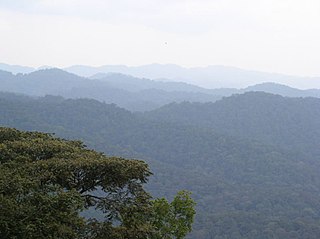
The Albertine Rift montane forests ecoregion, of the tropical moist broadleaf forest biome, are in the heart of Afromontane tropical central Africa.

Contents

Description

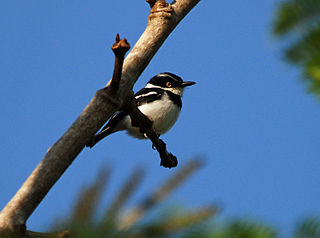
The Ruwenzori batis is a small, active black and white flycatcher-like bird. The upperparts are dark bluish black with a white stripe along the wing and a white loral spot. The underparts are mostly white except for a glossy bluish black breast band, a blacj chin spot and black thighs and grey axillaries. and the belly, . The tail is black with the feathers having white tips and white edges on the outer tail feathers The sexes are similar except that males have yellow eyes and females have been reported to sometimes have orangey red eyes. Juveniles are similar to adults but the plumage has a more rufous cast. [3] The Ruwenzori batis measures 11–12 cm in length, and it weighs 8–15·5 g. [4]

Voice

The territorial call is a slow, low piched whistle has been described as both ventriloqual and eerie. It is repeated with an interval of 2–4 seconds between each whistle. [3]

Distribution and habitat

Eastern central Africa in the Albertine Rift; in the Democratic Republic of Congo it is found from the Ruwenzori Mountains in the north to Mount Kabobo in the south, it is also found in western Uganda, Rwanda and Burundi. [4]

Uganda republic in East Africa

Uganda, officially the Republic of Uganda, is a landlocked country in East-Central Africa. It is bordered to the east by Kenya, to the north by South Sudan, to the west by the Democratic Republic of the Congo, to the south-west by Rwanda, and to the south by Tanzania. The southern part of the country includes a substantial portion of Lake Victoria, shared with Kenya and Tanzania. Uganda is in the African Great Lakes region. Uganda also lies within the Nile basin, and has a varied but generally a modified equatorial climate.

Rwanda country in Africa

Rwanda, officially the Republic of Rwanda, is a country in Central and East Africa and one of the smallest countries on the African mainland. Located a few degrees south of the Equator, Rwanda is bordered by Uganda, Tanzania, Burundi and the Democratic Republic of the Congo. Rwanda is in the African Great Lakes region and is highly elevated; its geography is dominated by mountains in the west and savanna to the east, with numerous lakes throughout the country. The climate is temperate to subtropical, with two rainy seasons and two dry seasons each year.

Burundi country in Africa

Burundi, officially the Republic of Burundi, is a landlocked country amid the African Great Lakes region where East and Central Africa converge. The capital is Gitega, having moved from Bujumbura in December 2018. The southwestern border is adjacent to Lake Tanganyika.

The Ruwenzori batis occurs in lower elevation montane evergreen forest between 1340m and 3300m above sea level, it is commonest in thick bamboo forest or otherwise closed canopy forest on ridges, suboptimal habitats include mixed forest and scrub. [3]

Habits

The breeding biology and habits of the Ruwenzori batis are little known. It is a shy, active bird which is constantly moving but tends to keep hidden in the foliage. It normally forages in mid levels in undergrowth at 2-6m above the ground but also in lower canopy of tall trees. It is insectivorous, flycatching using short flights but most food is probably gleaned from the foliage and twigs. The male appears to regularly feed the incubating or brooding females, the nest and its contents have never been formally described. [3]

Taxonomy

The Ruwenzori batis and Margaret's batis probably belong to the superspecies that also contains Cape batis, Forest batis, dark batis and Woodward's batis. [4] The Ruwenzori batis appears to replace the Ituri batis at higher atltitudes. [3]

Related Research Articles

Bar-winged flycatcher-shrike species of bird

The bar-winged flycatcher-shrike is a small passerine bird usually placed in the Vangidae. It is found in the forests of tropical southern Asia from the Himalayas and hills of southern India to Indonesia. Mainly insectivorous it is found hunting in the mid-canopy of forests, often joining mixed-species foraging flocks. They perch upright and have a distinctive pattern of black and white, males being more shiny black than the females. In some populations the colour of the back is brownish while others have a dark wash on the underside.

Virunga National Park national park

Virunga National Park is a national park in the Albertine Rift Valley in the eastern part of the Democratic Republic of the Congo. It was created in 1925 and is among the first protected areas in Africa. In altitude, it ranges from 680 m (2,230 ft) in the Semliki River valley to 5,109 m (16,762 ft) in the Rwenzori Mountains. From north to south it extends about 300 km (190 mi), largely along the international borders with Uganda and Rwanda in the east. It covers an area of 8,090 km2 (3,120 sq mi) and is listed in the List of World Heritage in Danger since 1994.

Mgahinga Gorilla National Park national park in Uganda

Mgahinga Gorilla National Park is a national park in southwestern Uganda. It was created in 1991 and covers an area of 33.9 km2 (13.1 sq mi).

<i>Batis</i> (bird) genus of birds

Batis is a genus of passerine birds in the wattle-eye family. Its species are resident in Africa south of the Sahara. They were previously classed as a subfamily of the Old World flycatcher family, Muscicapidae.

Shelley's crimsonwingCryptospiza shelleyi is a vulnerable species of estrildid finch found in Burundi, eastern Democratic Republic of the Congo, Rwanda and western Uganda in Africa. It has shown population decline over the past few decades, with a current population estimate of 2,500–9,999. This is possibly related to uncontrolled deforestation.

The Ituri batis or Chapin's batis is a species of bird in the wattle-eye family, Platysteiridae which is found in the humid forests of eastern central Africa.

Margarets batis species of bird

Margaret's batis or Boulton's batis is a species of small passerine bird in the wattle-eyes family, Platysteiridae. It is found in south western central Africa.
Eastern black-headed batis species of bird

The eastern black-headed batis is a passerine bird in the Platysteiridae family from eastern Africa. It was formerly treated as conspecific with the western black-headed batis.

Forest batis species of bird

The forest batis or short-tailed batis is a species of bird in the wattle-eye family, Platysteiridae occurring in eastern Africa.

Grey-headed batis species of bird

The grey-headed batis is a species of bird in the wattle-eyes family, Platysteiridae, it was previously classified with the Old World flycatchers in the family Muscicapidae. It is found in eastern and central Africa.

Pygmy batis species of bird

The pygmy batis is a very small insectivorous bird which finds its food foraging among leaves, it is a member of the wattle-eyes family, the Platysteiridae. It occurs in the dry savannahs of north-eastern Africa.
Fernando Po batis species of bird

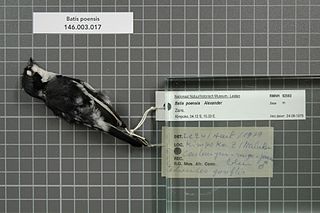
The Fernando Pó batis, also known as the Bioko batis, is a species of bird in the family Platysteiridae. It is endemic to the island of Bioko in Equatorial Guinea.

Scarlet-tufted sunbird species of bird

The scarlet-tufted sunbird is a species of bird in the Nectarinia genus of the Nectariniidae family. It is found in Democratic Republic of the Congo, Kenya, Malawi, Rwanda, Tanzania, Uganda, and Zambia. It is also known as the red-tufted sunbird and the scarlet-tufted malachite sunbird.

Stripe-breasted woodpecker species of bird

The stripe-breasted woodpecker is a species of bird in the woodpecker family, Picidae. It is found in Southeast Asia within subtropical or tropical moist lowland forest and subtropical or tropical moist montane forest.

The dark batis is a small passerine bird belonging to the genus Batis in the wattle-eye family, Platysteiridae. It is found in highland forest in south-west Tanzania and northern Malawi. These birds were formerly thought to be forest batises but in 2006 were described as a new species based on differences in morphology and mitochondrial DNA from those birds in northern Tanzania and Kenya.
Itombwe Mountains

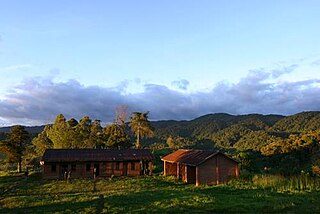
The Itombwe Mountains are a range of mountains in the South Kivu province of the Democratic Republic of the Congo (DRC). They run along the west shore of the northern part of Lake Tanganyika. They contain a vast area of contiguous montane forest and are home to a rich diversity of wildlife.

Rwenzori-Virunga montane moorlands montane grasslands and shrublands ecoregion of central Africa

The Ruwenzori-Virunga montane moorlands is a montane grasslands and shrublands ecoregion of central Africa.

References

  1. "Batis diops". The IUCN Red List of Threatened Species. International Union for Conservation of Nature and Natural Resources . Retrieved 2016-11-05.
  2. "Batis diops Reichenow, 1903". Integrated Taxonomic Information System (ITIS) (https://www.itis.gov). Retrieved 2016-11-05.
  3. 1 2 3 4 5 Harris, Tony; Franklin, Kim (2000). Shrikes and Bush-shrikes. Christopher Helm. pp. 320–321. ISBN   0-7136-3861-3.
  4. 1 2 3 "Ruwenzori Batis (Batis perkeo)". Handbook of the Birds of the World Alive. Lynx Edicions. Retrieved 2016-11-05.