
Look up stp in Wiktionary, the free dictionary.
STP may refer to:
STP may refer to:


OSI may refer to:
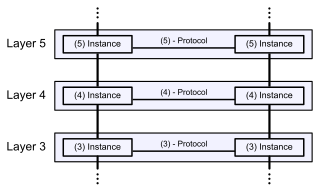
The Open Systems Interconnection (OSI) model is a reference model from the International Organization for Standardization (ISO) that "provides a common basis for the coordination of standards development for the purpose of systems interconnection." In the OSI reference model, the communications between systems are split into seven different abstraction layers: Physical, Data Link, Network, Transport, Session, Presentation, and Application.
The Session Initiation Protocol (SIP) is a signaling protocol used for initiating, maintaining, and terminating communication sessions that include voice, video and messaging applications. SIP is used in Internet telephony, in private IP telephone systems, as well as mobile phone calling over LTE (VoLTE).
SAS or Sas may refer to:
TNG may refer to:
DTP may refer to:

KNX is an open standard for commercial and residential building automation. KNX devices can manage lighting, blinds and shutters, HVAC, security systems, energy management, audio video, domestic appliances, displays, remote control, etc. KNX evolved from three earlier standards; the European Home Systems Protocol (EHS), BatiBUS, and the European Installation Bus.
TCM may refer to:
Pat or PAT may refer to:
ST, St, or St. may refer to:
Tap(s), TAP(S) or tapped may refer to:
Health Level Seven, abbreviated to HL7, is a range of global standards for the transfer of clinical and administrative health data between applications with the aim to improve patient outcomes and health system performance. The HL7 standards focus on the application layer, which is "layer 7" in the Open Systems Interconnection model. The standards are produced by Health Level Seven International, an international standards organization, and are adopted by other standards issuing bodies such as American National Standards Institute and International Organization for Standardization. There are a range of primary standards that are commonly used across the industry, as well as secondary standards which are less frequently adopted.
Set, The Set, SET or SETS may refer to:
CDR may refer to:
A fieldbus is a member of a family of industrial digital communication networks used for real-time distributed control. Fieldbus profiles are standardized by the International Electrotechnical Commission (IEC) as IEC 61784/61158.
IEC 61850 is an international standard defining communication protocols for intelligent electronic devices at electrical substations. It is a part of the International Electrotechnical Commission's (IEC) Technical Committee 57 reference architecture for electric power systems. The abstract data models defined in IEC 61850 can be mapped to a number of protocols. Current mappings in the standard are to Manufacturing Message Specification (MMS), GOOSE [see section 3, Terms and definitions, term 3.65 on page 14], SV or SMV, and soon to web services. In the previous version of the standard, GOOSE stood for "Generic Object Oriented Substation Event", but this old definition is still very common in IEC 61850 documentation. These protocols can run over TCP/IP networks or substation LANs using high speed switched Ethernet to obtain the necessary response times below four milliseconds for protective relaying.
Dad is a synonym for father in English.
Cop or Cops commonly refers to a police officer.
Medical device connectivity is the establishment and maintenance of a connection through which data is transferred between a medical device, such as a patient monitor, and an information system. The term is used interchangeably with biomedical device connectivity or biomedical device integration. By eliminating the need for manual data entry, potential benefits include faster and more frequent data updates, diminished human error, and improved workflow efficiency.