
Pavia, Lombard: [paˈʋiːa]; Latin: Ticinum; Medieval Latin: Papia) is a town and comune of south-western Lombardy, in Northern Italy, 35 kilometres south of Milan on the lower Ticino near its confluence with the Po. It has a population of c. 73,086. The city was the capital of the Ostrogothic Kingdom from 540 to 553, of the Kingdom of the Lombards from 572 to 774, of the Kingdom of Italy from 774 to 1024 and seat of the Visconti court from 1365 to 1413.
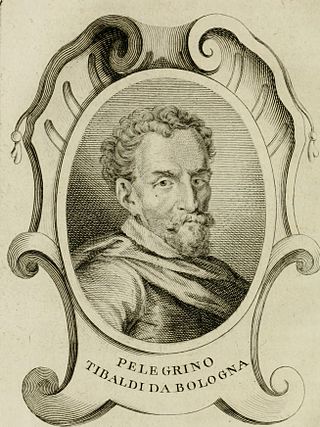
Pellegrino Tibaldi, also known as Pellegrino di Tibaldo de Pellegrini, was an Italian mannerist architect, sculptor, and mural painter.

Rozzano is a comune (municipality) in the Metropolitan City of Milan in the Italian region Lombardy, located about 9 kilometres (6 mi) south of Milan.

Santa Maria del Carmine is a church in Pavia, Lombardy, northern Italy, considered amongst the best examples of Lombard Gothic architecture. It was begun in 1374 by Gian Galeazzo Visconti, Duke of Milan, on a project attributed to Bernardo da Venezia. The construction followed a slow pace, and was restarted in 1432, being finished in 1461.

San Lazzaro dei Mendicanti is an ancient church in the sestiere of Castello, Venice, northern Italy, with a facade facing a Rio of the same name. It now serves as the chapel of the Civic Hospital of Venice.
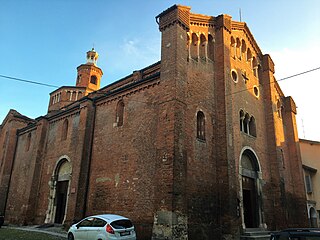
San Teodoro is a Romanesque-style Roman Catholic church in the town center of Pavia, Italy.

San Lazzaro is a 19th-century, Roman Catholic church located on Via Aurelia number 298 in the neighborhood of San Lazzaro di Sarzana, just south-east of Sarzana, region of Liguria, Italy. The parish church happens to be located, for historical reasons, within the region of Tuscany.

Visconti Park was the private park of the Visconti and Sforza families, lords, and dukes of Milan. Located in Lombardy, northern Italy, it extended between the Pavia Castle and the Pavia Charterhouse. It covered an area of about 2,200 hectares (22 km2) and was encircled by walls about 25 kilometres (16 mi) in length. It was founded in 1360 by Galeazzo II Visconti and enlarged by his son Gian Galeazzo. Its decay began in 1525 with the damages inflicted during the Battle of Pavia. Today, the park's area mainly serves agriculture purposes, while some portions are nature reserves.

The Visconti Castle, or Castello Visconteo, is a castle in the town of Cusago near Milan, Lombardy, Northern Italy. It was built in the 14th century by Bernabò Visconti and used as a hunting lodge by him and other Visconti family members. The castle underwent significant changes in the Renaissance period; today, it is in neglected conditions.

Characteristic of the historic center of Pavia is the presence of medieval noble towers that survive in its urban fabric, despite having once been more numerous, as evidenced by the sixteenth-century representation of the city frescoed in the church of San Teodoro. They were mostly built between the 11th and 13th centuries when the Ghibelline city was at the height of its Romanesque flowering.

The Basilica of Santissimo Salvatore is a Roman Catholic church in Pavia, region of Lombardy, Italy. It was founded in 657 by the Lombard king Aripert I and became a mausoleum for many of the Lombard kings.

The church of Santa Maria in Betlem, founded around 1130, stands in the characteristic district of the Borgo of Pavia, located, after the Ponte Coperto, on the other bank of the Ticino river from the city center.

The monastery of San Felice was one of the main female Benedictine monasteries of Pavia; founded since the Lombard period, it was suppressed in the 18th century.Part of the church and the crypt survive from the original Lombard complex.

The church of San Marino is a Catholic church in Pavia, in Lombardy.

The Church of San Tommaso is a former Catholic church and monastery in the city of Pavia, Lombardy, Italy. It is located within the historic city center and belongs to the University of Pavia.

The monastery of Santa Maria Teodote, also known as Santa Maria della Pusterla, was one of the oldest and most important female monasteries in Pavia, Lombardy, now Italy. Founded in the seventh century, it stood in the place where the diocesan seminary is located and was suppressed in the eighteenth century.

Palazzo Cornazzani is a palace in Pavia, in Lombardy, where, between 1895 and 1896, Albert Einstein lived.
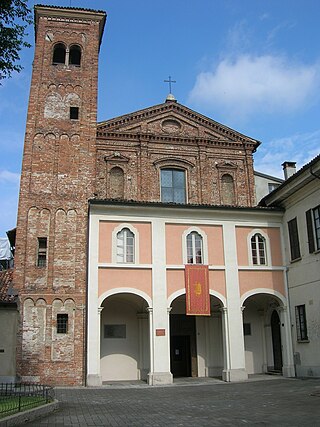
The Church of Santi Gervasio e Protasio is a church in Pavia, in Lombardy.


