
Ice wine is a type of dessert wine produced from grapes that have been frozen while still on the vine. The sugars and other dissolved solids do not freeze, but the water does, allowing for a more concentrated grape juice to develop. The grapes' must is pressed from the frozen grapes, resulting in a smaller amount of more concentrated, very sweet wine. With ice wines, the freezing happens before the fermentation, not afterwards. Unlike the grapes from which other dessert wines are made, such as Sauternes, Tokaji, or Trockenbeerenauslese, ice wine grapes should not be affected by Botrytis cinerea or noble rot, at least not to any great degree. Only healthy grapes keep in good shape until the opportunity arises for an ice wine harvest, which in extreme cases can occur after the New Year, on a northern hemisphere calendar. This gives ice wine its characteristic refreshing sweetness balanced by high acidity. When the grapes are free of Botrytis, they are said to come in "clean".
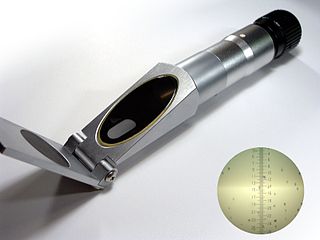
Must weight is a measure of the amount of sugar in grape juice (must) and, hence, indicates the amount of alcohol that could be produced if it is all fermented to alcohol, rather than left as residual sugar. While must weight is a commonly used term among wine makers, the physically correct term would be must density.

The German wine classification system puts a strong emphasis on standardization and factual completeness, and was first implemented per the German Wine Law of 1971. Almost all of Germany's vineyards are delineated and registered as one of approximately 2,600 Einzellagen, and the produce from one can be used to make German wine at any quality level, depending not on yields but on the ripeness, or must weight of the grapes.

Chaptalization is the process of adding sugar to unfermented grape must in order to increase the alcohol content after fermentation. The technique is named after its developer, the French chemist Jean-Antoine-Claude Chaptal. This process is not intended to make the wine sweeter, but rather to provide more sugar for the yeast to ferment into alcohol.

Kabinett, or sometimes Kabinettwein, is a German language wine term for a wine which is made from fully ripened grapes of the main harvest, typically picked in September, and are usually made in a light style. In the German wine classification system, Kabinett is the lowest level of Prädikatswein, lower in ripeness than Spätlese.
Trocken is German for dry, and is used in the classification of German wine. On a wine label, it indicates a wine that is dry rather than off-dry (halbtrocken), sweeter (lieblich) or sweet (süß). Technically, trocken wines are not devoid of residual sugar, but have, at most, a few grams per liter, which can be perceptible but is not overtly sweet. Trocken is also used as a designation for Austrian wine, but more rarely than in Germany, since many quality categories of Austrian wines are dry by default.

The subjective sweetness of a wine is determined by the interaction of several factors, including the amount of sugar in the wine, but also the relative levels of alcohol, acids, and tannins. Sugars and alcohol enhance a wine's sweetness; acids (sourness) and bitter tannins counteract it. These principles are outlined in the 1987 work by Émile Peynaud, The Taste of Wine.
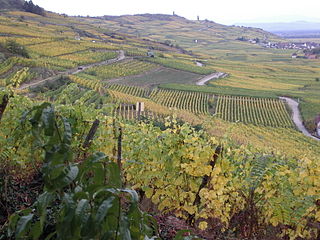
Alsace wine or Alsatian wine is produced in the Alsace region in France and is primarily white wine. Because of its Germanic influence, it is the only Appellation d'Origine Contrôlée region in France to produce mostly varietal wines, typically from similar grape varieties to those used in German wine. Along with Austria and Germany, it produces some of the most noted dry Rieslings in the world as well as highly aromatic Gewürztraminer wines. Wines are produced under three different AOCs: Alsace AOC for white, rosé and red wines, Alsace Grand Cru AOC for white wines from certain classified vineyards and Crémant d'Alsace AOC for sparkling wines. Both dry and sweet white wines are produced.

Grasă de Cotnari is a Romanian wine variety associated with the Cotnari wine region, in Iași County, where it has been grown ever since the rule of Prince Stephen the Great (1457–1504).
The glossary of wine terms lists the definitions of many general terms used within the wine industry. For terms specific to viticulture, winemaking, grape varieties, and wine tasting, see the topic specific list in the "See also" section below.

Georgia is one of the oldest wine regions in the world. The fertile valleys and protective slopes of the Transcaucasia were home to grapevine cultivation and neolithic wine production for at least 8000 years. Due to the many millennia of wine in Georgian history and its prominent economic role, the traditions of wine are considered entwined with and inseparable from the national identity.
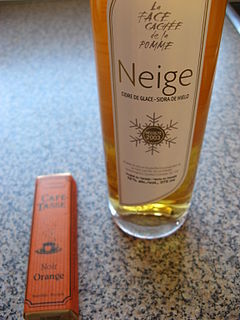
Ice cider is the cider equivalent of ice wine: a fermented beverage made from the frozen juice of apples. Similar to ice wine, the use of frozen apples concentrates the natural sugars in the apples, resulting in a higher alcohol content than cider made by traditional methods.
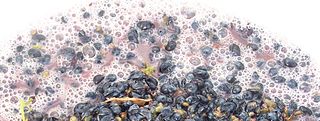
The process of fermentation in winemaking turns grape juice into an alcoholic beverage. During fermentation, yeasts transform sugars present in the juice into ethanol and carbon dioxide. In winemaking, the temperature and speed of fermentation are important considerations as well as the levels of oxygen present in the must at the start of the fermentation. The risk of stuck fermentation and the development of several wine faults can also occur during this stage, which can last anywhere from 5 to 14 days for primary fermentation and potentially another 5 to 10 days for a secondary fermentation. Fermentation may be done in stainless steel tanks, which is common with many white wines like Riesling, in an open wooden vat, inside a wine barrel and inside the wine bottle itself as in the production of many sparkling wines.
Sélection de Grains Nobles (SGN) is French for "selection of noble berries" and refers to wines made from grapes affected by noble rot. SGN wines are sweet dessert wines with rich, concentrated flavours. Alsace wines were the first to be described as Sélection de Grains Nobles, with the legal definition introduced in 1984, but the term is also seen in some other wine regions France, such as Loire.

Sugars in wine are at the heart of what makes winemaking possible. During the process of fermentation, sugars from wine grapes are broken down and converted by yeast into alcohol (ethanol) and carbon dioxide. Grapes accumulate sugars as they grow on the grapevine through the translocation of sucrose molecules that are produced by photosynthesis from the leaves. During ripening the sucrose molecules are hydrolyzed (separated) by the enzyme invertase into glucose and fructose. By the time of harvest, between 15 and 25% of the grape will be composed of simple sugars. Both glucose and fructose are six-carbon sugars but three-, four-, five- and seven-carbon sugars are also present in the grape. Not all sugars are fermentable with sugars like the five-carbon arabinose, rhamnose and xylose still being present in the wine after fermentation. Very high sugar content will effectively kill the yeast once a certain (high) alcohol content is reached. For these reasons, no wine is ever fermented completely "dry". Sugar's role in dictating the final alcohol content of the wine sometimes encourages winemakers to add sugar during winemaking in a process known as chaptalization solely in order to boost the alcohol content – chaptalization does not increase the sweetness of a wine.

Slovak wine is produced in the southern part of Slovakia, which is divided into 6 wine-producing areas. Although Slovak wines except Tokaj are not well known internationally, they are popular domestically and in neighbouring countries.

Cadillac is an Appellation d'Origine Contrôlée (AOC) for sweet white wine from the Bordeaux wine region in France. It is located within the Entre-Deux-Mers subregion of Bordeaux. It takes its name from the town of Cadillac.

Wachau is one of Austria's most established and notable wine regions, specializing in dry wines made from Riesling and Grüner Veltliner. Located in Lower Austria along the Danube, west of Vienna and Krems an der Donau, it is one of the westernmost wine producing regions in Austria with only a few scattered plantings in Tyrol being further west. While most of Austria follows a wine classification systems based on ripeness and harvest must weight that parallels the German wine classification system, Wachau wines have a unique classification system. The three classification levels for Wachau wine include Steinfeder for wines up to 11.5% alcohol level, Federspiel for wines between 11.5–12.5% and Smaragd that must have a minimum of 12.5% alcohol level. Despite its renown, the Wachau is a small wine region that usually accounts for only around 3% of Austria's wine production.


