Related Research Articles

A dendritic cell (DC) is an antigen-presenting cell of the mammalian immune system. A DC's main function is to process antigen material and present it on the cell surface to the T cells of the immune system. They act as messengers between the innate and adaptive immune systems.

Phagocytes are cells that protect the body by ingesting harmful foreign particles,bacteria,and dead or dying cells. Their name comes from the Greek phagein,"to eat" or "devour",and "-cyte",the suffix in biology denoting "cell",from the Greek kutos, "hollow vessel". They are essential for fighting infections and for subsequent immunity. Phagocytes are important throughout the animal kingdom and are highly developed within vertebrates. One litre of human blood contains about six billion phagocytes. They were discovered in 1882 by Ilya Ilyich Mechnikov while he was studying starfish larvae. Mechnikov was awarded the 1908 Nobel Prize in Physiology or Medicine for his discovery. Phagocytes occur in many species;some amoebae behave like macrophage phagocytes,which suggests that phagocytes appeared early in the evolution of life.
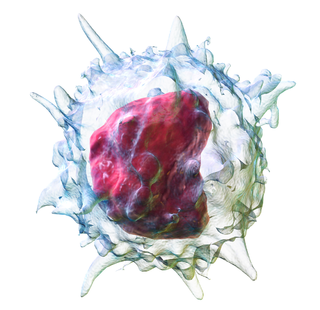
Monocytes are a type of leukocyte or white blood cell. They are the largest type of leukocyte in blood and can differentiate into macrophages and monocyte-derived dendritic cells. As a part of the vertebrate innate immune system monocytes also influence adaptive immune responses and exert tissue repair functions. There are at least three subclasses of monocytes in human blood based on their phenotypic receptors.

An antigen-presenting cell (APC) or accessory cell is a cell that displays an antigen bound by major histocompatibility complex (MHC) proteins on its surface;this process is known as antigen presentation. T cells may recognize these complexes using their T cell receptors (TCRs). APCs process antigens and present them to T cells.
Cross-presentation is the ability of certain professional antigen-presenting cells (mostly dendritic cells) to take up,process and present extracellular antigens with MHC class I molecules to CD8 T cells (cytotoxic T cells). Cross-priming,the result of this process,describes the stimulation of naive cytotoxic CD8+ T cells into activated cytotoxic CD8+ T cells. This process is necessary for immunity against most tumors and against viruses that infect dendritic cells and sabotage their presentation of virus antigens. Cross presentation is also required for the induction of cytotoxic immunity by vaccination with protein antigens,for example,tumour vaccination.
Immune tolerance,also known as immunological tolerance or immunotolerance,refers to the immune system's state of unresponsiveness to substances or tissues that would otherwise trigger an immune response. It arises from prior exposure to a specific antigen and contrasts the immune system's conventional role in eliminating foreign antigens. Depending on the site of induction,tolerance is categorized as either central tolerance,occurring in the thymus and bone marrow,or peripheral tolerance,taking place in other tissues and lymph nodes. Although the mechanisms establishing central and peripheral tolerance differ,their outcomes are analogous,ensuring immune system modulation.
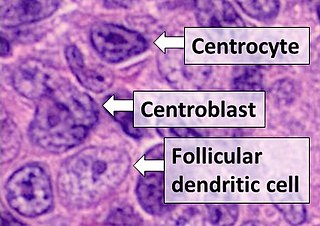
Follicular dendritic cells (FDC) are cells of the immune system found in primary and secondary lymph follicles of the B cell areas of the lymphoid tissue. Unlike dendritic cells (DC),FDCs are not derived from the bone-marrow hematopoietic stem cell,but are of mesenchymal origin. Possible functions of FDC include:organizing lymphoid tissue's cells and microarchitecture,capturing antigen to support B cell,promoting debris removal from germinal centers,and protecting against autoimmunity. Disease processes that FDC may contribute include primary FDC-tumor,chronic inflammatory conditions,HIV-1 infection development,and neuroinvasive scrapie.
Antigen presentation is a vital immune process that is essential for T cell immune response triggering. Because T cells recognize only fragmented antigens displayed on cell surfaces,antigen processing must occur before the antigen fragment can be recognized by a T-cell receptor. Specifically,the fragment,bound to the major histocompatibility complex (MHC),is transported to the surface of the antigen-presenting cell,a process known as presentation. If there has been an infection with viruses or bacteria,the antigen-presenting cell will present an endogenous or exogenous peptide fragment derived from the antigen by MHC molecules. There are two types of MHC molecules which differ in the behaviour of the antigens:MHC class I molecules (MHC-I) bind peptides from the cell cytosol,while peptides generated in the endocytic vesicles after internalisation are bound to MHC class II (MHC-II). Cellular membranes separate these two cellular environments - intracellular and extracellular. Each T cell can only recognize tens to hundreds of copies of a unique sequence of a single peptide among thousands of other peptides presented on the same cell,because an MHC molecule in one cell can bind to quite a large range of peptides. Predicting which antigens will be presented to the immune system by a certain MHC/HLA type is difficult,but the technology involved is improving.

MHC Class II molecules are a class of major histocompatibility complex (MHC) molecules normally found only on professional antigen-presenting cells such as dendritic cells,macrophages,some endothelial cells,thymic epithelial cells,and B cells. These cells are important in initiating immune responses.
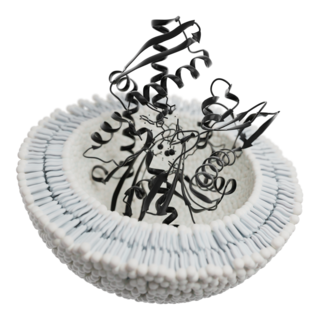
Exosomes,ranging in size from 30 to 150 nanometers,are membrane-bound extracellular vesicles (EVs) that are produced in the endosomal compartment of most eukaryotic cells. In multicellular organisms,exosomes and other EVs are found in biological fluids including saliva,blood,urine and cerebrospinal fluid. EVs have specialized functions in physiological processes,from coagulation and waste management to intercellular communication.

Antonio Lanzavecchia is an Italian and Swiss immunologist. As a fellow of Collegio Borromeo he obtained a degree with honors in Medicine in 1976 from the University of Pavia where he specialized in Pediatrics and Infectious Diseases. He is Head Human Immunology Program,Istituto Nazionale di Genetica Molecolare-INGM,Milan and SVP Senior research Fellow,Humabs/Vir Biotechnology,Bellinzona and San Francisco (USA). Since 2017,he is also Professor at the Faculty of Biomedical Sciences of the Universitàdella Svizzera italiana (USI).

HLA-DM is an intracellular protein involved in the mechanism of antigen presentation on antigen presenting cells (APCs) of the immune system. It does this by assisting in peptide loading of major histocompatibility complex (MHC) class II membrane-bound proteins. HLA-DM is encoded by the genes HLA-DMA and HLA-DMB.

Ralph Marvin Steinman was a Canadian physician and medical researcher at Rockefeller University,who in 1973 discovered and named dendritic cells while working as a postdoctoral fellow in the laboratory of Zanvil A. Cohn,also at Rockefeller University. Steinman was one of the recipients of the 2011 Nobel Prize in Physiology or Medicine.
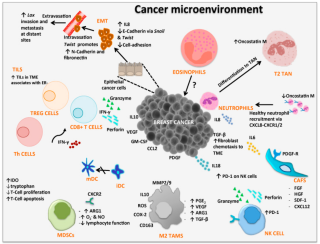
Cancer immunology (immuno-oncology) is an interdisciplinary branch of biology and a sub-discipline of immunology that is concerned with understanding the role of the immune system in the progression and development of cancer;the most well known application is cancer immunotherapy,which utilises the immune system as a treatment for cancer. Cancer immunosurveillance and immunoediting are based on protection against development of tumors in animal systems and (ii) identification of targets for immune recognition of human cancer.
Alloantigen recognition refers to immune system recognition of genetically encoded polymorphisms among the genetically distinguishable members of same species. Post-transplant recognition of alloantigens occurs in secondary lymphoid organs. Donor specific antigens are recognized by recipient’s T lymphocytes and triggers adaptive pro-inflammatory response which consequently leads to rejection of allogenic transplants. Allospecific T lymphocytes may be stimulated by three major pathways:direct recognition,indirect recognition or semidirect recognition. The pathway involved in specific cases is dictated by intrinsic and extrinsic factors of allograft and directly influence nature and magnitude of T lymphocytes mediated immune response. Furthermore,variant tissues and organs such as skin or cornea or solid organ transplants can be recognized in different pathways and therefore are rejected in different fashion.
Paracytophagy is the cellular process whereby a cell engulfs a protrusion which extends from a neighboring cell. This protrusion may contain material which is actively transferred between the cells. The process of paracytophagy was first described as a crucial step during cell-to-cell spread of the intracellular bacterial pathogen Listeria monocytogenes,and is also commonly observed in Shigella flexneri. Paracytophagy allows these intracellular pathogens to spread directly from cell to cell,thus escaping immune detection and destruction. Studies of this process have contributed significantly to our understanding of the role of the actin cytoskeleton in eukaryotic cells.
Paola Ricciardi-Castagnoli,is an Italian Immunologist based in Siena,Italy. Paola is the scientific director of Toscana Life Sciences Foundation (TLS) in Siena. She was former scientific director of the Singapore Immunology Network (SIgN).
Antigen transfer in the thymus is the transmission of self-antigens between thymic antigen-presenting cells which contributes to the establishment of T cell central tolerance.
Ana Rodriguez is a parasitologist and Professor in the Department of Microbiology at New York University School of Medicine. Her research focuses on Plasmodium falciparum and Trypanosoma cruzi and she is known for her work on Plasmodium liver infection,Plasmodium immunity,and T. cruzi drug development.

Clotilde Théry is a professor and INSERM director of research (DR2) at Institut Curie in Paris,France. She is president of the International Society for Extracellular Vesicles (ISEV),where she previously served as founding secretary general and as editor-in-chief of the Journal of Extracellular Vesicles. She is team leader of the group "Extracellular Vesicles,Immune Responses and Cancer" within the INSERM Unit 932 on "Immunity and Cancer." Théry researches extracellular vesicles that are released by immune and tumor cells,including exosomes that originate in the multivesicular body.
References
- ↑ "Rodriguez Lab". New York University. Retrieved 17 July 2019.
- ↑ "Sebastian Amigorena". Institut Curie. Retrieved 17 July 2019.
- 1 2 3 4 5 6 "Short CV: Sebastian Amigorena" (PDF). 15th International Symposium on Dendritic Cells. Retrieved 17 July 2019.
- ↑ "Sebastian Amigorena" (PDF). French Academy of Sciences. Retrieved 17 July 2019.
- ↑ "Sebastian Amigorena". French Academy of Sciences. Retrieved 17 July 2019.
- ↑ "Symposium Speaker: Sebastian Amigorena". International Congress of Immunology. Retrieved 17 July 2019.
| International | |
|---|---|
| Academics | |
| Other | |
