External links
- Sergey Bezrukov at the Mathematics Genealogy Project
- Bezrukov's math genealogy
- Bezrukov's homepage
- Bezrukov at Scientific Commons
| Authority control: Academics |
|---|
Sergey M. Bezrukov | |
|---|---|
| Alma mater | Saint Petersburg Polytechnical University Moscow State University |
| Known for | Stochastic resonance Ion channels Noise-based brain logic |
| Scientific career | |
| Fields | Biophysicist |
| Institutions | St. Petersburg Nuclear Physics Institute National Institutes of Health |
| Doctoral advisor | Giliary Moiseevich Drabkin |
Sergey M. Bezrukov is a Russian born biophysicist notable for his work on ion channels and stochastic resonance.
He received his MS in Electronics and Theoretical Physics from Saint Petersburg Polytechnical University, 1973; and he obtained his PhD under Giliary Moiseevich Drabkin in Physics and Mathematics from Moscow State University, Russia, 1981.
During 1981-87, he was a research scientist, Leningrad Nuclear Physics Institute, Laboratory of Condensed Matter Physics; in 1987-90 a senior research scientist, Leningrad Nuclear Physics Institute, Laboratory of Condensed Matter Physics; in 1990-92 he was a visiting research associate, University of Maryland, College Park and special volunteer, National Institutes of Health, LBM, NIDDK; in 1992-98 he was visiting scientist, National Institutes of Health, LSB, DCRT and LPSB, NICHD; in 1998-02 he was an investigator, head of unit, National Institutes of Health, LPSB, NICHD. He took up his present position in 2002, as section chief in the Laboratory of Physical and Structural Biology, National Institutes of Health, Bethesda, Maryland.
Bezrukov was elected Member of executive council of the Division of Biological Physics of the American Physical Society in 2002.
| Authority control: Academics |
|---|

Moscow Institute of Physics and Technology, is a public research university located in Moscow Oblast, Russia. It prepares specialists in theoretical and applied physics, applied mathematics and related disciplines.

The Joint Institute for Nuclear Research, in Dubna, Moscow Oblast, Russia, is an international research center for nuclear sciences, with 5500 staff members including 1200 researchers holding over 1000 Ph.Ds from eighteen countries. Most scientists are scientists of Russian Federation.
Jeffrey Goldstone is a British theoretical physicist and an emeritus physics faculty member at the MIT Center for Theoretical Physics.
Isaak Yakovlevich Pomeranchuk was a Soviet physicist of Polish origin in the former Soviet program of nuclear weapons. His career in physics spent mostly studying the particle physics, quantum field theory, electromagnetic and synchrotron radiation, condensed matter physics and the physics of liquid helium.
The Abdus Salam International Centre for Theoretical Physics (ICTP) is an international research institute for physical and mathematical sciences that operates under a tripartite agreement between the Italian Government, United Nations Educational, Scientific and Cultural Organization (UNESCO), and International Atomic Energy Agency (IAEA). It is located near the Miramare Park, about 10 kilometres from the city of Trieste, Italy. The centre was founded in 1964 by Pakistani Nobel Laureate Abdus Salam.
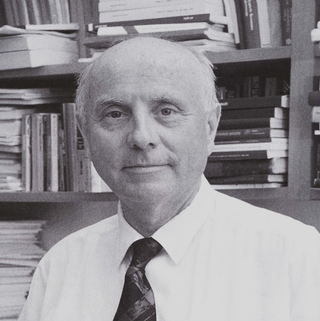
Robert Blinc was a prominent Slovene physicist a full professor of physics and, with more than 650 articles in prestigious international journals and two extensive monographs published abroad, a highly regarded and quoted researcher in condensed matter physics.
Abdullah Sadiq, is a Pakistani physicist and ICTP laureate who received the ICTP Prize in the honour of Nikolay Bogolyubov, in the fields of mathematics and solid state physics in 1987 for his contributions to scientific knowledge in the field of mathematics and statistical physics. He is the professor of physics and current dean of the department of physics of the Air University of the Pakistan Air Force (PAF).
Arkady Beynusovich (Benediktovich) Migdal was a Soviet physicist and member of the USSR Academy of Sciences. He developed the formula that accounts for the Landau–Pomeranchuk–Migdal effect, a reduction of the bremsstrahlung and pair production cross sections at high energies or high matter densities.

Giorgio Parisi is an Italian theoretical physicist, whose research has focused on quantum field theory, statistical mechanics and complex systems. His best known contributions are the QCD evolution equations for parton densities, obtained with Guido Altarelli, known as the Altarelli–Parisi or DGLAP equations, the exact solution of the Sherrington–Kirkpatrick model of spin glasses, the Kardar–Parisi–Zhang equation describing dynamic scaling of growing interfaces, and the study of whirling flocks of birds. He was awarded the 2021 Nobel Prize in Physics jointly with Klaus Hasselmann and Syukuro Manabe for groundbreaking contributions to theory of complex systems, in particular "for the discovery of the interplay of disorder and fluctuations in physical systems from atomic to planetary scales".

Rajagopala Chidambaram is an Indian Physicist who is known for his integral role in India's nuclear weapons program; he coordinated test preparation for the Pokhran-I (1975) and Pokhran-II (1998).

Witold (Witek) Nazarewicz is a Polish-American nuclear physicist, researcher, and educator. He is a John A. Hannah Distinguished Professor in Physics and Chief Scientist at the Facility for Rare Isotope Beams (FRIB) and the Department of Physics and Astronomy at Michigan State University, and a Professor at the University of Warsaw, Faculty of Physics, Institute of Theoretical Physics.

Riazuddin, also spelled as Riaz-Ud-Din, was a Pakistani theoretical physicist, specialising in high-energy physics and nuclear physics. Starting his scientific research in physics in 1958, Riazuddin was considered one of the early pioneers of Pakistan's nuclear weapons development and atomic deterrence development. He was the director of the Theoretical Physics Group (TPG) of the Pakistan Atomic Energy Commission (PAEC) from 1974 until 1984. Riazuddin was a pupil of the winner of the 1979 Nobel Prize in Physics, Abdus Salam.
Wick C. Haxton is an American theoretical nuclear physicist and astrophysicist. He is a professor of physics at the University of California, Berkeley and senior faculty scientist at Lawrence Berkeley National Laboratory. He was appointed a co-editor of the journal Annual Review of Nuclear and Particle Science as of 2023.

John M. "Jack" Carpenter was an American nuclear engineer known as the originator of the technique for utilizing accelerator-induced intense pulses of neutrons for research and developing the first spallation slow neutron source based on a proton synchrotron, the Intense Pulsed Neutron Source (IPNS). He died on 10 March 2020.
James Arthur Krumhansl was an American physicist who specialized in condensed matter physics and materials science. He spent much of his career at Cornell University. He also served as president of the American Physical Society and assistant director for mathematics, physical sciences, and engineering for the National Science Foundation. In 1987 he testified before Congress that the Superconducting Super Collider would be too costly.
Georges Amsel was a French physicist, Director of Research at the French National Centre for Scientific Research.
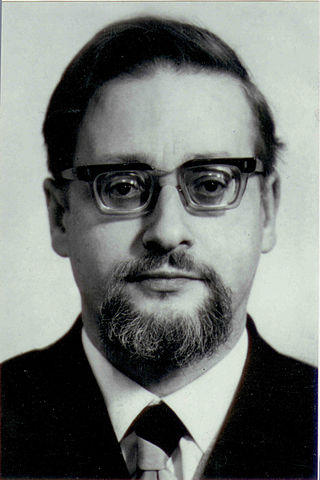
Yuri Andreevich Yappa was a Soviet and Russian theoretical physicist. He is known for publications on particle physics, quantum field theory, General Relativity, philosophy of science, and for his graduate texts on classical electrodynamics and theory of spinors.
George Daniels Watkins is an American solid-state physicist.
Alexei Lvovich Efros is an American theoretical physicist who specializes in condensed matter physics. He is currently a Distinguished Professor at University of Utah.
