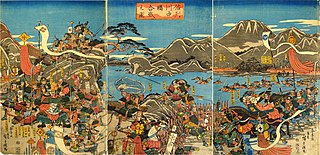
The Battles of Kawanakajima were a series of battles fought in the Sengoku period of Japan between Takeda Shingen of Kai Province and Uesugi Kenshin of Echigo Province from 1553 to 1564.
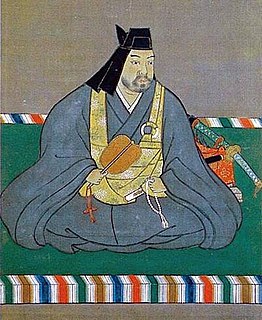
Uesugi Kenshin was a daimyō who was born as Nagao Kagetora of the Nagao clan, and after adoption into the Uesugi clan, ruled Echigo Province in the Sengoku period of Japan. He was one of the most powerful daimyōs of the Sengoku period. Known as the "Dragon of Echigo", while chiefly remembered for his prowess on the battlefield, Kenshin is also regarded as an extremely skillful administrator who fostered the growth of local industries and trade and his rule saw a marked rise in the standard of living of Echigo.

Shibata Katsuie or Gonroku (権六) was a Japanese samurai and military commander during the Sengoku period. He served Oda Nobunaga as one of his trusted generals, was severely wounded in the 1571 siege of Nagashima, but then fought in the 1577 Battle of Tedorigawa.
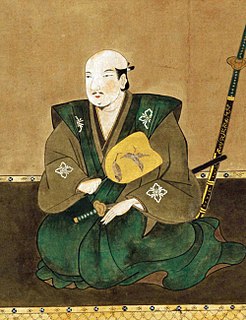
Takeda Katsuyori was a Japanese daimyō of the Sengoku period, who was famed as the head of the Takeda clan and the successor to the legendary warlord Takeda Shingen.
The Battle of Tedorigawa took place near the Tedori River in Japan's Kaga Province in 1577, between the forces of Oda Nobunaga against Uesugi Kenshin. Kenshin tricked Nobunaga into launching a frontal attack across the Tedorigawa and defeated him. Having suffered the loss of 1,000 men, the Oda withdrew south. This was destined to be Kenshin's last great battle. The battle site is in the modern-day Ishikawa Prefecture.

Uesugi Kagekatsu was a Japanese samurai daimyō during the Sengoku and Edo periods. He was the adopted son of Uesugi Kenshin and Uesugi Kagetora’s brother in law.

Niwa Nagahide, also known as Gorōzaemon (五郎左衛門), his other legal alias was Hashiba Echizen no Kami (羽柴越前守), was a Japanese samurai of the Sengoku through Azuchi-Momoyama periods of the 16th century. He served as a retainer to the Oda clan, and was eventually a daimyō in his own right. Going on to fight in the Oda clan's major campaigns, including Mino Campaign 1567, Omi Campaign 1568, the Honganji Campaign from 1570-1580, and Iga Campaign 1581, he was named one of the administrators of Kyoto after Nobunaga entered that city in 1568.

Kōsa, also known as Hongan-ji Kennyo, was the 11th head of the Hongan-ji in Kyoto, and Chief Abbot of Ishiyama Hongan-ji, cathedral fortress of the Ikkō-ikki, during its siege at the end of the Sengoku period. He engineered many alliances, and organized the defenses of the cathedral to the point that most at the time considered Ishiyama Hongan-ji to be unbreachable.

Uesugi Norimasa was a daimyō of feudal Japan from Yamanouchi branch Uesugi clan and held the post of Kantō Kanrei, the shōgun's deputy in the Kantō region. He was the adoptive father of Uesugi Kenshin, one of the most famous warlords in Japanese history.

The Uesugi clan is a Japanese samurai clan which was at its most powerful during the Muromachi and Sengoku periods. At its height, the clan had three main branches: the Ōgigayatsu, Inukake, and Yamanouchi. Its most well-known member is the warlord Uesugi Kenshin (1530–1578).

Hōjō Ujiyasu was a daimyō (warlord) and third head of the Odawara Hōjō clan. Known as the "Lion of Sagami", he was revered as a fearsome warrior and a cunning man. He is famous for his strategies of breaking the siege from Takeda Shingen and Uesugi Kenshin. The son of Hōjō Ujitsuna, his only known wife was Imagawa Yoshimoto's sister, Zuikei-in. Among his sons are Hōjō Ujimasa and Uesugi Kagetora.
Uesugi Kagetora was the seventh son of Hōjō Ujiyasu; known as Hōjō Saburō, he was adopted by Uesugi Kenshin, and was meant to be Kenshin's heir. However, in 1578, he was attacked in his castle at Otate by Uesugi Kagekatsu—Kagetora's respective brother-in-law—and was subsequently defeated. Kagetora committed suicide the following year in the Samegao Castle.

Naoe Kanetsugu was a Japanese samurai of the 16th–17th centuries. The eldest son of Higuchi Kanetoyo, Kanetsugu was famed for his service to two generations of the Uesugi daimyōs. He was also known by his court title, Yamashiro no Kami (山城守) or his childhood name, Higuchi Kanetsugu.
The Shibata clan a Japanese clan that had originated during the Heian period of Japan. The Shibata clan of Echigo province were notably related to that of the Shibata clan of Owari province. The Shibata clan of Echigo were descended from Sasaki Moritsuna, a supporter of Minamoto no Yoritomo and a son of Sasaki Hideyoshi. The Shibata later became retainers of the Nagao clan, which was under control by the famed Uesugi Kenshin. After Shibata Shigeie died during the year of 1587, the Shibata clan attempted to break away from the Uesugi. After this, the clan of Echigo became extinct, never to be seen again.
The 1578 siege of Otate took place following the sudden death of Uesugi Kenshin. Kenshin had requested that the inheritance be split between his nephew, Uesugi Kagekatsu, and his adopted son Uesugi Kagetora. This conflict happened because of neither heirs being born with the Uesugi name. Kagekatsu was the biological son of Nagao Masakage and Kagetora was biological son of Hojo Ujiyasu.

Sassa Narimasa, also known as Kura-no-suke (内蔵助), was a Japanese samurai of the Sengoku through Azuchi–Momoyama period. He entered Nobunaga's service at the age of 14 and remained in his lord's service throughout Nobunaga's rise to power.
Takanashi Masayori (高梨政頼) was a retainer beneath the clan of Uesugi throughout the latter Sengoku period of Feudal Japan. Masayori was the eldest son of Shinano warlord Takanashi Sumiyori and supported his father's intent to restore their land after Takeda Shingen claimed it as his own.

Shibata Castle is a flatland-style Japanese castle located in the city of Shibata, Niigata Prefecture, Japan. Throughout the Edo period, Shibata Castle was home to the Mizoguchi clan, daimyō of Shibata Domain. The castle was also known as "Ayame-jō".

Matsukura Castle was a Muromachi period yamajiro-style Japanese castle located in what is now the city of Uozu, Toyama Prefecture, in the Hokuriku region of Japan. It was one of the three major mountain-castles in Etchū Province, along with Matsuyama Castle in central Etchū and Moriyama Castle in western Etchū.

Lady Shirai was a Japanese noble lady and aristocrat from the Sengoku period. She was born to the Nagao clan in Shirai, who were head retainers to the Uesugi clan in Kantō. She was the wife of Narita Nagayasu, the lord of Oshi castle in Musashi. She is also thought to be either the daughter or granddaughter of Nagao Kageharu. Lady Shirai was a retainer of the Ashikaga Shogunate, fought and died during the Incident of Kyoto in 1565, when Ashikaga Yoshiteru was killed.

