
The Academy Awards, also known as the Oscars, are a set of awards for artistic and technical merit in the film industry. Given annually by the Academy of Motion Picture Arts and Sciences (AMPAS), the awards are an international recognition of excellence in cinematic achievements as assessed by the Academy's voting membership. The various category winners are awarded a copy of a golden statuette, officially called the "Academy Award of Merit", although more commonly referred to by its nickname "Oscar".
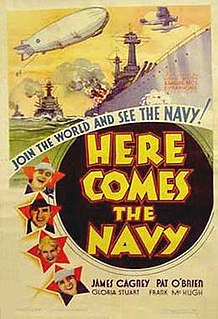
Here Comes the Navy is a 1934 American romantic comedy film written by Earl Baldwin and Ben Markson and directed by Lloyd Bacon. The film stars James Cagney, Pat O'Brien, Gloria Stuart and Frank McHugh. Stuart was Oscar-nominated 63 years later for another nautical epic, Titanic (1997).

The Academy Award for Best Film Editing is one of the annual awards of the Academy of Motion Picture Arts and Sciences (AMPAS). Nominations for this award are closely correlated with the Academy Award for Best Picture. For 33 consecutive years, 1981 to 2013, every Best Picture winner had also been nominated for the Film Editing Oscar, and about two thirds of the Best Picture winners have also won for Film Editing. Only the principal, "above the line" editor(s) as listed in the film's credits are named on the award; additional editors, supervising editors, etc. are not currently eligible. The nominations for this Academy Award are determined by a ballot of the voting members of the Editing Branch of the Academy; there were 220 members of the Editing Branch in 2012. The members may vote for up to five of the eligible films in the order of their preference; the five films with the largest vote totals are selected as nominees. The Academy Award itself is selected from the nominated films by a subsequent ballot of all active and life members of the Academy. This process is essentially the reverse of that of the British Academy of Film and Television Arts (BAFTA); nominations for the BAFTA Award for Best Editing are done by a general ballot of Academy voters, and the winner is selected by members of the editing chapter.
The 21st Academy Awards features numerous firsts. It was the first time a non-Hollywood production won Best Picture, Hamlet and the first time an individual directed himself in an Oscar-winning performance.

Octavia Lenora Spencer is an American actress, author, and producer. She is the recipient of several accolades, including an Academy Award, a British Academy Film Award, and a Golden Globe Award. She is one of two black actresses to have received three Academy Award nominations.
City of Wax is a 1934 American short documentary film produced by Horace and Stacy Woodard about the life of a bee. It won the Oscar at the 7th Academy Awards in 1935 for Best Short Subject (Novelty). The Academy Film Archive preserved City of Wax in 2007.
Casals Conducts: 1964 is a 1964 American short film directed by Larry Sturhahn. It won an Oscar at the 37th Academy Awards in 1965 for Best Short Subject. The Academy Film Archive preserved Casals Conducts: 1964 in 2013.
In the Region of Ice is a 1976 American short film directed by Peter Werner, based upon the short story of the same name by Joyce Carol Oates. It was made as a thesis film for the Center for Advanced Film Studies. It won an Oscar at the 49th Academy Awards in 1977 for Best Short Subject. The Academy Film Archive preserved In The Region of Ice in 2012.

So Much for So Little is a 1949 American short documentary film directed by Chuck Jones. In 1950, it won an Oscar at the 22nd Academy Awards for Documentary Short Subject, tying with A Chance to Live. As a work of the United States Government, the film is in the public domain. The Academy Film Archive preserved So Much for So Little in 2005. Produced during the Harry S. Truman administration, it attained renewed relevance during the Donald Trump administration nearly seven decades later.
The Flight of the Gossamer Condor is a 1978 American short documentary film directed by Ben Shedd, about the development of the Gossamer Condor, the first human-powered aircraft. It won an Oscars at the 51st Academy Awards in 1979 for Documentary Short Subject. The Academy Film Archive preserved The Flight of the Gossamer Condor in 2007.
Mister Mugg is a 1933 short American pre-Code comedy film directed by James W. Horne. It was nominated for an Academy Award at the 6th Academy Awards in 1933 for Best Short Subject (Comedy). The Academy Film Archive preserved Mister Mugg in 2012.
A Preferred List is a 1933 American Pre-Code short comedy film produced by Lou Brock. At the 6th Academy Awards, held in 1933, it was nominated for an Academy Award for Best Short Subject (Comedy).
Lou Brock was an American film producer, screenwriter and director. He produced 79 films between 1930 and 1953. He was nominated for two Academy Awards in 1934 in the category Best Short Subject. He won with his film So This Is Harris! He was born in Kalamazoo, Michigan and died in Los Angeles.
What, No Men! is a 1934 American short comedy film directed by Ralph Staub and starring El Brendel, Wini Shaw, and Phil Regan. It was filmed in Technicolor. In 1934, it was nominated for an Academy Award for Best Short Subject (Comedy) at the 7th Academy Awards.
Oh, My Nerves is a 1935 American short comedy film directed by Del Lord. It was nominated for an Academy Award at the 8th Academy Awards, held in 1935, for Best Short Subject (Comedy). The Academy Film Archive preserved Oh, My Nerves in 2012.
Double or Nothing is a 1936 American short musical comedy film directed by Joseph Henabery. It was nominated for an Academy Award at the 9th Academy Awards in 1936 for Best Short Subject (Two-Reel). The Academy Film Archive preserved Double or Nothing in 2013.
Dummy Ache is a 1936 American short comedy film directed by Leslie Goodwins. It was nominated for an Academy Award at the 9th Academy Awards in 1936 for Best Short Subject (Two-Reel). The Academy Film Archive preserved Dummy Ache in 2013.
ShortsTV is a cable and satellite television channel dedicated to short film including Academy Award nominated short films. It is franchise owned and operated by Shorts International and AMC Networks International. The channel launched in Europe on November 26, 2008 and in the United States on February 17, 2010. It is available in 40 million homes worldwide.

Banjo on My Knee is a 1936 American musical comedy-drama film directed by John Cromwell. The film was nominated for an Academy Award in the category Sound Recording.


