
Gothic architecture is an architectural style that was prevalent in Europe from the late 12th to the 16th century, during the High and Late Middle Ages, surviving into the 17th and 18th centuries in some areas. It evolved from Romanesque architecture and was succeeded by Renaissance architecture. It originated in the Île-de-France and Picardy regions of northern France. The style at the time was sometimes known as opus Francigenum ; the term Gothic was first applied contemptuously during the later Renaissance, by those ambitious to revive the architecture of classical antiquity.

Overijssel is a province of the Netherlands located in the eastern part of the country. The province's name comes from the perspective of the Episcopal principality of Utrecht, which held the territory until 1528. The capital city of Overijssel is Zwolle and the largest city is Enschede. The province had a population of about 1,184,000 as of January 2023. The land mostly consists of grasslands and some forests ; it also borders a small part of the IJsselmeer to the west.

Zutphen is a city and municipality located in the province of Gelderland, Netherlands. It lies some 30 km (18.6 mi) northeast of Arnhem, on the eastern bank of the river IJssel at the point where it is joined by the Berkel. First mentioned in the 11th century, the place-name appears to mean "south fen". In 2005, the municipality of Zutphen was merged with the municipality of Warnsveld, retaining its name. In 2021, the municipality had a population of 48,111.

Deventer is a city and municipality in the Salland historical region of the province of Overijssel, Netherlands. In 2020 the municipality of Deventer had a population of 100,913. The city is largely situated on the east bank of the river IJssel, but it also has a small part of its territory on the west bank. In 2005 the municipality of Bathmen was merged with Deventer as part of a national effort to reduce bureaucracy in the country.

Kampen is a city and municipality in the province of Overijssel, Netherlands. A member of the former Hanseatic League, it is located at the lower reaches of the river IJssel.

IJsselstein is a municipality and city in the Netherlands, in the province of Utrecht. IJsselstein received city rights in 1331. IJsselstein owes its name to the river Hollandse IJssel which flows through the city. It is a major commuting suburb for the Utrecht area, along with the neighbouringing towns Houten and Nieuwegein. It's surrounded by the municipalities of Utrecht, Montfoort, Lopik, Vijfheerenlanden and Nieuwegein.

St. Martin's Cathedral, Utrecht, or Dom Church, is a Gothic church dedicated to Saint Martin of Tours, which was the cathedral of the Diocese of Utrecht during the Middle Ages. It is the country's only pre-Reformation cathedral, but has been a Protestant church since 1580.
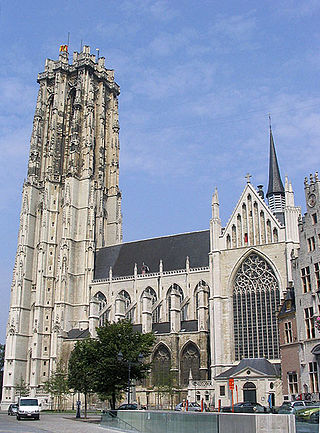
St. Rumbold's Cathedral is the Roman Catholic metropolitan archiepiscopal cathedral in Mechelen, Belgium, dedicated to Saint Rumbold, Christian missionary and martyr who founded an abbey nearby. His remains are rumoured to be buried inside the cathedral. State-of-the-art examination of the relics honoured as Saint Rumbold's and kept in a shrine in the retro-choir, showed a life span of about 40 years and a death date between 580 and 655, while tradition had claimed 775 AD.

Olst is a town in the Dutch province of Overijssel, about 8 km (5 mi) north of Deventer. It is located in the municipality of Olst-Wijhe.

St. James' Church is a former collegiate church in Antwerp, Belgium. The church is built on the site of a hostel for pilgrims to Santiago de Compostela. The present building is the work of the Waghemakere family and Rombout Keldermans, in Brabantine Gothic style. The church contains the grave of Peter Paul Rubens in the eastern chapel.

The Church of St. Nicholas was a Gothic Revival cathedral that was formerly one of the five Lutheran Hauptkirchen in the city of Hamburg, Germany. The original chapel, a wooden building, was completed in 1195. It was replaced by a brick church in the 14th century, which was eventually destroyed by fire in 1842. The church was completely rebuilt by 1874, and was the tallest building in the world from 1874 to 1876. It was designed by the English architect George Gilbert Scott.

The Cathedral of St. Bartholomew, originally the Church of St. Bartholomew, is a Gothic church located on the Main Square in Plzeň, Czech Republic. It was probably established together with the city around the year 1295. The church became a cathedral in 1993, when the Plzeň diocese was created. It was designated a national cultural monument of the Czech Republic in 1995.

The Basilica of Saint Nicholas is located in the Old Centre district of Amsterdam, Netherlands, very close to Amsterdam's main railway station. St, Nicholas is the patron saint of both the church and the city of Amsterdam. The basilica is the city's primary Roman Catholic church.

Saint Peter's Church is a Roman Catholic church in Leuven, Belgium, built in the 15th century in the Brabantine Gothic style. The church has a cruciform floor plan and a low bell tower that has never been completed. It is 93 metres (305 ft) long. It is located on the city's Grote Markt, opposite the Town Hall. In 1999, the belfry and bell tower of the church was inscribed on the UNESCO World Heritage List as part of the Belfries of Belgium and France site, in recognition of the civil importance and architecture of the belfries in the region.

Carpathian Wooden Churches is the name of a UNESCO World Heritage Site that consists of nine wooden religious buildings constructed between the 16th and 18th centuries in eight different locations in Slovakia. They include two Roman Catholic, three Protestant and three Greek Catholic churches plus one belfry in Hronsek. In addition to these churches there are about 50 more wooden churches in the territory of present-day Slovakia mainly in the northern and eastern part of the Prešov Region.

St Silas' Church is in Preston New Road, Blackburn, Lancashire, England. It is an active Anglican parish church in the deanery of Blackburn with Darwen, the archdeaconry of Blackburn, and the diocese of Blackburn. The church is recorded in the National Heritage List for England as a designated Grade II* listed building.
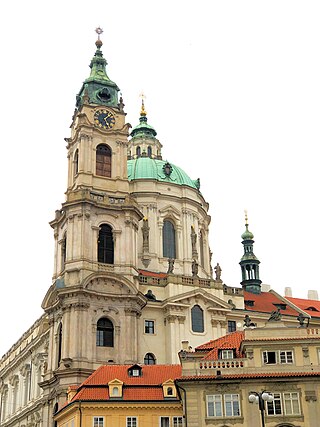
The Church of Saint Nicholas is a Baroque church in the Lesser Town of Prague. It was built between 1704 and 1755 on the site where formerly a Gothic church from the 13th century stood, which was also dedicated to Saint Nicholas. It has been described as the greatest example of Prague Baroque.
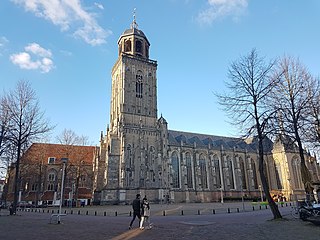
The Great Church or St. Lebuinus Church is the main church building of the Dutch city of Deventer, Netherlands.

St Francis Xavier Church is a Roman Catholic Parish church in Enkhuizen, West Friesland, Netherlands. It was founded and is run by the Society of Jesus and is in the Diocese of Haarlem-Amsterdam. It is situated on Westerstraat 107 and was built in 1905 on the site of a clandestine church. The baptismal font is a registered national monument.
The architecture of Slovakia has a long, rich and diverse history. Besides Roman ruins, Slovakia hosts several Romanesque and Gothic castles and churches, most notably Spiš Castle, which were built at the time of the Kingdom of Hungary. Renaissance architecture was of particular relevance in town hall squares, such as in Bardejov and Levoča. Affluent architecture in the following centuries made use of Baroque, Rococo and historicist styles, while vernacular architecture in the countryside developed a specific style of wooden houses and wooden churches. In the 20th century, Slovakia knew Art Nouveau and modernist architecture, including socialist modernism, and finally contemporary architecture.


