
A bomber is a military combat aircraft designed to attack ground and naval targets by dropping air-to-ground weaponry, launching torpedoes, or deploying air-launched cruise missiles. The first use of bombs dropped from an aircraft occurred in the Italo-Turkish War, with the first major deployments coming in the First World War and Second World War by all major airforces causing devastating damage to cities, towns, and rural areas. The first purpose built bombers were the Italian Caproni Ca 30 and British Bristol T.B.8, both of 1913. Some bombers were decorated with nose art or victory markings.

A strategic bomber is a medium- to long-range penetration bomber aircraft designed to drop large amounts of air-to-ground weaponry onto a distant target for the purposes of debilitating the enemy's capacity to wage war. Unlike tactical bombers, penetrators, fighter-bombers, and attack aircraft, which are used in air interdiction operations to attack enemy combatants and military equipment, strategic bombers are designed to fly into enemy territory to destroy strategic targets. In addition to strategic bombing, strategic bombers can be used for tactical missions. There are currently only three countries that operate strategic bombers: the United States, Russia and China.

The Russian Navy is the naval arm of the Russian Armed Forces. It has existed in various forms since 1696, the present iteration of which was formed in January 1992 when it succeeded the Navy of the Commonwealth of Independent States.

The GIUK gap is an area in the northern Atlantic Ocean that forms a naval choke point. Its name is an acronym for Greenland, Iceland, and the United Kingdom, the gap being the open ocean between these three landmasses. The term is typically used in relation to military topics. The area has been considered strategically important since the beginning of the 20th century.

The Tupolev Tu-160 is a supersonic, variable-sweep wing heavy strategic bomber designed by the Tupolev Design Bureau in the Soviet Union in the 1970s. It is the largest and heaviest Mach 2+ supersonic military aircraft ever built and next to the experimental XB-70 Valkyrie in overall length. As of 2021, it is the largest and heaviest combat aircraft, the fastest bomber in use and the largest and heaviest variable-sweep wing airplane ever flown.

The Tupolev Tu-95 is a large, four-engine turboprop-powered strategic bomber and missile platform. First flown in 1952, the Tu-95 entered service with the Long-Range Aviation of the Soviet Air Forces in 1956 and is expected to serve the Russian Aerospace Forces until at least 2040. A development of the bomber for maritime patrol is designated Tu-142, while a passenger airliner derivative was called Tu-114.

Soviet Naval Aviation was the naval aviation arm of the Soviet Navy.

The Tupolev Tu-22M is a supersonic, variable-sweep wing, long-range strategic and maritime strike bomber developed by the Tupolev Design Bureau in the 1960s. According to some sources, the bomber was believed to be designated Tu-26 at one time. During the Cold War, the Tu-22M was operated by the Soviet Air Forces (VVS) in a missile carrier strategic bombing role, and by the Soviet Naval Aviation in a long-range maritime anti-shipping role. Significant numbers remain in service with the Russian Air Force, and as of 2014 more than 100 Tu-22Ms are in use.

The Kh-55 is a Soviet/Russian subsonic air-launched cruise missile, designed by MKB Raduga. It has a range of up to 2,500 km (1,350 nmi) and can carry nuclear warheads. Kh-55 is launched exclusively from bomber aircraft and has spawned a number of conventionally armed variants mainly for tactical use, such as the Kh-65SE and Kh-SD, but only the Kh-101 and Kh-555 appear to have made it into service. Contrary to popular belief, the Kh-55 was not the basis of the submarine- and ground-launched S-10 Granat or RK-55 Relief designed by NPO Novator. The RK-55 is very similar to the air-launched Kh-55 but the Kh-55 has a drop-down turbofan engine and was designed by MKB Raduga. Both have formed the basis of post-Cold-War missiles, in particular the Sizzler which has a supersonic approach phase.

The Northern Fleet is the fleet of the Russian Navy in the Arctic.

Pyotr Velikiy is the fourth Kirov-class battlecruiser of the Russian Navy. It was initially named Yuri Andropov for Yuri Andropov, the former General Secretary of the Communist Party, but the ship's name was changed after the fall of the Soviet Union. The Russian designation for the type is "heavy nuclear missile cruiser", but Western defense commentators have resurrected the term "battlecruiser" to describe them, as they are the largest surface combatant warships in the world. Pyotr Velikiy is the flagship of the Northern Fleet.
The Russian Naval Aviation is the air arm of the Russian Navy, having superseded Soviet Naval Aviation. The Russian Navy is divided into four fleets and one flotilla: Northern Fleet, Pacific Fleet, Baltic Fleet, Black Sea Fleet, and Caspian Flotilla.

Šiauliai International Airport is located 7 kilometres (4.3 mi) southeast of the city of Šiauliai, in northern Lithuania. It covers an area of 471 hectares.

Long-Range Aviation is a branch of the Russian Aerospace Forces responsible for delivering long-range nuclear or conventional strikes. The branch was previously part of the Soviet Air Forces and Russian Air Force tasked with long-range bombardment of strategic targets with nuclear weapons. During the Cold War, it was the counterpart to the Strategic Air Command of the United States Air Force.
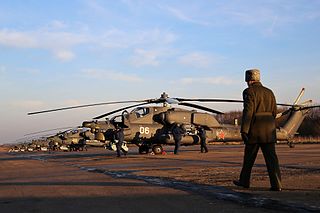
Ostrov is a Russian Naval Aviation air base in Pskov Oblast, Russia located 7 km southeast of Ostrov and 57 km south of Pskov. It is subordinate to the Baltic Fleet and is a nuclear bomber facility with 15 very large revetments on the east side of the airfield and about 30 small revetments on the west side. As many as 63 Tupolev Tu-16s were based here. A US intelligence analysis in 1984 identified a normal complement of 52 Tu-16 aircraft at Ostrov. The base currently hosts the Russian Navy's 444th Center for Combat Employment and Retraining of Personnel Naval Aviation.
The 37th Air Army of the High Supreme Command was the strategic bomber force of the Russian Air Force from 1998 to 2009. It was equipped with Tupolev Tu-95MS and Tu-160 armed with nuclear cruise missiles, and the intermediate range Tu-22M3 bombers.

Russia–Venezuela relations include cooperation between Russia and Venezuela in areas of common concern, such as their common status as oil exporters, and policy toward the United States. Venezuela is Russia's most important trading and military ally in Latin America. Russia recognizes Nicolás Maduro as the president of Venezuela, instead of Juan Guaidó, in the Venezuelan presidential crisis.
Vostok 2010 was a large-scale Russian military exercise held in Siberia and the country's Far East from June 29 to July 8, 2010. The drill involved at least 20,000 troops, up to 70 warplanes and 30 warships.

The Pacific Fleet is the Russian Navy fleet in the Pacific Ocean.

Operation Deep Water was a 1957 NATO naval exercise held in the Mediterranean Sea that simulated protecting the Dardanelles from a Soviet invasion. By controlling this bottleneck in a war situation, the Soviet Black Sea Fleet would be prevented from entering the Mediterranean.

