Related Research Articles
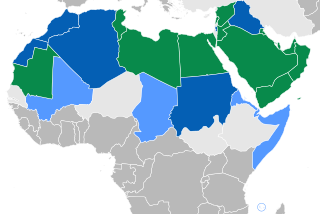
Arabic is a Central Semitic language of the Semitic language family spoken primarily in the Arab world. The ISO assigns language codes to 32 varieties of Arabic, including its standard form of Literary Arabic, known as Modern Standard Arabic, which is derived from Classical Arabic. This distinction exists primarily among Western linguists; Arabic speakers themselves generally do not distinguish between Modern Standard Arabic and Classical Arabic, but rather refer to both as al-ʿarabiyyatu l-fuṣḥā or simply al-fuṣḥā (اَلْفُصْحَىٰ).

The Levant is an approximate historical geographical term referring to a large area in the Eastern Mediterranean region of West Asia. In its narrowest sense, which is in use today in archaeology and other cultural contexts, it is equivalent to Cyprus and a stretch of land bordering the Mediterranean Sea in western Asia: i.e. the historical region of Syria, which includes present-day Israel, Jordan, Lebanon, Syria, the Palestinian territories and most of Turkey southwest of the middle Euphrates. Its overwhelming characteristic is that it represents the land bridge between Africa and Eurasia. In its widest historical sense, the Levant included all of the Eastern Mediterranean with its islands; that is, it included all of the countries along the Eastern Mediterranean shores, extending from Greece in Southern Europe to Cyrenaica, Eastern Libya in Northern Africa.

As-salamu alaykum, also written salamun alaykum and typically rendered in English as salam alaykum, is a greeting in Arabic that means 'Peace be upon you'. The salām has become a religious salutation for Muslims worldwide when greeting each other, though its use as a greeting pre-dates Islam, and is also common among Arabic speakers of other religions.

Bey, also spelled as Baig,Bayg, Beigh, Beig, Bek, Baeg or Beg, is a Turkic title for a chieftain, and an honorific title traditionally applied to people with special lineages to the leaders or rulers of variously sized areas in the numerous Turkic kingdoms, emirates, sultanates and empires in Central Asia, South Asia, and the Middle East, such as the Ottomans, Timurids or the various khanates and emirates in Central Asia and the Eurasian Steppe. The feminine equivalent title was begum. The regions or provinces where "beys" ruled or which they administered were called beylik, roughly meaning "governorate" and/or "region". However the exact scope of power handed to the beks varied with each country, thus there was no clear-cut system, rigidly applied to all countries defining all the possible power and prestige that came along with the title.

Arabic grammar is the grammar of the Arabic language. Arabic is a Semitic language and its grammar has many similarities with the grammar of other Semitic languages. Classical Arabic and Modern Standard Arabic have largely the same grammar; colloquial spoken varieties of Arabic can vary in different ways.
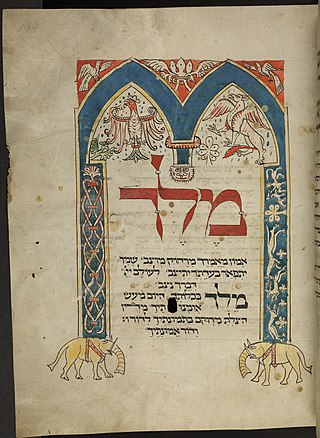
Malik is the Semitic term translating to "king", recorded in East Semitic and Arabic, and as mlk in Northwest Semitic during the Late Bronze Age.
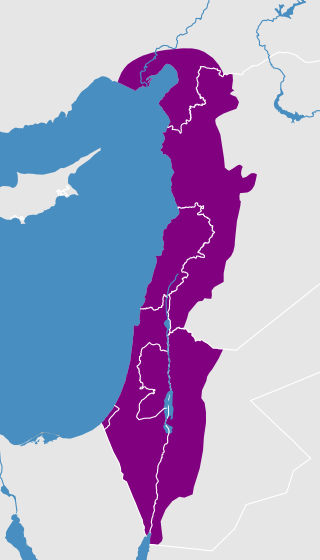
Levantine Arabic, also called Shami, is an Arabic variety spoken in the Levant: in Syria, Jordan, Lebanon, Palestine, Israel, and southern Turkey. With over 54 million speakers, Levantine is, alongside Egyptian, one of the two prestige varieties of spoken Arabic comprehensible all over the Arab world.
Sharīf, also spelled shareef or sherif, feminine sharīfa (شريفة), plural ashrāf (أشراف), shurafāʾ (شرفاء), or shurfāʾ, is a title used to designate a person descended, or claiming to be descended, from the family of the Islamic prophet Muhammad. It may be used in three senses:
- In the broadest sense, it refers to any descendant of Muhammad's great-grandfather Hashim, including all descendants of Muhammad's paternal uncles Abu Talib and al-Abbas.
- More often, it refers to a descendant of Ali, a son of Abu Talib and a paternal cousin of Muhammad, especially but not exclusively through Ali's marriage with Muhammad's daughter Fatima. In the sense of descendants of Fatima and Ali, the term effectively refers to all descendants of Muhammad.
- In the narrowest sense, it refers only to someone who descends from Fatima and Ali's eldest son Hasan. In this limited context, it is contrasted with the term sayyid ('lord', 'master', plural sāda,, which then refers only to the descendants of Hasan's younger brother Husayn.
'Ashraf ' is an Arabic name meaning 'most honorable one' or 'very noble'. It is used by many Arabs and non-Arabs regardless of their religious affiliation, both Christians and Muslims alike. In French-speaking contexts the transliteration is Achraf.
Aziz is a Semitic, Hebrew, Aramaic and Arabic male name. In Arabic and Hebrew the feminine form of both the adjective and the given name is Aziza. In Hebrew and Aramaic Aziz is derived from the root עזז meaning "strong, powerful". In Arabic it is derived from the root ʕ-z-z, again meaning "strong, powerful", while the adjective has also acquired the meaning of "dear, darling, precious" in both Arabic and Aramaic.
Al-watan, meaning homeland, heimat, country, or nation, may refer to:
Akhbar in Arabic (أخبار) is the plural of khabar (خبر), meaning news or, in Classical Arabic, reports about significant past events. The Arabic term occurs in the titles of many newspapers and other media, and may refer to:

Qalat or kalata (قلعه) in Persian, and qal'a(-t) or qil'a(-t) in Arabic, means 'fortress', 'fortification', 'castle', or simply 'fortified place'. The common English plural is "qalats".
Samar is a female/male given name, gender is based on the country. It is used in several languages.
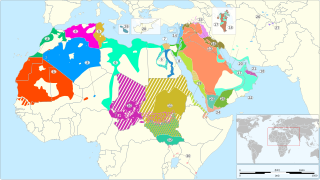
Varieties of Arabic are the linguistic systems that Arabic speakers speak natively. Arabic is a Semitic language within the Afroasiatic family that originated in the Arabian Peninsula. There are considerable variations from region to region, with degrees of mutual intelligibility that are often related to geographical distance and some that are mutually unintelligible. Many aspects of the variability attested to in these modern variants can be found in the ancient Arabic dialects in the peninsula. Likewise, many of the features that characterize the various modern variants can be attributed to the original settler dialects as well as local native languages and dialects. Some organizations, such as SIL International, consider these approximately 30 different varieties to be separate languages, while others, such as the Library of Congress, consider them all to be dialects of Arabic.

Jordanian Arabic is a dialect continuum of mutually intelligible varieties of Arabic spoken by the population of the Hashemite Kingdom of Jordan.
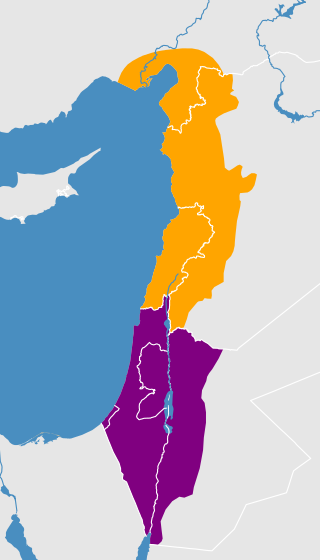
Palestinian Arabic is a dialect continuum of mutually intelligible varieties of Levantine Arabic spoken by most Palestinians in Palestine, Israel and in the Palestinian diaspora.
Maha is an Arabic female given name meaning "half moon" or "beautiful eyes". The wild deer — or the Arabian oryx antelope, which is identified with the word mahā in some sources — has been traditionally celebrated in Arabic poetry for the beauty of its eyes. The phrase ‘uyūnu ’l-mahā or "eyes of the mahā" used in poetry to praise by the beauty of their beloved.

Damascus Arabic or Damascus Dialect is a North Levantine Arabic spoken dialect, indigenous to and spoken primarily in Damascus. As the dialect of the capital city of Syria, and due to its use in the Syrian broadcast media, it is prestigious and widely recognized by speakers of other Syrian dialects, as well as in Lebanon, Palestine, and Jordan. Accordingly, in modern times it is sometimes known as Syrian Arabic or the Syrian Dialect; however, the former term may also be used to refer to the group of similar urban sedentary dialects of the Levant, or to mean Levantine Arabic in general.
Levantine Arabic grammar is the set of rules by which Levantine Arabic creates statements, questions and commands. In many respects, it is quite similar to that of the other vernacular Arabic varieties.
References
- 1 2 "Sumru". Turkish Language Association. Retrieved 19 October 2013.
- ↑ Hovhannes I. Pilikian (10 February 2012). "Powerful Turkish Cinematic Condemnation". Keghart. Retrieved 19 October 2013.
- ↑ Begum Sumru The Church of Basilica Retrieved 19 October 2013
- ↑ Ranajit Guha; Gayatri Chakravorty Spivak (1988). Selected Subaltern Studies. New York: Oxford University Press. p. 137. ISBN 9780195052893.
- ↑ "About the German Adventurer Walter Reinhard". REG. Retrieved 19 October 2013.
- ↑ "Sumru". Guzel Isimler. Retrieved 19 October 2013.
- ↑ "What is the meaning of the name, Sumru?". Dictionary of names (in Turkish). Retrieved 19 October 2013.
- 1 2 "Chronology: Pakistan". The Middle East Journal. 50 (2). Spring 1996. JSTOR 4328928.
- ↑ Leslie J. McLoughlin (1999). Colloquial Arabic (Levantine). London: Routledge. p. 108. ISBN 978-0415000734.
- ↑ Talib Ghaffari (7 January 2011). "Writings of Imam Jalaluddin al-Suyuti". Maktabah Mujaddidiyah. Retrieved 23 November 2013.
- 1 2 "Contents" (PDF). Egyptian Arabic Dictionary. Retrieved 23 November 2013.
- ↑ Derya Adalar Subaşı (Spring 2012). "Renkler ulamı üzerine Türkçe ve Arapça sözlük tabanına yönelik gözlemler (Observations on Turkish and Arabic dictionaries in terms of color terms)" (PDF). Turkish Studies. 7/2: 963–977. Retrieved 23 November 2013.
- ↑ Moshe Piamenta (1 May 1990). A Dictionary of Post-Classical Yemeni Arabic. BRILL. p. 232. ISBN 978-90-04-09294-5 . Retrieved 23 November 2013.
- ↑ "Abyaḍ and the Black Arabs Some Clarifications" (PDF). Wesley Muhammad. 2012. Retrieved 23 November 2013.
- ↑ "Theory of everything (TOE)". An Etymological Dictionary of Astronomy and Astrophysics. English-French-Persian. Retrieved 23 November 2013.
- ↑ Jonathan Slocum; Todd B. Krause. "Old Norse Online". The University of Texas at Austin. Retrieved 23 November 2013.
- ↑ "some (adj.)". Online Etymology Dictionary. Retrieved 23 November 2013.
- ↑ "some (sʌm)". Collins English Dictionary. Retrieved 23 November 2013.
- ↑ "Sumr". iJunoon. Retrieved 23 November 2013.
- ↑ "Baby names". Joy2Day. Retrieved 23 November 2013.
- ↑ Juliana de Luna (2001). "Jewish Women's Names in an Arab Context: Names from the Geniza of Cairo". SCA College of Arms. Retrieved 23 November 2013.
- 1 2 Jim Arlow; Ila Neustadt (27 June 2005). UML 2 and the Unified Process: Practical Object-Oriented Analysis and Design. Pearson Education. p. 746. ISBN 978-0-13-270263-8.
- ↑ "SUMR". The Free Dictionary. Retrieved 23 November 2013.

If an internal link led you here, you may wish to change that link to point directly to the intended article.