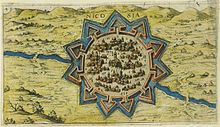
Nicosia, also known as Lefkosia in Greek and Lefkoşa in Turkish, is the capital and largest city of Cyprus.

A crescent shape is a symbol or emblem used to represent the lunar phase in the first quarter, or by extension a symbol representing the Moon itself.

The national flag of Turkey, officially the Turkish flag, is a red flag featuring a white star and crescent on its emblem, a prominent symbol of the Ottoman Empire. Although the symbol is now a recognized symbol of Islam, it does not carry any religious meaning on the Turkish flag. The flag is often called "the red flag", and is referred to as "the red banner" in the Turkish national anthem. The measures, geometric proportions, and exact tone of red of the flag of Turkey were legally standardized with the Turkish Flag Law on 29 May 1936.
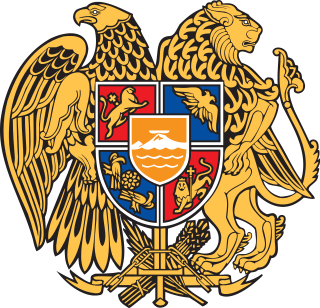
The national coat of arms of Armenia was adopted on April 19, 1992, by resolution of the Armenian Supreme Council. On June 15, 2006, the Armenian Parliament passed the law on the state coat of arms of Armenia.
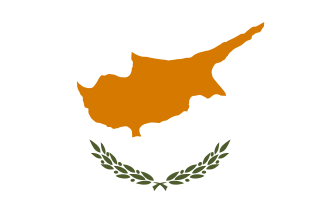
The national flag of Cyprus came into use on 16 August 1960, under the Zürich and London Agreements, whereby a constitution was drafted and Cyprus was proclaimed an independent state. The flag was designed by Turkish Cypriot artist İsmet Güney. The design of the flag deliberately employs peaceful and neutral symbols in an attempt to indicate harmony between the Greek and Turkish Cypriot communities, an ideal that has not yet been realised. In 1963, Greek Cypriot and Turkish Cypriot communities separated because of Cypriot intercommunal violence.

The National Emblem of the People's Republic of China is a national symbol of the People's Republic of China and contains in a red circle a representation of Tiananmen Gate, the entrance gate to the Forbidden City, where Mao Zedong declared the foundation of the People's Republic of China (PRC) in 1949. Above this representation are the five stars found on the national flag. The largest star represents the Chinese Communist Party (CCP), while the four smaller stars represent the four revolutionary social classes as defined in Maoism. The emblem is described as being "composed of patterns of the national flag":
...The red color of the flag symbolizes revolution and the yellow color of the stars the golden brilliant rays radiating from the vast red land. The design of four smaller stars surrounding a bigger one signifies the unity of the Chinese people under the leadership of the Communist Party of China (CPC).
—China Yearbook 2004

The flag of the Turkish Republic of Northern Cyprus is the national flag of the Turkish Republic of Northern Cyprus and is based on the flag of Turkey, with the colors reversed and two additional horizontal red stripes at the top and bottom. The flag was drawn by the Turkish Cypriot artist Emin Çizenel. It was adopted in 1984 by Northern Cyprus, a self-declared state that is recognized only by Turkey, after its unilateral declaration of independence in 1983.

North Nicosia or Northern Nicosia is the capital and largest city of the de facto state of Northern Cyprus. It is the northern part of the divided city of Nicosia, and is governed by the Nicosia Turkish Municipality. As of 2011, North Nicosia had a population of 61,378 and a metropolitan area with a population of 82,539.

The Blue Sky with a White Sun is the national emblem of the Republic of China that covers the period of history in Mainland China and Taiwan.
The coat of arms of Cyprus may refer to the national symbol used in the Republic of Cyprus.

The state emblem of Uzbekistan was formally adopted on July 2, 1992, by the newly establish Republic of Uzbekistan. It bears many similarities to the emblem of the previous Uzbek Soviet Socialist Republic (SSR), which Republic of Uzbekistan succeeded. Like other post-Soviet republics whose symbols do not predate the October Revolution, the current emblem retains some components of the Soviet one. Prior to 1992, Uzbekistan had an emblem similar to all other Soviet Republics, with standard communist emblems and insignia.
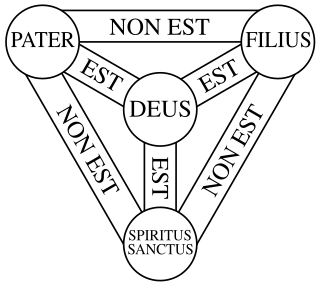
The Shield of the Trinity or Scutum Fidei is a traditional Christian visual symbol which expresses many aspects of the doctrine of the Trinity, summarizing the first part of the Athanasian Creed in a compact diagram. In late medieval Europe, this emblem was considered to be the heraldic arms of God.

The national emblem of East Timor is one of the national symbols of East Timor.
A flag of Mars is a concept of a possible flag design, meant to symbolize the planet Mars or to represent a fictional Martian government, in works of fiction.
Koutsovendis or Koutsoventis is a village in the Kyrenia District of Cyprus. It is under the de facto control of Northern Cyprus.

The Kyrenia Gate, is a gate in the Nicosia walls, in North Nicosia, Northern Cyprus. It was the gate which was used for transport to the northern areas, especially Kyrenia.

The Walls of Nicosia, also known as the Venetian Walls, are a series of defensive walls which surround Nicosia, the capital city of Cyprus. The first city walls were built in the Middle Ages, but they were completely rebuilt in the mid-16th century by the Republic of Venice. The walls are still largely intact, and are among the best preserved Renaissance fortifications in the Eastern Mediterranean. They are a major tourist attraction.

The coat of arms of the Chechen Republic is the official symbol of the Chechen Republic. Approved by acting President of Chechnya Sergey Abramov on 22 June 2004.
The flag of Earth is a concept of a possible flag design meant to symbolize the planet Earth, humankind, or a possible world government.