
The Neo Geo, stylized as NEO•GEO and also written as NEOGEO, is a ROM cartridge-based video gaming system released on April 26, 1990, by Japanese game company SNK Corporation. Designed as both an arcade system board and home video game console, the Neo Geo was marketed as the first 24-bit system; its CPU is actually a 16/32-bit 68000 with an 8-bit Z80 coprocessor, while its GPU chipset has a 24-bit graphics data bus. It was a very powerful system when released, more powerful than any video game console at the time, and many arcade systems such as rival Capcom's CPS, which did not surpass it until the CP System II in 1993. Neo Geo hardware production lasted seven years; it was succeeded by Hyper Neo Geo 64.

The Neo Geo CD is a home video game console produced by SNK Corporation, released on September 9, 1994. The system is the same platform as the cartridge-based Neo Geo released four years earlier, but converted to the cheaper CD media format which retailed at $49 to 79 per title compared to over $200 for the equivalent cartridge.
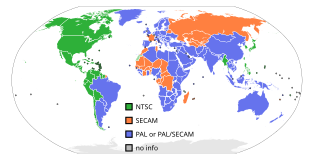
Phase Alternating Line (PAL) is a colour encoding system for analog television. It was one of three major analogue colour television standards, the others being NTSC and SECAM. In most countries it was broadcast at 625 lines, 50 fields per second, and associated with CCIR analogue broadcast television systems B, D, G, H, I or K. The articles on analog broadcast television systems further describe frame rates, image resolution, and audio modulation.

The Zilog Z80 is an 8-bit microprocessor designed by Zilog that played an important role in the evolution of early computing. Launched in 1976, it was designed to be software-compatible with the Intel 8080, offering a compelling alternative due to its better integration and increased performance. In addition to the 8080's seven registers and flags register, the Z80 featured an alternate register set, two 16-bit index registers, and additional instructions, including bit manipulation and block copy/search.
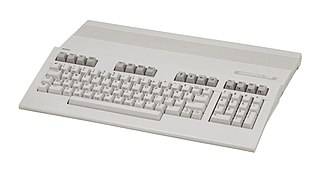
The Commodore 128, also known as the C128, C-128, or C= 128, is the last 8-bit home computer that was commercially released by Commodore Business Machines (CBM). Introduced in January 1985 at the CES in Las Vegas, it appeared three years after its predecessor, the Commodore 64, the bestselling computer of the 1980s. Approximately 2.5 million C128s were sold during its four year production run.

Tiki-100 was a desktop home/personal computer manufactured by Tiki Data of Oslo, Norway. The computer was launched in the spring of 1984 under the original name Kontiki-100, and was first and foremost intended for the emerging educational sector, especially for primary schools. Early prototypes had 4 KB ROM, and the '100' in the machine's name was based on the total KB amount of memory.

Chase H.Q. is a vehicular combat racing game, originally released as an arcade video game by Taito in 1988. It is sometimes seen as a spiritual successor to Taito's earlier Full Throttle. The player assumes the role of a police officer named Tony Gibson, member of the "Chase Special Investigation Department". Along with his partner, Raymond Broady, he must stop fleeing criminals in high-speed pursuits in a black Porsche 928.
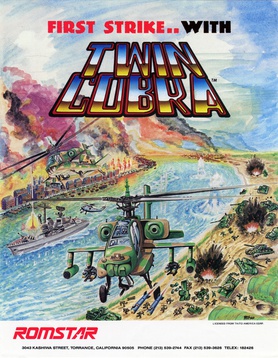
Twin Cobra, known as Kyukyoku Tiger in Japan, is a vertically scrolling shooter developed by Toaplan and released for arcades in 1987 by Taito in Japan and Europe, then in North America by Romstar. It is a sequel to the 1985 arcade game Tiger-Heli. Controlling the titular attack helicopter, the players must fight endless waves of military vehicles while avoiding collision with their projectiles and other obstacles. It was the fourth shoot 'em up game from Toaplan, and their tenth video game overall. It was ported to multiple platforms, with each done by different third-party developers that made several changes or additions.

Elevator Action is a platform shooter game released in arcades by Taito in 1983. The player assumes the role of a secret agent infiltrating a 30-story building from the roof, then descending to ground level via elevators and stairways. Enemy agents emerge from closed doors and shoot at the player. The goal is to collect secret documents from specially marked rooms, then exit to a waiting getaway car. It runs on the Taito SJ System arcade system.
The CP System II, also known as Capcom Play System 2 or CPS-2, is an arcade system board that Capcom first used in 1993 for Super Street Fighter II. It was the successor to their previous CP System, CP System Dash and Capcom Power System Changer arcade hardware and was succeeded by the CP System III hardware in 1996, of which the CPS-2 would outlive by over four years. The arcade system had new releases for it until the end of 2003, ending with Hyper Street Fighter II. Technical support for the CPS-2 ended on February 28, 2019.

The CP System, also known as Capcom Play System, CPS for short, and retroactively as CPS-1, is an arcade system board developed by Capcom that ran game software stored on removable daughterboards. More than two dozen arcade titles were released for CPS-1, before Capcom shifted game development over to its successor, the CP System II. Technical support for the CPS-1 ended on March 31, 2015.

Tomohiro Nishikado is a Japanese video game developer and engineer. He is the creator of the arcade shoot 'em up game Space Invaders, released to the public in 1978 by the Taito Corporation of Japan, often credited as the first shoot 'em up and for beginning the golden age of arcade video games. Prior to Space Invaders, he also designed other earlier Taito arcade games, including the shooting electro-mechanical games Sky Fighter (1971) and Sky Fighter II, the sports video game TV Basketball in 1974, the vertical scrolling racing video game Speed Race in 1974, the multi-directional shooter Western Gun in 1975, and the first-person combat flight simulator Interceptor (1975).

The Legend of Kage is a side-scrolling hack-and-slash game developed and published by Taito in 1985. In this game, the player controls the ninja Kage, with the objective being to get through five stages in order to save the princess Kirihime. These stages are littered with enemies, but Kage has various skills and weapons on his hands in order to get through them.
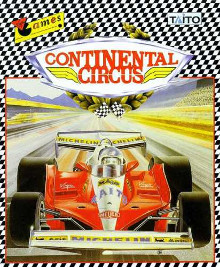
Continental Circus is a racing arcade video game, manufactured by Taito in 1987. In 1989, ports for the Amiga, Amstrad CPC, Atari ST, Commodore 64, MSX, and ZX Spectrum were published by Virgin Games.

Wonder Boy is a 1986 platform game published by Sega and developed by Escape. Originally designed for arcades, it was later ported to the SG-1000, Mark III/Master System and Game Gear video game consoles by Sega, and to the ZX Spectrum, Commodore 64 and Amstrad CPC home computers by Activision. The game is also known as Super Wonder Boy for its Sega Mark III release in Japan and Revenge of Drancon for its Game Gear release in North America. A high definition remake of the game, titled Wonder Boy Returns, was developed by CFK and released on Steam on October 12, 2016. Wonder Boy was rereleased in 2022 as part of Wonder Boy Collection for the Nintendo Switch and PlayStation 4 which includes its versions on arcade, Master System, SG-1000 and Game Gear.
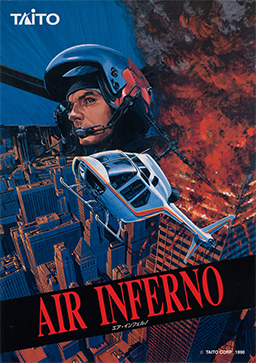
Air Inferno is a 1990 flight simulation arcade video game developed and released by Taito, in Japan, Europe and North America. A spin-off from Taito's Landing series, Air Inferno is an aerial firefighting simulation that involves piloting a helicopter on various rescue missions, shooting a fire extinguisher to extinguish flames while rescuing civilians.
The Namco System 246 is a development of the Sony PlayStation 2 technology as a basis for an arcade system board. It was released in December 2000 on its first game Bloody Roar 3. Like the Sega NAOMI, it is widely licensed for use by other manufacturers. Games such as Battle Gear 3 and Capcom Fighting Evolution are examples of System 246-based arcade games that are not Namco products.
Battle Gear (バトル・ギア), previously known as Side by Side (サイド・バイ・サイド), is a series of racing video games developed and published by Taito, first released in arcades with Side by Side in 1996. The series was later released for various home consoles, such as the PlayStation and PlayStation 2.
The PolyGame Master (PGM) is an arcade system board released in 1997 by the Taiwan company IGS. The PGM was developed in order to compete with the likes of SNK's Neo Geo MVS system in Taiwan. It was succeeded by PGM2 in 2007, and PGM3 in 2012.

Speed Race is a 1974 arcade racing video game developed and manufactured by Taito and released under the titles Racer and Wheels in North America by distributor Midway Manufacturing in 1975. Designed by Tomohiro Nishikado, the gameplay involves the player using the attached steering wheel to maneuver a car alongside a fast vertical scrolling road. The objective is to score points by driving past other cars without colliding with them; more points are awarded for driving faster. Players must do this under a 90-second time limit, which ends the game when it runs out. The gameplay concepts were adapted from two earlier driving electro-mechanical games: Kasco's Mini Drive (1958) and Taito's Super Road 7 (1970).


