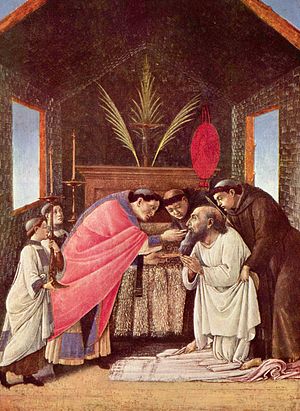
The Last Communion of Saint Jerome

Last updated
The Last Communion of Saint Jerome
Sandro Botticelli 019.jpg
Artist Sandro Botticelli
Year 1494–1495
Medium Tempera on panel
Dimensions 34.3 cm× 25.5 cm(13.5 in× 10.0 in)
Location Metropolitan Museum of Art, New York

The Last Communion of Saint Jerome is a painting by the Italian Renaissance master Sandro Botticelli, finished around 1494–1495. It is housed in the Metropolitan Museum of Art, in New York City.

Italian Renaissance painting art movement

Italian Renaissance painting is the painting of the period beginning in the late 13th century and flourishing from the early 15th to late 16th centuries, occurring in the Italian peninsula, which was at that time divided into many political states, some independent but others controlled by external powers. The painters of Renaissance Italy, although often attached to particular courts and with loyalties to particular towns, nonetheless wandered the length and breadth of Italy, often occupying a diplomatic status and disseminating artistic and philosophical ideas.

Sandro Botticelli 15th and 16th-century Italian Renaissance painter

Alessandro, known as Sandro Botticelli, was an Italian painter of the Early Renaissance. He belonged to the Florentine School under the patronage of Lorenzo de' Medici, a movement that Giorgio Vasari would characterize less than a hundred years later in his Vita of Botticelli as a "golden age". Botticelli's posthumous reputation suffered until the late 19th century; since then, his work has been seen to represent the linear grace of Early Renaissance painting.

Metropolitan Museum of Art Art museum in New York City, New York

The Metropolitan Museum of Art of New York City, colloquially "the Met", is the largest art museum in the United States. With 7.06 million visitors to its three locations in 2016, it was the third most visited art museum in the world, and the fifth most visited museum of any kind. Its permanent collection contains over two million works, divided among seventeen curatorial departments. The main building, on the eastern edge of Central Park along Museum Mile in Manhattan 's Upper East Side is by area one of the world's largest art galleries. A much smaller second location, The Cloisters at Fort Tryon Park in Upper Manhattan, contains an extensive collection of art, architecture, and artifacts from Medieval Europe. On March 18, 2016, the museum opened the Met Breuer museum at Madison Avenue on the Upper East Side; it extends the museum's modern and contemporary art program.

Contents

The small picture is inspired by one of the three apocryphal letters of Saint Eusebius, according to which, before dying, Saint Jerome received the Last Communion from Eusebius himself. The choice of this scene, far less frequent than the usual depiction of Jerome in his studio, has been connected to Girolamo Savonarola's preaching in Florence at the time the work was executed; the latter's commissioner, identified by some scholars as the rich merchant Francesco del Pugliese, would be in fact a followed of the Ferrarese preacher. [1]

Eusebius of Vercelli Bishop and saint

Eusebius of Vercelli was an Italian bishop and is counted a saint. Along with Athanasius, he affirmed the divinity of Jesus against Arianism.

Jerome 4th and 5th-century Catholic priest, theologian, and saint

Saint Jerome was a Christian priest, confessor, theologian, and historian. He was born at Stridon, a village near Emona on the border of Dalmatia and Pannonia. He is best known for his translation of most of the Bible into Latin, and his commentaries on the Gospels. His list of writings is extensive.

Girolamo Savonarola Italian Dominican reformer (1452–1498)

Girolamo Savonarola was an Italian Dominican friar and preacher active in Renaissance Florence. He was known for his prophecies of civic glory, the destruction of secular art and culture, and his calls for Christian renewal. He denounced clerical corruption, despotic rule and the exploitation of the poor. He prophesied the coming of a biblical flood and a new Cyrus from the north who would reform the Church. In September 1494, when Charles VIII of France invaded Italy, and threatened Florence, such prophecies seemed on the verge of fulfilment. While Savonarola intervened with the French king, the Florentines expelled the ruling Medici and, at the friar's urging, established a "popular" republic. Declaring that Florence would be the New Jerusalem, the world centre of Christianity and "richer, more powerful, more glorious than ever", he instituted an extreme puritanical campaign, enlisting the active help of Florentine youth.

The topic was depicted by the baroque Bolognese painter Agostino Carracci in his painting now at the Galleria Nazionale of Bologna, and also by the Baroque painter Domenichino in a painting in the Vatican Museum.

Agostino Carracci Bolognese painter of the Baroque

Agostino Carracci was an Italian painter, printmaker, tapestry designer, and art teacher. He was, together with his brother, Annibale Carracci, and cousin, Ludovico Carracci, one of the founders of the Accademia degli Incamminati in Bologna. This teaching academy promoted the Carracci emphasized drawing from life. It promoted progressive tendencies in art and was a reaction to the Mannerist distortion of anatomy and space. The academy helped propel painters of the School of Bologna to prominence.
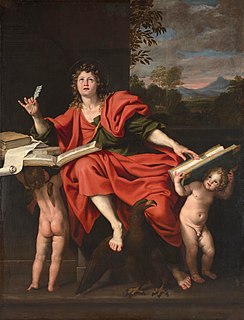
Domenichino Italian painter

Domenico Zampieri, known as Domenichino for his shortness, was an Italian Baroque painter of the Bolognese or Carracci School of painters.

Related Research Articles

Lorenzo Lotto Italian painter, draughtsman and illustrator

Lorenzo Lotto was an Italian painter, draughtsman and illustrator, traditionally placed in the Venetian school, though much of his career was spent in other North Italian cities. He painted mainly altarpieces, religious subjects and portraits. He was active during the High Renaissance and the first half of the Mannerist period, but his work maintained a generally similar High Renaissance style throughout his career, although his nervous and eccentric posings and distortions represented a transitional stage to the Florentine and Roman Mannerists.

Bartolomeo Montagna Italian painter

Bartolomeo Montagna was an Italian Renaissance painter who mainly worked in Vicenza. He also produced works in Venice, Verona, and Padua. He is most famous for his many Madonnas and his works are known for their soft figures and depiction of eccentric marble architecture. He is considered to be heavily influenced by Giovanni Bellini, in whose workshop he might have worked around 1470. Benedetto Montagna, a productive engraver, was his son and pupil and active until about 1540. He was mentioned in Vasari's Lives as a student of Andrea Mantegna but this is widely contested by art historians.

Petrus Christus Flemish painter

Petrus Christus was an Early Netherlandish painter active in Bruges from 1444, where, along with Hans Memling, he became the leading painter after the death of Jan van Eyck. He was influenced by van Eyck and Rogier van der Weyden and is noted for his innovations with linear perspective and a meticulous technique which seems derived from miniatures and manuscript illumination. Today, some 30 works are confidently attributed to him. The best-known include the 1446 Portrait of a Carthusian and c. 1470 Berlin Portrait of a Young Girl, both are highly innovative in presentation of the figure against detailed, rather than flat, backgrounds.

Cosimo Rosselli Italian painter

Cosimo Rosselli (1439–1507) was an Italian painter of the Quattrocento, active mainly in his birthplace of Florence, but also Lucca earlier in his career, and from 1480 in the Sistine Chapel in Rome, where he painted some of the large fresco panels on the side walls. Despite being roughly the same age as Sandro Botticelli, Pietro Perugino and Domenico Ghirlandaio, the other leading Florentine painters, all regarded as greater talents, Rosselli was still able to win several large commissions, which is a testament to the high level of activity in the city.

Giovanni di Paolo Italian painter

Giovanni di Paolo di Grazia was an Italian painter, working primarily in Siena. He may have apprenticed with Taddeo di Bartolo, becoming a prolific painter and illustrator of manuscripts, including Dante's texts.

Girolamo Savoldo Italian painter

Girolamo Savoldo, also called Girolamo da Brescia was an Italian High Renaissance painter active mostly in Venice, although he also worked in other cities in northern Italy. He is noted for his subtle use of color and chiaroscuro, and the sober realism of his works, which are mostly religious subjects, with a few portraits, which are given interest by their accessories or settings, "some even look like extracts from larger narratives".

Francesco di Giovanni Botticini, commonly referred to as Francesco Botticini, was an Italian Early Renaissance painter. He was born in Florence and remained active as a painter until his death in 1498. He studied in the workshops of Neri di Becci, Cosimo Rosselli and Andrea del Verrocchio. He established his own Florentine workshop after a brief period as Neri di Bicci's assistant. Although there are few works attributed to Botticini directly, in recent years historians have unearthed of a considerable number of works that were certainly authored by Botticini. Since the assembly of the complete record of his works, he is viewed as a remarkable minor master of Renaissance Art.

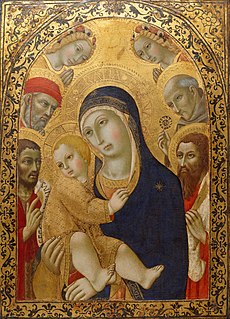
Sano di Pietro Italian painter

Sano di Pietro or Ansano di Pietro di Mencio (1406–1481) was an Italian painter of the Sienese school of painting. He was active for about half a century during the Quattrocento period, and his contemporaries included Giovanni di Paolo and Sassetta.

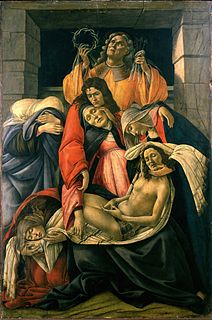
<i>Lamentation over the Dead Christ</i> (Botticelli, Milan) painting by Sandro Botticelli

The Lamentation over the Dead Christ with Saints is a painting of the Lamentation of Christ by the Italian Renaissance artist Sandro Botticelli, dated between 1490-1495. The painting was originally kept in Santa Maria Maggiore, Florence. It is now in the Museo Poldi Pezzoli of Milan. The painting is one of two versions of The Lamentation by Botticelli. The Lamentation over Dead Christ, circa 1492, is currently housed in the Alte Pinakothek in Munich.

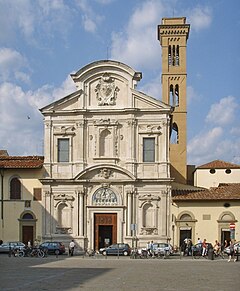
Ognissanti, Florence church in Florence

The chiesa di San Salvatore di Ognissanti or more simply chiesa di Ognissanti, is a Franciscan church located on the piazza of the same name in central Florence, region of Tuscany, Italy. Founded by the lay order of the Umiliati, the church was dedicated to all the saints and martyrs, known and unknown.

The decade of the 1480s in art involved some significant events.

<i>Madonna and Child with an Angel</i> (Botticelli) painting by Sandro Botticelli in 1465-1467

The Madonna and Child with an Angel is a painting by the Italian Renaissance painter Sandro Botticelli, c. 1465-1467. It is housed in Spedale degli Innocenti of Florence.

<i>Virgin and Child with the Young Saint John the Baptist</i> (Botticelli) painting by Sandro Botticelli in the Cleveland Museum of Art

The Virgin and Child with the Young Saint John the Baptist is a painting by the Italian Renaissance painter Sandro Botticelli, c. 1490. It is housed in the Cleveland Museum of Art.

Andrea di Niccolò Italian painter

Andrea di Niccolò, also Andrea di Niccolò di Giacomo, (1440-1514) was an Italian painter of the Sienese School.

<i>Communion of the Apostles</i> (Barocci) painting by Federico Barocci

The Communion of the Apostles, or Institution of the Eucharist is a painting of the Last Supper by Federico Barocci located at Santa Maria sopra Minerva in Rome. It was commissioned for the family chapel of Pope Clement VIII Aldobrandini and completed between 1603 and 1608.

<i>Portrait of a Man</i> (Domenico Ghirlandaio) painting by Domenico Ghirlandaio (Domenico Bigordi)

Portrait of a Man is a painting from c. 1448–1494 made by the Italian Renaissance painter Domenico Ghirlandaio executed in tempera on wood.

This is an ongoing bibliography of work related to the Italian baroque painter Artemisia Gentileschi.

<i>Scenes from the Life of Saint Zenobius</i> series of paintings by Sandro Botticelli

Scenes from the Life of Saint Zenobius is a series of paintings by the Italian Renaissance artist Sandro Botticelli. Four panels from the series survive, which are now in three different museums. Each depicts three or more incidents from the life of Zenobius, an early Bishop of Florence who perhaps died in 417. The works are all in tempera on wood, and around 66 cm (26 in) high, though their length varies rather more, from about 149 to 182 cm.

References

  1. "Archived copy". Archived from the original on 2007-09-28. Retrieved 2007-06-23.

Further reading

Christiansen, Keith (Fall 1983), "Early Renaissance Narrative Painting in Italy", The Metropolitan Museum of Art Bulletin, 41 (2), pp. 12–14 
Horne, Herbert P. (March 1915), "The Last Communion of St. Jerome by Sandro Botticelli", The Metropolitan Museum of Art Bulletin, Metropolitan Museum of Art, 10 (3), pp. 39+52–56, doi:10.2307/3254048, JSTOR   3254048  
(April 1915), "The Last Communion of St. Jerome by Sandro Botticelli (Continued)", The Metropolitan Museum of Art Bulletin, Metropolitan Museum of Art, 10 (4), pp. 72–75, doi:10.2307/3253504, JSTOR   3253504  
(May 1915), "The Last Communion of St. Jerome by Sandro Botticelli (Concluded)", The Metropolitan Museum of Art Bulletin, Metropolitan Museum of Art, 10 (5), pp. 101–105, doi:10.2307/3253423, JSTOR   3253423  
Zeri, Federico; Gardner, Elizabeth E. (1971), Italian Paintings: A Catalogue of the Collection of The Metropolitan Museum of Art. Vol. 1, Florentine School, New York: Metropolitan Museum of Art, pp. 159–163