Third Saudi state

Last updated
Third Saudi State
الدَّولةُ السُّعوديَّة الثالثة (Arabic)
Emblem of Saudi Arabia.svg
Emblem
Motto: لا إله إلا الله، محمد رسول الله
Lā ilāha illa allāh, Muḥammadun rasūlu allāh
"There is no god but Allah, Muhammad is the Messenger of God" [1] [a] ( shahada )
Anthem: النشيد الوطني السعودي
"an-Našīd al-Waṭaniyy as-Suʿūdiyy"
"Chant of the Saudi Nation"
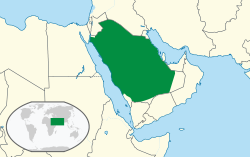
Saudi Unification Map.png
Capital
and largest city
Riyadh
24°39′N46°46′E / 24.650°N 46.767°E / 24.650; 46.767
Official languages Arabic [5]
Common languages Arabic
Religion
Sunni Islam (official) [6]
Demonyms
GovernmentIslamic absolute monarchy
History 
13 January 1902
April 1913
2 November 1921
8 January 1926
 Saudi Arabia established
23 September 1932
Preceded by
Flag of the Emirate of Ha'il.svg Emirate of Jabal Shammar
Flag of Hejaz (1917).svg Kingdom of Hejaz
Flag of the Idrisid Emirate of Asir (1927-1930).svg Emirate of Asir
Flag of the Mutawakkilite Kingdom of Yemen.svg Kingdom of Yemen
Blank.png Principality of Najran
Flag of Upper Asir.svg Sheikdom of Upper Asir

The Third Saudi state is the current Saudi state and heir to the two earlier states: the first and the second, founded by Abdul Aziz bin Abdul Rahman (also known as "Ibn Saud"), who managed to capture the city of Riyadh on January 13, 1902. A long series of conflicts and conquests ultimately led to the establishment of the modern and contemporary Saudi state, the Kingdom of Saudi Arabia.

Contents

The third Saudi state was known at the beginning of its reign as "the Emirate of Riyadh" (1902–1913) and "the Emirate of Nejd and Hasa" (1913–1921). After the overthrow of the rival Emirate of Ha'il, which gave the Emirate of Najd and Al-Ahsa control of the entire Nejd region, it became known as the Sultanate of Nejd. Abdul Aziz conquered the Kingdom of Hejaz in 1925. He raised Nejd to a kingdom in 1927, and his dominions became known as the Kingdom of Hejaz and Nejd and its annexes. Abdul Aziz administered the two portions of his dual kingdom separately until the annexation of the Southern Territory and the announcement of the establishment of the Kingdom of Saudi Arabia in 1932. [7]

History

Emirate of Riyadh

Map of the Emirate of Riyadh Emirate of Riyadh 1902.svg
Map of the Emirate of Riyadh

The Emirate of Riyadh [8] was the first iteration of the Third Saudi State from 1902 to 1913. [9] It was a monarchy led by the House of Saud. [8] The state was formed after Saudi forces seized Riyadh from the control of the Emirate of Jabal Shammar, led by the House of Rashid, during the Battle of Riyadh. [8] It was the direct antecedent of the Emirate of Nejd and Hasa, and the earliest legal predecessor of present-day Saudi Arabia. Al-Hasa was conquered in 1913.

Emirate of Nejd and Hasa

Map of the Emirate of Nejd and Hasa Emirate of Nejd and Hasa 1913.svg
Map of the Emirate of Nejd and Hasa

The Emirate of Nejd and Hasa was the second iteration of the Third Saudi State from 1913 to 1921. It was a monarchy led by the House of Saud. [10] The state was formed after Saudi forces seized al-Hasa from the control of the Ottoman Empire garrison, during the Conquest of al-Hasa. It was the direct antecedent of the Sultanate of Nejd, and a legal predecessor of modern-day Saudi Arabia.

Sultanate of Nejd

Map of the Sultanate of Nejd Sultanate of Nejd 1921.svg
Map of the Sultanate of Nejd

The Sultanate of Nejd (Arabic : سلطنة نجد, Salṭanat Najd) was the third iteration of the Third Saudi State, from 1921 to 1926. It was a monarchy led by the House of Saud, and a legal predecessor of modern-day Saudi Arabia. This version of the Third Saudi State was created when Abdulaziz ibn Saud, Emir of Riyadh, declared himself sultan over Nejd and its dependencies. [11] On 2 December 1922, the Nejd signed an agreement with Kuwait defining their border with each other, which would be a straight line along the 29th parallel. [12] On 19 December 1925, the Kingdom of Hejaz surrendered to the forces of Ibn Saud, who was thereafter proclaimed king of the Hejaz on 8 January 1926 and merged his dominions into the Kingdom of Hejaz and Nejd.

Kingdom of Hejaz and Nejd

Map of the Kingdom of Hejaz and Nejd Kingdom of Hejaz and Nejd 1926.svg
Map of the Kingdom of Hejaz and Nejd

The Kingdom of Hejaz and Nejd (Arabic : مملكة الحجاز ونجد, Mamlakat al-Ḥijāz wa-Najd), initially the Kingdom of Hejaz and Sultanate of Nejd (Arabic: مملكة الحجاز وسلطنة نجد, Mamlakat al-Ḥijāz wa-Salṭanat Najd), was a dual monarchy ruled by Abdulaziz (Ibn Saud) following the Saudi conquest of Hejaz by the Sultanate of Nejd in 1925. It was the fourth iteration of the Third Saudi State.

On 8 January 1926, Abdulaziz (Ibn Saud), the Sultan of Nejd, was crowned King of the Hejaz in the Masjid al-Haram in Mecca, and he elevated Nejd to the status of a kingdom on 29 January 1927. [13] At the Treaty of Jeddah on 20 May 1927, Abdulaziz's realm was recognised by the United Kingdom of Great Britain and Northern Ireland, and was addressed as the Kingdom of Hejaz and Nejd.

For the next five years, Abdulaziz administered the two parts of his dual kingdom as separate units. On 23 September 1932, Abdulaziz proclaimed the union of the main Saudi dominions of al-Hasa, Qatif, Nejd and the Hejaz as the Kingdom of Saudi Arabia.

The Kingdom of Hejaz and Nejd could pursue its expansionist policy with British arms supplies because of its close relations with the United Kingdom. Under King Abdulaziz, the Hejaz withdrew from the League of Nations.

In 1926, the Kingdom of Hejaz and Nejd was recognised by the Soviet Union, followed by the United States of America in 1931. By 1932, the United Kingdom, the French Third Republic, the Soviet Union, Turkey, the Imperial State of Iran, Kingdom of Italy and The Netherlands maintained legations in Jeddah; the Kingdom of Egypt maintained unofficial consular representatives.

See also

Notes

  1. The Shahādah (Statement of faith) is sometimes translated into English as 'There is no god but Allah', using the romanization of the Arabic word Allāh instead of its translation. The word Allāh (Arabic: اللَّٰه) literally translates as God. [2] [3] [4]

References

  1. "About Saudi Arabia: Facts and figures". The Royal Embassy of Saudi Arabia, Washington, DC. Archived from the original on 17 April 2012.
  2. "God". Islam: Empire of Faith. PBS. Archived from the original on 27 March 2014. Retrieved 3 September 2017.
  3. 'Islam and Christianity', Encyclopedia of Christianity (2001): Arabic-speaking Christians and Jews also refer to God as Allah.
  4. L. Gardet. "Allah". Encyclopaedia of Islam Online.
  5. "Basic Law of Governance". Ministry of Education. Ministry of Education – Kingdom of Saudi Arabia. Archived from the original on 5 December 2022. Retrieved 1 September 2020.
  6. "Saudi Arabia" (PDF). U.S. Department of State. According to the basic law, Sunni Islam is the official religion and the country's constitution is the Qur'an and the Sunna (traditions and sayings of the Prophet Muhammad).
  7. Madawi Al-Rasheed. A History of Saudi Arabia. Cambridge, England, UK: Cambridge University Press, 2002. Pp. 40.
  8. 1 2 3 Madawi Al-Rasheed. A History of Saudi Arabia. Cambridge, England, UK: Cambridge University Press, 2002. Pp. 40.
  9. J. A. Hammerton. Peoples Of All Nations: Their Life Today And Story Of Their Past (in 14 Volumes). Concept Publishing Company, 2007. Pp. 193.
  10. Madawi Al-Rasheed. (2002). A History of Saudi Arabia. Cambridge, England, UK: Cambridge University Press, p. 40.
  11. Madawi Al Rasheed. (2002). A History of Saudi Arabia. Cambridge, England, UK: Cambridge University Press, p. 63.
  12. "No. 1083 SULTANATE OF NEJD and KUWAIT" (PDF). 1922.
  13. Joseph Kostiner. (1993). The Making of Saudi Arabia, 1916–1936: From Chieftaincy to Monarchical State. Oxford University Press US, ISBN   0-19-507440-8, p. 104.