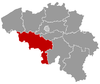
Wallonia, officially the Walloon Region, is one of the three regions of Belgium—along with Flanders and Brussels. Covering the southern portion of the country, Wallonia is primarily French-speaking. It accounts for 55% of Belgium's territory, but only a third of its population. The Walloon Region and the French Community of Belgium, which is the political entity responsible for matters related mainly to culture and education, are independent concepts, because the French Community of Belgium encompasses both Wallonia and the bilingual Brussels-Capital Region but not the German-speaking Community of Belgium.
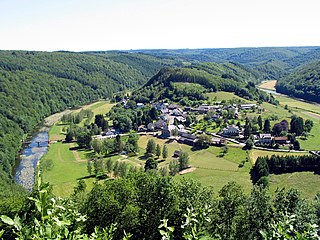
The Ardennes, also known as the Ardennes Forest or Forest of Ardennes, is a region of extensive forests, rough terrain, rolling hills and ridges primarily in Belgium and Luxembourg, extending into Germany and France.

Hainaut, historically also known as Heynault in English, is a province of Wallonia and Belgium.

Charleroi is a city and a municipality of Wallonia, located in the province of Hainaut, Belgium. The city is situated in the valley of the Sambre, in the south-west of Belgium, not far from the border with France. By 1 January 2008, the total population of Charleroi was 201,593. The metropolitan area, including the outer commuter zone, covers an area of 1,462 square kilometres (564 sq mi) with a total population of 522,522 by 1 January 2008, ranking it as the 5th most populous in Belgium after Brussels, Antwerp, Liège, and Ghent. The inhabitants are called Carolorégiens or simply Carolos.

Châtelet is a city and municipality of Wallonia located in the province of Hainaut, Belgium. It lies on the river Sambre.

La Louvière is a city and municipality of Wallonia located in the province of Hainaut, Belgium.

Lobbes is a municipality of Wallonia located in the province of Hainaut, Belgium.
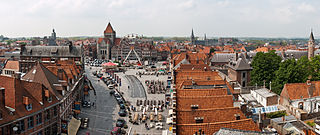
Tournai or Tournay is a city and municipality of Wallonia located in the Province of Hainaut, Belgium. It lies 89 km (55 mi) by road southwest of the centre of Brussels on the river Scheldt, and is part of Eurometropolis Lille–Kortrijk–Tournai, In 2022, the municipality of Tournai had an estimated population of 68,518 people.

Huy is a city and municipality of Wallonia located in the province of Liège, Belgium. Huy lies along the river Meuse, at the mouth of the small river Hoyoux. It is in the sillon industriel, the former industrial backbone of Wallonia, home to the Walloon population.

Seraing is a city and municipality of Wallonia located in the province of Liège, Belgium.

The County of Hainaut, sometimes spelled Hainault, was a territorial lordship within the medieval Holy Roman Empire that straddled the present-day border of Belgium and France. Its most important towns included Mons, now in Belgium, and Valenciennes, now in France.

The National Company of Light Railways was a state-owned transportation provider which comprised a system of narrow-gauge tramways or local railways in Belgium, which covered the whole country, including the countryside, and had a greater route length than the mainline railway system. They were 1,000 mmmetre gauge and included electrified city lines and rural lines using steam locomotives and diesel railcars; half the system was electrified.
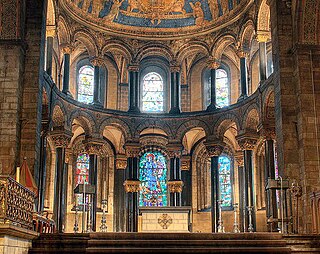
Mosan art is a regional style of art from the valley of the Meuse in present-day Belgium, the Netherlands, and Germany. Although in a broader sense the term applies to art from this region from all periods, it generally refers to Romanesque art, with Mosan Romanesque architecture, stone carving, metalwork, enamelling and manuscript illumination reaching a high level of development during the 11th, 12th and 13th centuries.

Aulne Abbey was a Cistercian monastery located between Thuin and Landelies on the river Sambre in the Bishopric of Liège, Belgium. It is now a Walloon Heritage Site.
Lobbes Abbey was a Benedictine monastery in the municipality of Lobbes, Hainaut, Belgium. The abbey played an important role in the religious, political and religious life of the Prince-Bishopric of Liège, especially around the year 1000. The abbey's founding saint is Saint Landelin; four other saints are also connected with the abbey.
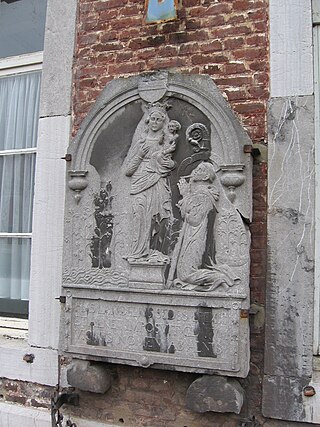
Saint Landelin is a saint in the Eastern Orthodox Church and Roman Catholic Church.

Mirwart Castle is situated in Mirwart in Saint-Hubert, in the province of Luxembourg, Wallonia, Belgium.
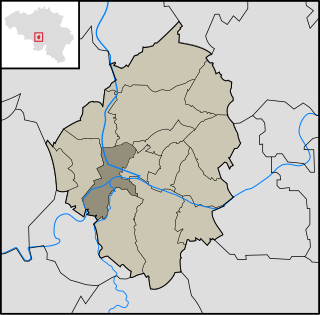
Marchienne-au-Pont is a town of Wallonia and a district of the municipality of Charleroi, located in the province of Hainaut, Belgium.
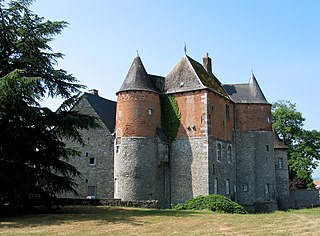
Fosteau Castle is a castle in Leers-et-Fosteau in the municipality of Thuin, province of Hainaut, Wallonia, Belgium.

The Church of Saint Sulpice is a Catholic church in Jumet, a neighborhood of the Belgian city of Charleroi in Hainaut Province, Wallonia. It is dedicated to Sulpitius the Pious. The oldest material traces of a religious building on the site date back to the 10th century. Three churches built there before the current structure were identified during excavations carried out in 1967. The current classical building was built between 1750 and 1753 by an unknown architect. The brick and limestone church is uniform in appearance. It is composed of six bayed naves flanked by aisles, a three-sided transept, and a choir with a polygonal ambulatory with a sacristy in its axis. The chamfered base is in dimension stone on the frontage and in rubble stones and sandstone for the rest of the base. All of the building's angles are toothed and every second stone is bossed. The church has been listed as a Belgian cultural heritage site since 1949.




 Belgium