Tranny (slang)

Last updated

Tranny (or trannie) is a derogatory and offensive slang term for a transgender, transsexual, transvestite, or cross-dressing person. [1] [2] During the early 2010s, there was confusion and debate over whether the term was a pejorative, or was still considered acceptable, or even a reappropriated term of unity and pride. But by 2017, the word was banned by several major media stylebooks and considered hate speech by Facebook. [3] [4]

Transgender people have a gender identity or gender expression that differs from their assigned sex. Some transgender people identify as transsexual if they desire medical assistance to transition from one sex to another. Transgender – often shortened as trans – is also an umbrella term: in addition to including people whose gender identity is the opposite of their assigned sex, it may include people who are not exclusively masculine or feminine. Other definitions of transgender also include people who belong to a third gender, or else conceptualize transgender people as a third gender. Infrequently, the term transgender is defined very broadly to include cross-dressers, regardless of their gender identity.

Transsexual condition in which an individual identifies with a gender inconsistent or not culturally associated with their biological sex

Transsexual people experience a gender identity that is inconsistent with, or not culturally associated with, their assigned sex, and desire to permanently transition to the gender with which they identify, usually seeking medical assistance to help them align their body with their identified sex or gender.

Transvestism practice of dressing and acting in a style or manner traditionally associated with the opposite sex; sometimes practiced for religious, traditional or ceremonial reasons, but at other times considered deviant

Transvestism is the practice of dressing and acting in a style or manner traditionally associated with the opposite sex. In some cultures, transvestism is practiced for religious, traditional, or ceremonial reasons. The term is rarely applied to women.

History

Roz Kaveney wrote in The Guardian in 2010 that 'tranny' had recently appeared to be undergoing reappropriation to be used with pride by trans activists, but "it didn't take", due in part to the word's continued currency as a term of abuse. [5] Lance Bass said in 2011 that he had thought the term was not a slur, having heard it frequently on RuPaul's Drag Race or Project Runway , but apologized for using the term on Access Hollywood after learning from The Advocate and the Gay & Lesbian Alliance Against Defamation (GLAAD) that it was no longer acceptable. [6] GLAAD's 2011 Transgender Resource Page said the term is "usually considered offensive and/or defamatory to transgender people". [7] Trans activists like Justin Vivian Bond, Kate Bornstein, and drag queens such as RuPaul and Lady Bunny have advocated for use of the term. [8] Bond said in 2014 that banning the word does not eliminate transphobia but only, "steal[s] a joyous and hard-won identity from those of us who are and have been perfectly comfortable, if not delighted to be trannies." [8] At the same time, RuPaul said "I love the word tranny," and that the word was not being redefined by the transgender community, but only by "fringe people who are looking for story lines to strengthen their identity as victims". [9] Kate Bornstein said the word was used in the 1960s and 1970s in Sydney, Australia by trans people as "a name for the identity they shared", but said no one should think Bornstein was giving them permission to use the term to describe anyone without first knowing the term they used for their gender identity. [10] Cristin Williams reviewed historic uses of the term and found the first published instance in 1983, originating among gay men, and expressed doubt that it originated many years prior to this. [11]

Roz Kaveney British writer

Roz Kaveney is a British writer, critic, and poet, best known for her critical works about pop culture and for being a core member of the Midnight Rose collective. Kaveney's works include fiction and non-fiction, poetry, reviewing, and editing.

<i>The Guardian</i> British national daily newspaper

The Guardian is a British daily newspaper. It was founded in 1821 as The Manchester Guardian, and took its current name in 1959. Along with its sister papers The Observer and The Guardian Weekly, the Guardian is part of the Guardian Media Group, owned by the Scott Trust. The Scott Trust was created in 1936 "to secure the financial and editorial independence of the Guardian in perpetuity and to safeguard the journalistic freedom and liberal values of the Guardian free from commercial or political interference". The Scott Trust was converted into a limited company in 2008, with a constitution written so as to project the same protections for The Guardian as were originally built into the very structure of the Scott Trust by its creators. Profits are reinvested in journalism rather than to benefit an owner or shareholders.

In sociology and cultural studies, reappropriation or reclamation is the cultural process by which a group reclaims terms or artifacts that were previously used in a way disparaging of that group.

In 2014, the Tranny Awards changed its name to the Transgender Erotica Awards, citing feedback from the "extended trans adult community" as a reason to stop using the term. [12] In 2017, Facebook's anti-hate speech algorithms were blocking posts containing tranny, as well as dyke or fag. [3]

Transgender Erotica Awards award

The Transgender Erotica Awards, formerly known as The Tranny Awards, are a group of movie awards presented annually in the United States recognizing performances and performers in the field of transgender pornography, with an emphasis on erotic photography and pornographic movies. Organized by adult industry production company Grooby Productions, the awards were first given in 2009. Citing a poor representation of transgender performers and producers in mainstream adult awards ceremonies, the Tranny Awards were created to recognize achievement in the transgender adult industry.

Facebook Global online social networking service

Facebook, Inc. is an American online social media and social networking service company. It is based in Menlo Park, California. It was founded by Mark Zuckerberg, along with fellow Harvard College students and roommates Eduardo Saverin, Andrew McCollum, Dustin Moskovitz and Chris Hughes. It is considered one of the Big Four technology companies along with Amazon, Apple, and Google.

Related Research Articles

LGBT initialism referring to sexual and gender minorities

LGBT, or GLBT, is an initialism that stands for lesbian, gay, bisexual, and transgender. In use since the 1990s, the term is an adaptation of the initialism LGB, which was used to replace the term gay in reference to the LGBT community beginning in the mid-to-late 1980s. Activists believed that the term gay community did not accurately represent all those to whom it referred.

Cisgender is a term for people whose gender identity matches the sex that they were assigned at birth. Someone who identifies as a woman and was assigned female at birth is, for example, a cisgender woman. The term cisgender is the opposite of the word transgender..

Transphobia is a range of negative attitudes, feelings or actions toward transgender or transsexual people, or toward transsexuality. Transphobia can be emotional disgust, fear, violence, anger, or discomfort felt or expressed towards people who do not conform to society's gender expectation. It is often expressed alongside homophobic views and hence is often considered an aspect of homophobia. Transphobia is a type of prejudice and discrimination similar to racism and sexism, and transgender people of color are often subjected to all three forms of discrimination at once.

Genderqueer Range of gender identities that are not exclusively masculine or feminine

Genderqueer, also known as non-binary, is a catch-all category for gender identities that are not exclusively masculine or feminine‍—‌identities which are outside the gender binary and cisnormativity. Genderqueer people may express a combination of masculinity and femininity, or neither, in their gender expression.

Shemale is a term primarily used in sex work to describe a transgender woman with male genitalia and female secondary sex characteristics, usually including breasts from breast augmentation or use of hormones.

GLAAD US-based LGBT media monitoring group

GLAAD is an American non-governmental media monitoring organization founded by LGBT people in the media. Before March 2013, the name "GLAAD" had been an acronym for "Gay & Lesbian Alliance Against Defamation", but became the primary name due to its inclusiveness of bisexual and transgender issues.

Transgender Day of Remembrance day to memorialize those who have been killed as a result of transphobia

The Transgender Day of Remembrance (TDoR), also known as the International Transgender Day of Remembrance, has been observed annually on November 20 as a day to memorialize those who have been murdered as a result of transphobia. It is a day to draw attention to the continued violence endured by transgender people.

Romantic and/or sexual attraction to transgender people can be toward trans men, trans women, non-binary people, or a combination of these. This attraction can be a person's occasional, or exclusive interest.

Gender variance, or gender nonconformity, is behavior or gender expression by an individual that does not match masculine or feminine gender norms. People who exhibit gender variance may be called gender variant, gender non-conforming, gender diverse,gender atypical or genderqueer, and may be transgender or otherwise variant in their gender identity. In the case of transgender people, they may be perceived, or perceive themselves as, gender nonconforming before transitioning, but might not be perceived as such after transitioning. Some intersex people may also exhibit gender variance.
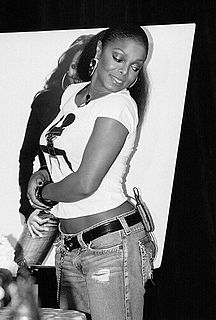
Janet Jackson as a gay icon

Janet Jackson is an American pop singer-songwriter and actress. Jackson garnered a substantial gay following during the 1990s as she gained prominence in popular music. Recognized as a long-term ally of the LGBT community, Jackson received the GLAAD Media Award for Outstanding Music Album for her Grammy Award-winning sixth studio album The Velvet Rope (1997), which spoke out against homophobia and embraced same-sex love. In 2005, Jackson received the Humanitarian Award from the Human Rights Campaign and AIDS Project Los Angeles in recognition of her involvement in raising funds for AIDS Charities and received the Vanguard Award at the 19th Annual GLAAD Media Awards in 2008. In June 2012, Jackson announced she is currently executive producing a documentary on the lives of transgender people around the world titled Truth, saying she agreed to sign on to help stop discrimination against the transgender community.

Transgender rights movement

The transgender rights movement is a movement to promote transgender rights and to eliminate discrimination and violence against transgender people regarding housing, employment, public accommodations, education, and health care. In some jurisdictions, transgender activism seeks to allow changes to identification documents to conform with a person's current gender identity without the need for sex reassignment surgery.

Womyn-born womyn (WBW) is a term developed during second-wave feminism to designate women who were identified as female at birth, were raised as girls, and identify as women.
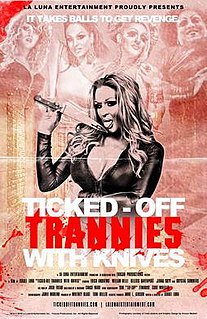
<i>Ticked-Off Trannies with Knives</i> 2010 film by Israel Luna

Ticked-Off Trannies with Knives is a 2010 rape and revenge exploitation film directed by Israel Luna. The film follows a trio of trans women who exact revenge on the men who brutally assault them and murder two of their friends. The film is split into five chapters, one of which is a missing reel.

Carmen Carrera

Carmen Carrera is an American reality television personality, model, burlesque performer, and actress, known for appearing on the third season of the Logo reality television series RuPaul's Drag Race, as well as its spin-off series RuPaul's Drag U. Carrera is a transgender woman.

Feminist views on transgender topics range from accepting to critical. Some feminists such as Judith Butler and Jack Halberstam believe that transgender and transsexual people challenge repressive gender norms and that transgender politics are fully compatible with feminism, while others such as Janice Raymond and Sheila Jeffreys believe that transgender and transsexual people uphold and reinforce sexist gender roles and the gender binary. Additionally, some transgender and transsexual people, such as Julia Serano and Jacob Anderson-Minshall, identify as transfeminists. Feminists with exclusionary views have been referred to as "TERFs". They generally object to the acronym and have called it a slur or even hate speech.

Transsexual pornography is a genre of pornography.

Parker Marie Molloy is an American writer, blogger, and transgender rights activist. Molloy, until the fall of 2014, was an editorial and news contributor to Advocate.com, particularly on transgender issues. She has also written op-eds in a number of other publications. In September 2018, she began working as an editor at large for Media Matters for America.

References

  1. "Tranny", Dictionary.com
  2. "Tranny", The American Heritage Dictionary of the English Language (5th ed.), 2017
  3. 1 2 Dottie Lux; Lil Miss Hot Mess (2017-08-14), "Facebook's Hate Speech Policies Censor Marginalized Users", Wired
  4. GLAAD Media Reference Guide - AP, Reuters & New York Times Style, Gay & Lesbian Alliance Against Defamation
  5. Kaveney, Roz (2010-06-30). "Why trans is in but tranny is out". London: The Guardian . Retrieved 2017-05-18.
  6. Bass, Lance (23 December 2011). "Lance Bass Apologizes For Using The Word 'Tranny'". The Huffington Post. Retrieved 18 May 2017.
  7. "GLAAD's Transgender Resource Page". Gay & Lesbian Alliance Against Defamation. Archived from the original on 2011-01-03.
  8. 1 2 Lowder, J. Bryan (30 May 2014). "Is "Tranny" Always a Slur?". Slate Magazine. Retrieved 18 May 2017.
  9. Nichols, James (2014-05-22). "RuPaul Responds To Controversy Over The Word 'Tranny'". The HuffingtonPost. Retrieved 2017-05-18.
  10. Bornstein, Kate. "Who You Calling A Tranny?". Kate Bornstein is a Queer and Pleasant Danger. Retrieved 24 June 2015.
  11. Williams, Cristan (2014-04-28), Tranny: An Evidence-Based Review, The TransAdvocate, retrieved 2017-05-18
  12. Molloy, Parker Marie (2014-03-14), "'Tranny Awards' Changes Its Name, Not Its Nature", The Advocate