Related Research Articles
Monarda is a monotypic moth genus in the family Sphingidae. Its only species, Monarda oryx, is known from Mexico. Both the genus and species were described by Herbert Druce in 1896.
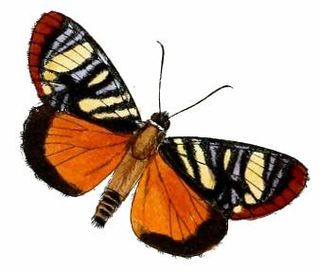
Polacanthopoda tigrina is a moth in the family Noctuidae first described by Herbert Druce in 1882. It is found in Cameroon, the Republic of Congo, the Democratic Republic of Congo, Gabon, Ghana, Guinea, Nigeria and Uganda.

Podomachla chromis is a moth in the family Erebidae first described by Herbert Druce in 1882. It is found in Cameroon, the Democratic Republic of the Congo and Equatorial Guinea.
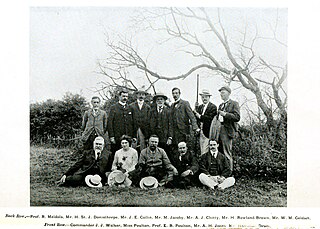
Hamilton Herbert Charles James Druce was an English entomologist who specialised in Lycaenidae and to a lesser extent Hesperiidae. He is not to be confused with his father, the English entomologist Herbert Druce (1846–1913) who also worked on Lepidoptera.
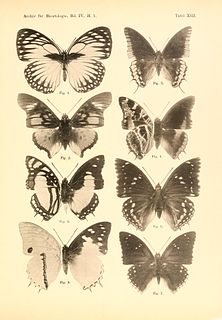
Charaxes acraeoides is a butterfly in the family Nymphalidae first described by Herbert Druce in 1908. It is found in Cameroon, Gabon, the Republic of the Congo, the Central African Republic and the Democratic Republic of the Congo.
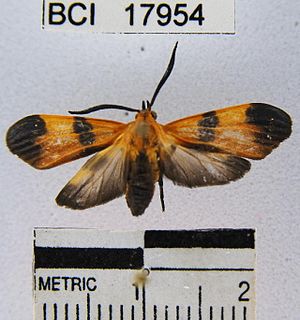
Correbidia elegans is a moth of the subfamily Arctiinae. It was described by Herbert Druce in 1884. It is found in Mexico and Panama.
Ptychoglene phrada is a moth in the subfamily Arctiinae. It was described by Herbert Druce in 1889. It is found in Arizona and Mexico.
Laniifera cyclades is a snout moth in the subfamily Spilomelinae of the family Crambidae. It was described by Herbert Druce in 1895, based on three imagines collected in Mexico City and near Durango City in Mexico. Apart from Mexico, the species is also found in the states of Arizona and Texas in the United States.
Blepharomastix randalis is a moth in the family Crambidae. It was described by Herbert Druce in 1895. It is found in Mexico.
Bocchoropsis pharaxalis is a moth in the family Crambidae. It was described by Herbert Druce in 1895. It is found in Costa Rica.
Hileithia rhealis is a moth in the family Crambidae. It was described by Herbert Druce in 1895. It is found in Guerrero, Mexico.
Phostria buckleyi is a moth in the family Crambidae. It was described by Herbert Druce in 1902. It is named for the naturalist Samuel Botsford Buckley. It is found in Ecuador.
Phostria purpuralis is a moth in the family Crambidae. It was described by Herbert Druce in 1895. It is found in Costa Rica.
Polygrammodes nervosa is a moth in the family Crambidae. It was described by William Warren in 1889. It is found in Brazil and Ecuador.
Polygrammodes quatrilis is a moth in the family Crambidae. It was described by Herbert Druce in 1902. It is found in Venezuela and Colombia.
Psara prumnides is a moth in the family Crambidae. It was described by Herbert Druce in 1895. It is found in Mexico, Costa Rica, Honduras and Panama.
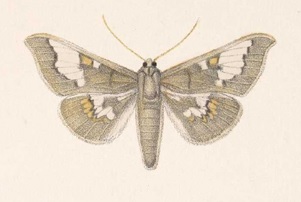
Siga pyronia is a moth in the family Crambidae first described by Herbert Druce in 1895. It is found in Panama and Costa Rica.
Trichaea eusebia is a moth in the family Crambidae. It was described by Herbert Druce in 1902. It is found in Ecuador.
Trichaea pudens is a moth in the family Crambidae. It was described by Herbert Druce in 1902. It is found in Ecuador.
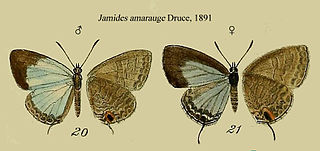
Jamides amarauge, the amarauge cerulean, is a butterfly in the family Lycaenidae. It was described by Hamilton Herbert Druce in 1891. It is found in the Australasian realm.
References
- ↑ Nuss, M.; et al. (2003–2014). "GlobIZ search". Global Information System on Pyraloidea. Retrieved July 15, 2014.
- ↑ Druce, Herbert (May 1902). "Descriptions of some new species of Lepidoptera". Annals and Magazine of Natural History. 7. 9 (53): 321–334. doi:10.1080/00222930208678598 – via Biodiversity Heritage Library.
 | This Spilomelinae-related article is a stub. You can help Wikipedia by expanding it. |