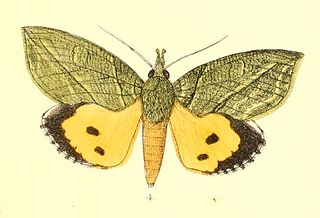
Eudocima hypermnestra is a moth of the family Erebidae described by Pieter Cramer in 1780. It is found in China, Thailand, Taiwan, India and Sri Lanka.

Ischyja manlia is a species of moth of the family Noctuidae first described by Pieter Cramer in 1776. It is found in the Indian subregion, Sri Lanka, Myanmar, Thailand, China, Okinawa, Sundaland, Sulawesi, Korea, the southern Moluccas, Australia (Queensland) and Palau. Adults pierce the skin of fruit to suck the juice.
Ziridava xylinaria, the indistinct carpet, is a moth in the family Geometridae. The species was first described by Francis Walker in 1863. It is found in Sri Lanka, India, Hong Kong and on Peninsular Malaysia, Borneo, Java and possibly the Philippines and Sulawesi.
Bocchoris rufiflavalis is a moth of the family Crambidae. It can be found in Madagascar.
Piletocera agathanalis is a moth in the family Crambidae. It was described by William Schaus in 1924. It is found in Panama.
Sinomphisa junctilinealis is a moth in the family Crambidae. It is found in Sierra Leone and Uganda.
Syllepte microspilalis is a moth in the family Crambidae. It was described by George Hampson in 1912. It is found in Singapore.
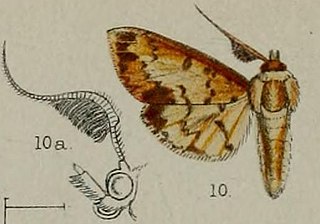
Syllepte plumifera is a moth in the family Crambidae. It was described by George Hampson in 1898. It is found in Indonesia and Papua New Guinea, where it has been recorded from the D'Entrecasteaux Islands.
Syllepte crenilinealis is a moth in the family Crambidae. It was described by George Hampson in 1918. It is found in Western New Guinea, Indonesia.
Syngamia albiceps is a moth in the family Crambidae. It was described by George Hampson in 1912. It is found in Singapore.
Udea diopsalis is a moth in the family Crambidae. It was described by George Hampson in 1913. It is found in Chile.
Udea scoparialis is a moth in the family Crambidae. It was described by George Hampson in 1899. It is found in Tibet, China.
Udea umbriferalis is a moth in the family Crambidae. It was described by George Hampson in 1918. It is found in Peru and Bolivia.
Ulopeza denticulalis is a moth in the family Crambidae. It was described by George Hampson in 1912. It is found in South Africa.
Ulopeza junctilinealis is a moth in the family Crambidae. It was described by George Hampson in 1912. It is found in Indonesia (Bali).
Ulopeza sterictodes is a moth in the family Crambidae. It was described by George Hampson in 1912. It is found in Papua New Guinea.
Ambia melanistis is a moth in the family Crambidae. It was described by George Hampson in 1917 and it is found in Taiwan.
Euphalacra trifenestrata is a moth in the family Drepanidae. It was described by Charles Swinhoe in 1902. It is found on Borneo and Peninsular Malaysia.
Eupterote patula is a moth in the family Eupterotidae. It was described by Francis Walker in 1855. It is found in Thailand, Myanmar and India.

Ichneutica chlorodonta is a moth of the family Noctuidae. This species is endemic to New Zealand. It is found throughout the North, South and Stewart Islands and is associated with native forest and shrubland. It can be confused with similar looking species such as I. subcyprea however I. chlorodonta can be distinguished through differences in colouration of its fore and hind wings as well as the length of the male pectinations. The life history of this species is unknown as are the host species of its larvae but adults of I. chlorodonta are on the wing from September to April.

