
Udea fulvalis is a species of moth of the family Crambidae. It was first described by Jacob Hübner in 1809.
Udea uliginosalis is a species of moth in the family Crambidae. It is found in Great Britain, Spain, France, Germany, Switzerland, Austria, Slovenia, Slovakia, Poland, Romania, Bulgaria, Serbia and Montenegro, Albania and the Republic of Macedonia.
The Barcode of Life Data System is a web platform specifically devoted to DNA barcoding. It is a cloud-based data storage and analysis platform developed at the Centre for Biodiversity Genomics in Canada. It consists of four main modules, a data portal, an educational portal, a registry of BINs, and a data collection and analysis workbench which provides an online platform for analyzing DNA sequences. Since its launch in 2005, BOLD has been extended to provide a range of functionality including data organization, validation, visualization and publication. The most recent version of the system, version 4, launched in 2017, brings a set of improvements supporting data collection and analysis but also includes novel functionality improving data dissemination, citation, and annotation. Before November 16, 2020, BOLD already contained barcode sequences for 318,105 formally described species covering animals, plants, fungi, protists.
Udea mandronalis is a moth in the family Crambidae. It is found in Sri Lanka.
Udea aenigmatica is a moth in the family Crambidae. It was described by Carl Heinrich in 1931. It is found in North America, where it has been recorded from Colorado.
Udea berberalis is a moth in the family Crambidae. It was described by William Barnes and James Halliday McDunnough in 1918. It is found in North America, where it has been recorded from California.
Udea binoculalis is a moth in the family Crambidae. It was described by George Hampson in 1904. It is found on the Bahamas.
Udea diopsalis is a moth in the family Crambidae. It was described by George Hampson in 1913. It is found in Chile.
Udea fusculalis is a moth in the family Crambidae. It was described by George Hampson in 1899. It is found in Mexico (Orizaba), Peru and Loja Province, Ecuador.
Udea indistinctalis is a moth in the family Crambidae. It was described by William Warren in 1892. It is found in North America, where it has been recorded from Alberta, Saskatchewan, Washington and California.
Udea melanostictalis is a moth in the family Crambidae. It was described by George Hampson in 1916. It is found in Kenya.
Udea nigripunctata is a moth in the family Crambidae. It was described by William Warren in 1892. It is found in Peru.
Udea nomophilodes is a moth in the family Crambidae. It was described by George Hampson in 1913. It is found in Chile.
Udea rusticalis is a moth in the family Crambidae. It was described by William Barnes and James Halliday McDunnough in 1914. It is found in North America, where it has been recorded from Arizona.
Udea scoparialis is a moth in the family Crambidae. It was described by George Hampson in 1899. It is found in Tibet, China.
Udea secticostalis is a moth in the family Crambidae. It was described by George Hampson in 1913. It is found in Paraguay and Argentina.

Udea torvalis is a moth in the Crambidae family. It was described by Möschler in 1864. It is found in North America, where it has been recorded from Labrador, Nunavut, the Northwest Territory and Yukon. It has also been recorded from Greenland and Russia.

Udea turmalis is a moth in the family Crambidae. It was described by Augustus Radcliffe Grote in 1881. It is found in North America, where it has been recorded from Alberta, Arizona, British Columbia, California, Colorado, Idaho, Manitoba, Montana, Nevada, New Mexico, Utah and Washington.
Udea vacunalis is a moth in the family Crambidae. It was described by Augustus Radcliffe Grote in 1881. It is found in North America, where it has been recorded from California.
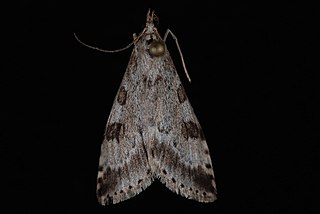
Udea washingtonalis, the Washington udea moth, is a moth in the family Crambidae. It was described by Augustus Radcliffe Grote in 1882. It is found in North America, where it has been recorded from Alaska, British Columbia, California, Montana and Washington.
