
The fieldfare is a member of the thrush family Turdidae. It breeds in woodland and scrub in northern Europe and across the Palearctic. It is strongly migratory, with many northern birds moving south during the winter. It is a very rare breeder in the British Isles, but winters in large numbers in the United Kingdom, Southern Europe, North Africa and the Middle East. It is omnivorous, eating a wide range of molluscs, insects and earthworms in the summer, and berries, grain and seeds in the winter.

The Coteau des Prairies is a plateau approximately 200 miles in length and 100 miles in width, rising from the prairie flatlands in eastern South Dakota, southwestern Minnesota, and northwestern Iowa in the United States. The southeast portion of the Coteau comprises one of the distinct regions of Minnesota, known as Buffalo Ridge.
Bistre can refer to two things: a very dark shade of grayish brown ; a shade of brown made from soot, or the name for a color resembling the brownish pigment. Bistre's appearance is generally of a dark grayish brown, with a yellowish cast.

Maroon is a dark brownish red or dark reddish color that takes its name from the French word marron, or chestnut. "Marron" is also one of the French translations for "brown".

Xenotime is a rare-earth phosphate mineral, the major component of which is yttrium orthophosphate (YPO4). It forms a solid solution series with chernovite-(Y) (YAsO4) and therefore may contain trace impurities of arsenic, as well as silicon dioxide and calcium. The rare-earth elements dysprosium, erbium, terbium and ytterbium, as well as metal elements such as thorium and uranium (all replacing yttrium) are the expressive secondary components of xenotime. Due to uranium and thorium impurities, some xenotime specimens may be weakly to strongly radioactive. Lithiophyllite, monazite and purpurite are sometimes grouped with xenotime in the informal "anhydrous phosphates" group. Xenotime is used chiefly as a source of yttrium and heavy lanthanide metals (dysprosium, ytterbium, erbium and gadolinium). Occasionally, gemstones are also cut from the finest xenotime crystals.

Lukanka is a Bulgarian salami unique to Bulgarian cuisine. It is similar to sujuk, but often stronger flavored. Lukanka is semi-dried, has a flattened cylindrical shape, and brownish-red interior in a skin that is normally covered with a white fungus. The mix of small pieces of meat and fat give the interior a grainy structure.

This is a table of the ranks and insignia of the Mexican Army. Spanish language ranks are in italics, with English translations. Rank insignia of the Mexican Air Force and Mexican Army are identical, as are the ranks, with the exception of two general ranks. Currently the ranks are supported with the Fuerza Aérea ranks for the air force itself only, with special titles in the army for all ranks per their respective specialty.

Auburn hair is a variety of red hair, most commonly described as reddish-brown in color or dark ginger. Auburn hair ranges in shades from medium to dark. It can be found with a wide array of skin tones and eye colors. The chemical pigments that cause the coloration of auburn hair are frequently pheomelanin with high levels of eumelanin; however, the auburn hair is due to a mutated melanocortin 1 receptor gene in Northwestern European people and by a mutated TYRP1 gene in the Melanesians and Austronesians, both genes that reduce the melanin production of the hair cells.

The grizzled giant squirrel is a large tree squirrel in the genus Ratufa found in the highlands of the Central and Uva provinces of Sri Lanka, and in patches of riparian forest along the Kaveri River and in the hill forests of Karnataka, Tamil Nadu and Kerala states of southern India. The International Union for Conservation of Nature (IUCN) lists the species as near threatened due to habitat loss and hunting.

The southern hawker or blue hawker is a species of hawker dragonfly.

The Hainan hare is a hare endemic to Hainan Island, China. The species was first described by Robert Swinhoe in 1870.
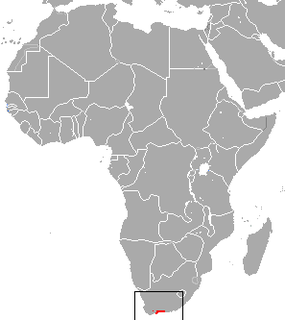
The long-tailed forest shrew, or long-tailed mouse shrew, is a species of mammal in the family Soricidae. It is endemic to South Africa, where its natural habitats are Mediterranean-type shrubby vegetation and swamps.

The satinbirds or cnemophilines, are a family, Cnemophilidae of passerine birds which consists of four species found in the mountain forests of New Guinea. They were originally thought to be part of the birds-of-paradise family Paradisaeidae until genetic research suggested that the birds are not closely related to birds-of-paradise at all and are perhaps closer to berry peckers and longbills (Melanocharitidae). The current evidence suggests that their closest relatives may be the cuckoo-shrikes (Campephagidae).
Psilocybe graveolens is an extremely rare psilocybin mushroom which has psilocybin and psilocin as main active compounds, discovered in the salt marshes or "meadows" of Hackensack, New Jersey. This mushroom is known for its strong and persistent odor.

Grevillea venusta, commonly known as the Byfield spider flower, is a woody shrub of the family Proteaceae native to a small region of central Queensland in eastern Australia. It has bright green leaves and unusually coloured green, gold and blackish inflorescences.

Mie ayam, mi ayam or bakmi ayam is a common Indonesian dish of seasoned yellow wheat noodles topped with diced chicken meat (ayam). It especially common in Indonesia, Singapore and Malaysia, and can trace its origin to Chinese cuisine. In Indonesia, the dish is recognized as a popular Chinese Indonesian dish, served from simple travelling vendor carts frequenting residential areas, humble street-side warung to restaurants.

Xylomelum cunninghamianum is a species of flowering plant in the family Proteaceae and is endemic to eastern Australia. It is a shrub or small tree with narrow elliptic to lance-shaped leaves with toothed edges when young, groups of flowers covered with brownish hairs and oval fruit densely covered with velvety rust-coloured to grey hair.

White-faced capuchin, or white headed capuchin, can refer to either of two species of gracile capuchin monkey:

Titian is a tint of red hair, most commonly described as brownish-orange in color. It is often confused with Venetian and auburn.

Grevillea raybrownii is a shrub of the family Proteaceae native to New South Wales. It was described by Peter Olde and Neil Marriott in 1994.
