
The cinereous vulture is a large raptorial bird that is distributed through much of temperate Eurasia. It is also known as the black vulture, monk vulture, or Eurasian black vulture. It is a member of the family Accipitridae, which also includes many other diurnal raptors such as kites, buzzards and harriers. It is one of the two largest Old World vultures, attaining a maximum size of 14 kg,, 1.2 m long and 3.1 m across the wings.

The cinereous bunting is a bird in the bunting family Emberizidae, a passerine family now separated by most modern authors from the finches, Fringillidae. This species was first described by Hugh Edwin Strickland.
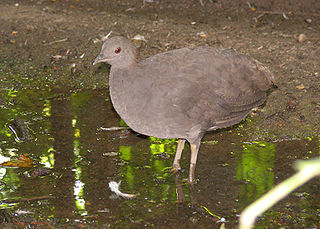
The cinereous tinamou, also known as brushland tinamou, is a type of ground bird found in swamp and lowland forests in northern South America. They have some localized names that have been used by the indigenous people such as in Amazonas where they are called inambu-pixuna, and in Pará, Brazil where they are called nambu-sujo. Also, throughout their range they are called inhambu-preto. Cinereous tinamous have been around for many centuries. They are part of the oldest families of the world today and have fossils discovered dating back tens of millions of years. Their quick reflexes play a role in their ability to survive.
Cinereous is a colour, meaning ashy grey in appearance, either consisting of or resembling ashes, or a grey colour tinged with coppery brown. It is derived from the Latin cinereus, from cinis (ashes).
Cryptobotys is a monotypic moth genus of the family Crambidae described by Eugene G. Munroe in 1956. Its only species, Cryptobotys zoilusalis, was described by Francis Walker in 1859. It is found in Cuba, Jamaica, Puerto Rico, Central America and the southern United States, where it has been recorded from Florida.
Assara albicostalis is a moth of the family Pyralidae. It has a wide distribution and has been recorded from India, Sri Lanka, Thailand, Sabah, the Philippines, Taiwan, Sulawesi, Australia, Fiji, Tahiti, Samoa, Hawaii and the Marquesas. This is the type species of genus Assara.
Bapara obliterosa is a species of snout moth in the genus Bapara. It was described by Francis Walker in 1865 and is known from New Guinea and the D'Entrecasteaux Islands.
Agriphila attenuata is a moth in the family Crambidae. It was described by Augustus Radcliffe Grote in 1880. It is found in North America, where it has been recorded from coastal California, Washington, Wyoming, British Columbia and Alberta. The habitat consists of grasslands.
Pyrausta insularis is a moth in the family Crambidae. It is found in Cuba.
Pyrausta napaealis is a moth in the family Crambidae. It was described by George Duryea Hulst in 1886. It is found in the United States, where it has been recorded from Washington to California and west to Arizona, Nevada, New Mexico and Texas. It is also found in northern Mexico.
Scoparia epigypsa is a moth in the family Crambidae. It was described by Oswald Bertram Lower in 1902. It is found in Australia, where it has been recorded from New South Wales.

Clupeosoma cinerea is a moth in the family Crambidae. It was described by William Warren in 1892. It is found in Japan, Borneo, China, Russia and Taiwan.
Cirrhochrista cydippealis is a moth in the family Crambidae. It was described by Francis Walker in 1859 and it is found on Borneo.
Cnaphalocrocis cochrusalis, the marasmia moth, is a moth in the family Crambidae. It is found in the West Indies, Costa Rica, Honduras and the United States, where it has been recorded from Florida, Louisiana, Mississippi, Oklahoma, South Carolina and Texas.
Psara dryalis is a moth in the family Crambidae. It was described by Francis Walker in 1859. It is found in the Dominican Republic, Puerto Rico, Jamaica, Cuba and from the southwestern United States to Central America.
Salbia tytiusalis is a moth in the family Crambidae. It was described by Francis Walker in 1859. It is found in Florida, the West Indies and Central America, including Honduras.
Samea sylvialis is a moth in the family Crambidae. It is found in Brazil, Venezuela and Costa Rica.
Sufetula sunidesalis is a moth in the family Crambidae. It was described by Francis Walker in 1859. It is found on Borneo and in India, Sri Lanka and Malaysia.
Udea ialis is a moth in the family Crambidae. It was described by Francis Walker in 1859. It is found in Brazil and Bolivia.
Voliba scoparialis is a moth in the family Crambidae. It was described by Francis Walker in 1866. It is found in Australia, where it has been recorded from New South Wales.
