
Minnehaha County is a county on the eastern border of the state of South Dakota. As of the 2010 United States Census, the population was 169,468, making it the state's most populous county. Its county seat is Sioux Falls, South Dakota's largest city. The county was created in 1862 and organized in 1868. Its name was derived from the Sioux word Mnihaha, meaning "rapid water," or "waterfall".

Webb is the northernmost town in Herkimer County, New York, United States. As of the 2010 census it had a population of 1,807.

Minnehaha Park is a city park in Minneapolis, Minnesota, United States, and home to Minnehaha Falls and the lower reaches of Minnehaha Creek. Officially named Minnehaha Regional Park, it is part of the Minneapolis Park and Recreation Board system and lies within the Mississippi National River and Recreation Area, a unit of the National Park Service. The park was designed by landscape architect Horace W.S. Cleveland in 1883 as part of the Grand Rounds Scenic Byway system, and was part of the popular steamboat Upper Mississippi River "Fashionable Tour" in the 1800s.
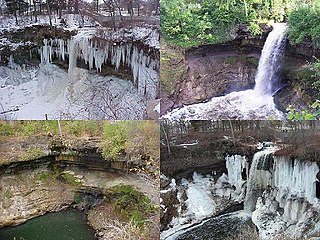
Minnehaha Creek is a 22-mile-long (35 km) tributary of the Mississippi River that flows east from Gray's Bay Dam on Lake Minnetonka through the suburban cities of Minnetonka, Hopkins, Saint Louis Park, and Edina, and the city of Minneapolis. The creek flows over Minnehaha Falls in Minnehaha Park near its mouth at the Mississippi River.

50th Street/Minnehaha Park is a light rail station on the Blue Line in Minneapolis, Minnesota, United States.
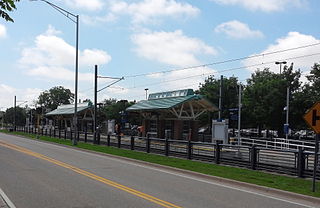
VA Medical Center station is a light rail station on the Blue Line on Fort Snelling in the Twin Cities region of Minnesota.

Minnehaha is a fictional Native American woman documented in Henry Wadsworth Longfellow's 1855 epic poem The Song of Hiawatha. She is the lover of the titular protagonist Hiawatha and comes to a tragic end. The name, often said to mean "laughing water", literally translates to "waterfall" or "rapid water" in Dakota.

The Grand Rounds National Scenic Byway is a linked series of park areas in Minneapolis, Minnesota, United States, that takes a roughly circular path through the city. The Minneapolis Park and Recreation Board developed the system over many years. The corridors include roads for automobile traffic plus separate paths for pedestrians and bicycles, and extend slightly into neighboring cities. About 50 miles (80 km) of roadway and paths are in the system, and much of it was built in the 1930s as part of Civilian Conservation Corps projects.
SS Minnehaha was a 13,443-ton ocean liner built by Harland and Wolff and launched on 31 March 1900. Operated by the American-owned Atlantic Transport Line, she was the sister ship of Minneapolis, Minnetonka, and Minnewaska.

Minnehaha Springs is an unincorporated community located in Pocahontas County, West Virginia, United States. It was named for the fictional Native American "princess," Minnehaha, and the mineral springs on the Lockridge farm. It is the only community with this name in the United States. On the site of what is now Camp Twin Creeks warm mineral springs can still be found.

Minnehaha Academy is a Christian private school in Minneapolis, Minnesota, United States, for students in preschool through 12th grade, and established in 1913. There are two campuses, the South Campus for preschool through 8th graders, and the North Campus, for 9th through 12th graders. It is a ministry of the Northwest Conference of the Evangelical Covenant Church, and is located in the Cooper and Hiawatha neighborhoods on West River Parkway. The student body is drawn from Minneapolis, St. Paul, and throughout the Minneapolis–Saint Paul metropolitan area, as well as several international students.

Longfellow is a defined community in Minneapolis, Minnesota which includes five smaller neighborhoods inside of it: Seward, Cooper, Hiawatha, Howe and Longfellow. Grouped with South Minneapolis between the city's eastern border with the Mississippi River and the Metro Blue Line, Longfellow takes its name from Longfellow neighborhood which in turn is named after Henry Wadsworth Longfellow. The renowned American poet incorporated elements into his poem The Song of Hiawatha from Henry Schoolcraft's accounts of native Dakota lore in Minnesota which included Minnehaha Falls in Longfellow's southern tip. The early reference of Highway 55 as Hiawatha Avenue, along the west border, may have influenced the naming decision when community borders were drawn in the 1960s. Hiawatha Avenue is the main thoroughfare leading north into Downtown Minneapolis and south to the Minneapolis-Saint Paul Airport.

Minnehaha is a neighborhood in the Nokomis community in Minneapolis, Minnesota. Its boundaries are Minnehaha Parkway to the north, Hiawatha Avenue to the east, 54th Street to the south, and 34th Avenue to the west. It shares a neighborhood organization with the Keewaydin, Morris Park, and Wenonah neighborhoods, which are collectively referred to as Nokomis East and served by the Nokomis East Neighborhood Association (NENA).

Minnehaha was a sternwheel-driven steamboat which was built in 1866 on Oswego Lake, then known as Sucker Lake, in Oregon, United States. Minnehaha was later transferred to the Willamette and Columbia rivers where it operated for the first part of the 1870s.

Minnehaha is a populated place situated in Yavapai County, Arizona. It has an estimated elevation of 5,469 feet (1,667 m) above sea level.
Snelling & Minnehaha is a bus rapid transit station on the METRO A Line in Saint Paul, Minnesota.
46th Street & Minnehaha is a bus rapid transit station on the METRO A Line in Minneapolis, Minnesota.

Minnehaha Trail is a 1.5-mile (2.4 km) paved, multi-use trail in Minneapolis, Minnesota, United States, that connects Minnehaha Regional Park and Fort Snelling State Park – two of the most popular recreation destinations in the Twin Cities metro area. The trail is considered a segment of a longer, loosely connected bicycle route system along the Mississippi River. Users of Minnehaha Trail traverse under a forest canopy. The trail received local recognition for its natural beauty, but it was criticized for its worn pavement and lack of signage.

Minnehaha Falls Lower Glen Trail is a popular hiking route in Minneapolis, Minnesota, United States. The 2.1-mile (3.4 km) trail loop begins and ends at the base of the iconic Minnehaha Falls. Hikers follow natural trails and elevated boardwalks through a sedimentary rock glen carved by Minnehaha Creek to its confluence with the Mississippi River where there is a sandy beach. Portions of the trail loop are rated moderate to challenging in difficulty.
