Description
Loudon thought the tree resembled his 'Cucullata' (probably the cultivar later called Ulmus montana cucullataHort.). [5] Petzold and Kirchner in Arboretum Muscaviense (1864) described the leaves of their Ulmus campestris concavaefolia, as short and rounded, dark green above and whitish green below, "more or less concave", that is, curling upwards at the edges so that the pale underside is more prominent than the darker upper (a description, as Henry noted, that matches 'Webbiana'). They noted that the leaves of their var. concavaefolia were smaller than those of their var. cucullata (again, probably Ulmus montana cucullataHort.), but not dissimilar in shape. [6]
Cultivation
If synonymous with 'Webbiana', 'Concavaefolia' is rare but remains in cultivation.
Royal Victoria Park, Bath had three Ulmus campestris var. concavaefolia, "concave-leaved field elm", in the second half of the 19th century and in the early 20th, Frederick Hanham describing them in 1857 as "a very ornamental and beautiful variety". He added that the tree was "frequently mistaken and sold in the nurseries for Ulmus montana crispa, though there is a wide difference between them". [7] The Bath trees could not have been 'Webbiana' either, as they were still present in 1902 when they were listed separately from the park's Webb's elm. [8] They may, however, have been the cultivar sometimes called Ulmus scabra concavaefolia, as this striking elm was in cultivation at the time but appeared on neither 1857 nor 1902 Bath list. Though currently (2025) classified as a wych cultivar, its leaves are smaller than the type, and may have passed for field elm in the 19th century.
See also 'Convex-leaved field elms' below.
Convex-leaved field elms
A young, fastigiate, suckering, convex-leaved U. minor cultivar (concave from the underside), stood in the yard of St James's Church, Constitution Street, Leith, till 2017, where an 1882 print showed a narrow elm-like tree, probably the original planting. [9] [10] Its sucker regrowth remains. A second similar convex-leaved suckering field elm stands in East Fettes Avenue, Edinburgh. The leaves of both resemble those of sweet basil, unlike Petzold and Kirchner's var. concavaefolia (probably 'Webbiana').
Convex-leaved field elm, St James's Church, Charlotte Street, Leith
Stems of same
Foliage of same
Convex-leaved field elm, East Fettes Avenue, Edinburgh
Foliage of same
Foliage, underside
For a convex-leaved field elm with a more elongated, rather hooded leaf, distributed erroneously by the Späth nursery of Berlin for a short time in the early 20th century as Ulmus racemosa, in cultivation in Brighton and Edinburgh, see 'Cucullata'. No cultivar names are known for convex-leaved field elms.
This page is based on this
Wikipedia article Text is available under the
CC BY-SA 4.0 license; additional terms may apply.
Images, videos and audio are available under their respective licenses.
 Convex-leaved field elm, St James's Church, Charlotte Street, Leith
 Stems of same
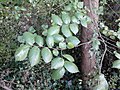 Foliage of same
 Convex-leaved field elm, East Fettes Avenue, Edinburgh
 Foliage of same
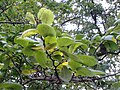 Foliage, underside


