In the English language, a split infinitive or cleft infinitive is a grammatical construction in which a word or phrase comes between the to and the bare infinitive of the to form of the infinitive verb. Usually an adverb or adverbial phrase comes between them.

A Dictionary of Modern English Usage (1926), by Henry Watson Fowler (1858–1933), is a style guide to British English usage, pronunciation, and writing. Covering topics such as plurals and literary technique, distinctions among like words, and the use of foreign terms, the dictionary became the standard for other guides to writing in English. Hence, the 1926 first edition remains in print, along with the 1965 second edition, edited by Ernest Gowers, and reprinted in 1983 and 1987. The 1996 third edition, re-titled as The New Fowler's Modern English Usage was mostly rewritten by Robert W. Burchfield, as a usage dictionary that incorporated corpus linguistics data; and the 2015 fourth edition, re-titled Fowler's Dictionary of Modern English Usage, edited by Jeremy Butterfield, takes the same approach as the third edition. Informally, users refer to the dictionary as Fowler's Modern English Usage, Fowler, and Fowler's.
In English writing, quotation marks or inverted commas, also known informally as quotes, talking marks, speech marks, quote marks, quotemarks or speechmarks, are punctuation marks placed on either side of a word or phrase in order to identify it as a quotation, direct speech or a literal title or name. They are also used to indicate that the meaning of the word or phrase they surround should be taken to be different from that typically associated with it ; in this way, they are often used to express irony. They also sometimes appear to be used as a means of adding emphasis, although this usage is usually considered incorrect.
In the English language, there are grammatical constructions that many native speakers use unquestioningly yet certain writers call incorrect. Differences of usage or opinion may stem from differences between formal and informal speech and other matters of register, differences among dialects, and so forth. Disputes may arise when style guides disagree with each other, or when a guideline or judgement is confronted by large amounts of conflicting evidence or has its rationale challenged.
In English language punctuation, a serial comma or series comma is a comma placed immediately before the coordinating conjunction in a series of three or more terms. For example, a list of three countries might be punctuated either as "France, Italy, and Spain", or as "France, Italy and Spain".
The Latin adverb sic inserted after a quoted word or passage indicates that the quoted matter has been transcribed or translated exactly as found in the source text, complete with any erroneous, archaic, or otherwise nonstandard spelling. It also applies to any surprising assertion, faulty reasoning, or other matter that might be likely interpreted as an error of transcription.
Irregardless is a word sometimes used in place of regardless or irrespective, which has caused controversy since the early twentieth century, though the word appeared in print as early as 1795. Most dictionaries list it as non-standard or incorrect usage, and recommend that "regardless" should be used instead.
According to prescriptive grammar, "fewer" should be used with nouns for countable objects and concepts. According to this rule, "less" should be used only with a grammatically singular noun. However, descriptive grammarians point out that this rule does not correctly describe the most common usage of today or the past and in fact arose as an incorrect generalization of a personal preference expressed by a grammarian in 1770.
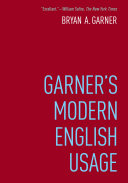
Garner's Modern English Usage (GMEU), written by Bryan A. Garner and published by Oxford University Press, is a usage dictionary and style guide for contemporary Modern English. It was first published in 1998 as A Dictionary of Modern American Usage, with a focus on American English, which it retained for the next two editions as Garner's Modern American Usage (GMAU). It was expanded to cover English more broadly in the 2016 fourth edition, under the present title. The work covers issues of usage, pronunciation, and style, from distinctions among commonly confused words and phrases and notes on how to prevent verbosity and obscurity. In addition, it contains essays about the English language. An abridged version of the first edition was also published as The Oxford Dictionary of American Usage and Style in 2000.

A style guide or manual of style is a set of standards for the writing, formatting and design of documents. It is often called a style sheet, although that term may have other meanings. These standards can be applied either for general use, or be required usage for an individual publication, a particular organization, or a specific field.
A false, coined, fake, bogus or pseudo-title, also called a Time-style adjective and an anarthrous nominal premodifier, is a kind of appositive phrase before a noun. It is said to formally resemble a title, in that it does not start with an article, but is a common noun phrase, not a title. An example is the phrase convicted bomber in "convicted bomber Timothy McVeigh".

The Sense of Style: The Thinking Person's Guide to Writing in the 21st Century is a 2014 English style guide written by cognitive scientist, linguist and popular science author Steven Pinker. Building upon earlier guides, such as Strunk & White's The Elements of Style and Fowler's A Dictionary of Modern English Usage, it applies science to the process of writing, and explains its prescriptions by citing studies in related fields – e.g., grammatical phenomena, mental dynamics, and memory load – as well as history and criticism, to "distinguish the rules that enhance clarity, grace, and emotional resonance from those that are based on myths and misunderstandings".
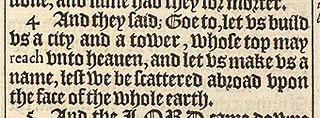
The inanimate whose refers to the use in English of the relative pronoun whose with non-personal antecedents, as in: "That's the car whose alarm keeps waking us up at night." The construction is also known as the whose inanimate, non-personal whose, and neuter whose.