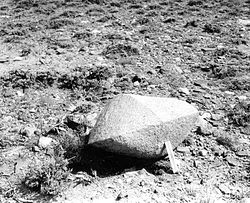
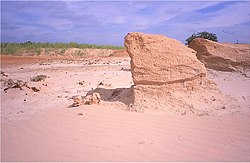
A ventifact (also wind-faceted stone, windkanter[1]) is a rock that has been abraded, pitted, etched, grooved, or polished by wind-driven sand or ice crystals.[2] The word "Ventifact" is derived from the Latin word "Ventus" meaning 'wind'. These geomorphic features are most typically found in arid environments where there is little vegetation to interfere with aeolian particle transport, where there are frequently strong winds, and where there is a steady but not overwhelming supply of sand.
Ventifacts are formed by a variety of factors, including the type of parent rock, wind speed and direction, size of aeolian particles, landscape variations, and the duration of this process. Studying ventifacts can lead to historical observations regarding landscape formation[3]. Scientists use ventifacts to describe both erosion processes and dominant wind patterns, which are used for both historical and future purposes. Many ventifacts on Earth are also influenced by the effects of water, which leads to studies on the planet Mars, where water is almost nonexistent[4].
Types of Ventifacts
Various types of features can be attributed to ventifacts, including flutes, pits, and grooves. Flutes are etched divots in the face of the rock; pits are rounded portions of the rock that have been removed; grooves are smooth, meandering carvings[5]. These formations are caused as sand particles blown onto rocks slowly etch away at weak points in the structure.
Ventifacts can be abraded to eye-catching natural sculptures such as the main features of the White Desert National Park near Farafra Oasis in Egypt. In moderately tall, isolated rock outcrops, mushroom-shaped pillars of rock may form as the outcrop is eroded by saltating sand grains. This occurs because, even in strong winds, sand grains cannot be continuously held in the air. Instead, the particles bounce along the ground, rarely reaching higher than a few feet above the Earth. Over time, the bouncing sand grains can erode the lower portions of a ventifact, while leaving a larger, less-eroded cap. The resulting forms thus frequently resemble fantastical stonemushrooms.
Individual stones, such as those forming desert pavement, are often found with grooved, etched, or polished surfaces where these same wind-driven processes have slowly worn away the rock.
Ventifacts are typically of three types:
Einkanters having one polished side (excluding the bottom part) (the German word 'ein' means 'one')
Zweikanters having two polished sides (excluding the bottom part) (the German word 'zwei' means 'two')
Dreikanters having three polished surface (excluding the polished surface at bottom) that meet up at sharp angles (the German word 'drei' means 'three')[6]
When ancient ventifacts are preserved without being moved or disturbed, they may serve as a paleo-wind indicators. The wind direction at the time the ventifact formed will be parallel to grooves or striations cut into the rock.
Ventifacts have also been discovered on Mars, where such sharp immobile rocks have caused significant damage to the wheels of the Curiosity rover.[7] An example of a Martian ventifact was named Jake Matijevic. By analyzing its shape, it was possible to reconstruct the main wind direction which sculpted the rock.[8]
Ventifact Knobs– Geographic feature in AntarcticaPages displaying short descriptions of redirect targets, Antarctica
References
↑Klaus K. E. Neuendorf, Glossary of Geology, p. 723
↑Laity, Julie E. (2009). "19. Landforms, landscapes, and processes of aeolian erosion". In Parsons, Anthony J.; Abrahams, Athol D. (eds.). Geomorphology of desert environments (2nd.ed.). [Dordrecht]: Springer. pp.597–628. ISBN978-1402057199.
This page is based on this Wikipedia article Text is available under the CC BY-SA 4.0 license; additional terms may apply. Images, videos and audio are available under their respective licenses.