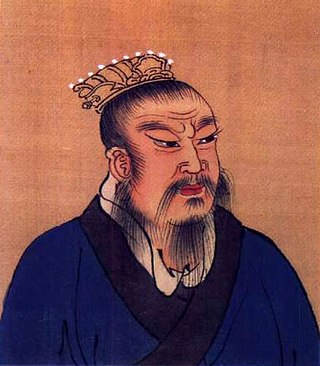
Emperor Gaozu of Han, also known by his given name Liu Bang (劉邦), was the founder and first emperor of the Han dynasty, reigning from 202 to 195 BC. He is considered by traditional Chinese historiography to be one the greatest emperors in history, credited with establishing the Pax Sinica, one of China's longest golden ages.
Liu Bian, also known as Emperor Shao of Han and the Prince of Hongnong, was the 13th emperor of the Eastern Han dynasty in China. He became emperor around the age of 13 upon the death of his father, Emperor Ling, and ruled briefly from 15 May to 28 September 189 before he was deposed, after which he became known as the "Prince of Hongnong". His emperor title, "Emperor Shao", was also used by other emperors who were in power for very short periods of time. In March 190, he was poisoned by Dong Zhuo, the warlord who deposed him and replaced him with his younger half-brother, Liu Xie.
Empress He, personal name unknown, posthumously known as Empress Lingsi, was an empress of the Eastern Han dynasty. She was the second empress consort of Emperor Ling and the mother of Emperor Shao. After the death of Emperor Ling in 189, she became empress dowager when her young son, Liu Bian, became the new emperor. She was caught up in the conflict between her brother, General-in-Chief He Jin, and the eunuch faction, who were both vying for power in the Han imperial court. After He Jin's assassination and the elimination of the eunuch faction, the warlord Dong Zhuo took advantage of the power vacuum to lead his forces into the imperial capital and seize control of the Han central government. Dong Zhuo subsequently deposed Emperor Shao replaced him with Liu Xie and had Empress Dowager He poisoned to death.

Han Xin was a Chinese military general and politician who served Liu Bang during the Chu–Han Contention and contributed greatly to the founding of the Han dynasty. Han Xin was named as one of the "Three Heroes of the early Han dynasty", along with Zhang Liang and Xiao He.

Zhuge Dan, courtesy name Gongxiu, was a Chinese military general and politician of the state of Cao Wei during the Three Kingdoms period of China. When he held key military appointments throughout his middle to late career, he was involved in all of the three rebellions which broke out in Shouchun between 251 and 258. During the second rebellion, he actively assisted the Wei regent Sima Shi in suppressing the revolt. After the rebellion, the Wei government put him in charge of Shouchun. As the Sima clan became more powerful and established themselves as the de facto rulers of Wei, Zhuge Dan feared that he would end up slain like Wang Ling and Guanqiu Jian – the leaders of the first two rebellions – so he started the third rebellion against Sima Zhao, who succeeded Sima Shi as regent of Wei in 255. Although he received some support from Wei's rival state Eastern Wu, his rebellion was eventually suppressed by Wei imperial forces and he met his end at the hands of Hu Fen, a military officer under Sima Zhao.
Fei Shi, courtesy name Gongju, was an official of the state of Shu Han during the Three Kingdoms period of China.
Yu Fan, courtesy name Zhongxiang, was a Chinese essayist, politician, and writer of the state of Eastern Wu during the Three Kingdoms period of China. Initially a minor officer under Wang Lang, the Administrator of Kuaiji Commandery, Yu Fan later served under the warlord Sun Ce, who conquered the territories in the Jiangdong region in a series of campaigns from 194 to 199. Sun Ce regarded him highly and once enlisted his help in persuading Hua Xin, another commandery administrator, to surrender. After Sun Ce's death, Yu Fan continued serving under Sun Quan, Sun Ce's younger brother and successor, as a Cavalry Commandant. Sun Quan confined him for some time due to his rude and disrespectful behaviour, but released him in 219 and allowed him to accompany the general Lü Meng to attack Jing Province. During the Jing Province campaign, Yu Fan warned Lü Meng about a possible ambush when Lü Meng was celebrating a minor victory, and was proven right later.
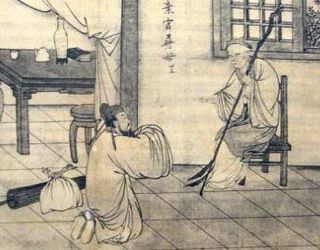
The Twenty-four Filial Exemplars, also translated as The Twenty-four Paragons of Filial Piety, is a classic text of Confucian filial piety written by Guo Jujing (郭居敬) during the Yuan dynasty (1260–1368). The text was extremely influential in the medieval Far East and was used to teach Confucian moral values.
This article contains the family trees of members of the Cao clan, who ruled the state of Cao Wei (220–265) in the Three Kingdoms period (220–280) in China. Only Cao Cao's lineage is shown in this article. The lineages of his relatives, such as Cao Ren, Cao Zhen and others, are not included here.
Xun Can, courtesy name Fengqian, was a Chinese xuanxue philosopher of the state of Cao Wei in the Three Kingdoms period of China. He was a son of Xun Yu.

The Battle of Handan began in 259 BC and concluded in 257 BC, during which the garrison of Handan, the capital city of Zhao, joined by the allied force of Wei and Chu, defeated the invading army of Qin. It was one of the most remarkable failures of the Qin army after the Reform of Shang Yang.

Liu Kun, courtesy name Yueshi, was a Chinese military general and poet of the Jin dynasty. An esteemed writer during the early years of his career, he was also known for his time as the Inspector of Bingzhou, during which he spearheaded Jin's efforts in fighting back against the Xiongnu-led Han-Zhao dynasty. Despite his determination and active role in the war against Han, he lacked the sufficient military and administrative skills to quash the growing Han threat, suffering repeated defeats and having to heavily rely on his alliance with the Tuoba-Xianbei. He was eventually driven out from Bingzhou following a decisive defeat to Shi Le in 316 and fled to Youzhou, where he allied with the chieftain, Duan Pidi. After Pidi suspected him of betrayal, he was arrested and executed via strangulation in 318.
Xi Jian, courtesy name Daohui, was a Chinese military general of the Jin dynasty (266–420). During the time of the Disaster of Yongjia, he led the refugees from his hometown to Yanzhou in 312 to escape the chaos in the north. They later fled to the south as Later Zhao were close to conquering the province. Under the Eastern Jin dynasty, Xi Jian became an important leading figure, standing with the likes of Wen Jiao and Tao Kan who greatly contributed to the dynasty's survival during the rebellions of Wang Dun and Su Jun. His name can be rendered as Chi Jian.
Huan Yi, courtesy name Shuxia was a Chinese military general and musician of the Jin dynasty (266–420). He was a very popular administrator among the people of Yuzhou, from his early days of Prefect of Huainan to Inspector of the province. He participated in the famous Battle of Fei River in 383, fighting alongside Xie Xuan as they repel Former Qin forces. Outside his military career, Huan Yi was most known for was his contribution in music. It is believed that he was the original composer of the popular guqin composition "Mei Hua Sannong (梅花三弄)" or "3 Variations on the Plum Blossom".
Xu Guang, courtesy name Jiwu, was a minister of Later Zhao during the Sixteen Kingdoms period. He was captured by Shi Le's general Wang Yang (王陽) and served as a servant, but after discovering his potential, he was recruited into Shi Le's army instead. Misconducts by Xu Guang angered Shi Le who had him and family imprisoned in 326. However, Xu Guang won Shi Le's favour back in 328, after his advice earned them a victory over Zhao's rival Han-Zhao. As he became a prominent member of the administration, Xu Guang tried to reduce the power of Shi Le's nephew, Shi Hu but could not convince Shi Le to fully remove him. Shi Hu resented him for this, and after his coup in 333, Shi Hu had him and his ally Cheng Xia executed.
Shao Xu, courtesy name Sizu, was a military general and warlord of the Jin dynasty (266–420). Shao Xu was an official under the Youzhou warlord, Wang Jun but after Wang was killed in 314, he submitted to Han-Zhao. In 315, Shao Xu declared his allegiance to Sima Rui in the south and revolted against Han. Shao Xu served as a loyal Jin vassal in Jizhou where he allied himself with the Duan chieftain, Duan Pidi before he was eventually captured by Shi Le in 320. Shi Le respected Shao Xu's loyalty and initially treated him as a guest. However, Shi Le became worried that he would rebel, and in 321, had him executed along with Duan Pidi.
Wang Yan, courtesy name Yifu, was a Chinese politician. He served as a minister and was one of the pure conversation leaders of the Jin dynasty (266–420). During the reign of Emperor Hui of Jin, Wang Yan grew popular among the court for his mastery in Qingtan and for being a patron of Xuanxue. Wang Yan vacillated between the warring princes during the War of the Eight Princes until he ended up with Sima Yue, who gave him a considerable amount of power in his administration. After Yue died in April 311, Wang Yan led his funeral procession but was ambushed and later executed by the Han-Zhao general, Shi Le at Ningping City. Though a bright scholar, Wang Yan was often associated by traditional historians as one of the root causes for Western Jin's demise due to his influential beliefs.
Pei Wei, courtesy name Yimin, was a Chinese essayist, philosopher, physician, and politician of the Western Jin dynasty. He was the cousin of Jia Nanfeng and rose to prominence during the reign of her husband, the Emperor Hui of Jin. Pei Wei was seen by traditional historian as one of Empress Jia's exemplary supporters along with Zhang Hua and Jia Mo. He pushed for a number of significant reforms during his tenure which met with mixed success before his execution by the Prince of Zhao, Sima Lun, in 300 following Sima Lun's coup.

Wang Hun, courtesy name Xuanchong, was a Chinese military general and politician of Cao Wei during the Three Kingdoms period and Western Jin dynasty period. He spent most of his early career serving at the eastern borders of Jin and Eastern Wu, where he occasionally battled with the southern state. He was most known for his role in the Conquest of Wu between 279 and 280, during which he destroyed Wu's main forces under Zhang Ti, as well as his subsequent dispute with Wang Jun, who he accused of going against orders by capturing Jianye on his own and stealing Wang Hun's chance at glory. Despite the controversy surrounding him following the conquest, he remained an accomplished and well-respected figure within the state.
Liu Ji'en, also known in historiography as Shaozhu of Northern Han , was the third emperor of China's Northern Han dynasty during the Five Dynasties and Ten Kingdoms period. He ruled for 60 days in 968 before being killed.
