
The water resources of China are affected by both severe water shortages and severe growing population and rapid economic development as well as lax environmental oversight have increased in a large scale the water demand and pollution. China has responded by measures such as rapidly building out the water infrastructure and increasing regulation as well as exploring a number of further technological solutions.
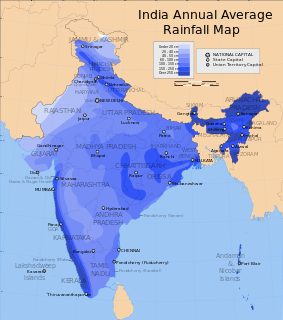
Water resources in India includes information on precipitation, surface and groundwater storage and hydropower potential. India experiences an average precipitation of 1,170 millimetres (46 in) per year, or about 4,000 cubic kilometres (960 cu mi) of rains annually or about 1,720 cubic metres (61,000 cu ft) of fresh water per person every year. India accounts for 18% of the world population and about 4% of the world’s water resources. One of the solutions to solve the country’s water woes is to create Indian Rivers Inter-link.c Some 80 percent of its area experiences rains of 750 millimetres (30 in) or more a year. However, this rain is not uniform in time or geography. Most of the rains occur during its monsoon seasons, with the north east and north receiving far more rains than India's west and south. Other than rains, the melting of snow over the Himalayas after winter season feeds the northern rivers to varying degrees. The southern rivers, however experience more flow variability over the year. For the Himalayan basin, this leads to flooding in some months and water scarcity in others. Despite extensive river system, safe clean drinking water as well as irrigation water supplies for sustainable agriculture are in shortage across India, in part because it has, as yet, harnessed a small fraction of its available and recoverable surface water resource. India harnessed 761 cubic kilometres (183 cu mi) (20 percent) of its water resources in 2010, part of which came from unsustainable use of groundwater. Of the water it withdrew from its rivers and groundwater wells, India dedicated about 688 cubic kilometres (165 cu mi) to irrigation, 56 cubic kilometres (13 cu mi) to municipal and drinking water applications and 17 cubic kilometres (4.1 cu mi) to industry.
Water supply and sanitation in Saudi Arabia is characterized by challenges and achievements. One of the main challenges is water scarcity. In order to overcome water scarcity, substantial investments have been undertaken in seawater desalination, water distribution, sewerage and wastewater treatment. Today about 50% of drinking water comes from desalination, 40% from the mining of non-renewable groundwater and only 10% from surface water in the mountainous southwest of the country. The capital Riyadh, located in the heart of the country, is supplied with desalinated water pumped from the Persian Gulf over a distance of 467 km. Water is provided almost for free to residential users. Despite improvements, service quality remains poor, for example in terms of continuity of supply. Another challenge is weak institutional capacity and governance, reflecting general characteristics of the public sector in Saudi Arabia. Among the achievements is a significant increase in desalination, and in access to water, the expansion of wastewater treatment, as well as the use of treated effluent for the irrigation of urban green spaces, and for agriculture.
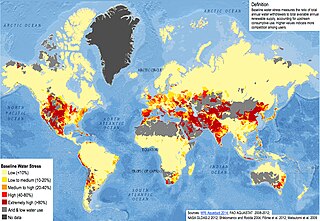
Water scarcity is the lack of fresh water resources to meet the standard water demand. Humanity is facing a water crisis, due to unequal distribution resulting in some very wet and some very dry geographic locations, plus a sharp rise in global freshwater demand in recent decades driven by industry. Water scarcity can also be caused by droughts, lack of rainfall, or pollution. This was listed in 2019 by the World Economic Forum as one of the largest global risks in terms of potential impact over the next decade. It is manifested by partial or no satisfaction of expressed demand, economic competition for water quantity or quality, disputes between users, irreversible depletion of groundwater, and negative impacts on the environment. Two-thirds of the global population live under conditions of severe water scarcity at least 1 month of the year. Half a billion people in the world face severe water scarcity all year round. Half of the world's largest cities experience water scarcity.

Peak water is a concept that underlines the growing constraints on the availability, quality, and use of freshwater resources.
While Peru accounts for about four per cent of the world's annual renewable water resources, over 98% of its water is available east of the Andes, in the Amazon region. The coastal area of Peru, with most of economic activities and more than half of the population, receives only 1.8% of the national freshwater renewable water resources. Economic and population growth are taking an increasing toll on water resources quantity and quality, especially in the coastal area of Peru.
Water resources management is a significant challenge for Mexico. The country has in place a system of water resources management that includes both central (federal) and decentralized institutions. Furthermore, water management is imposing a heavy cost to the economy.
Water supply and sanitation in Iran has witnessed some important improvements, especially in terms of increased access to urban water supply, while important challenges remain, particularly concerning sanitation and service provision in rural areas. Institutionally, the Ministry of Energy is in charge of policy and provincial companies are in charge of service provision.
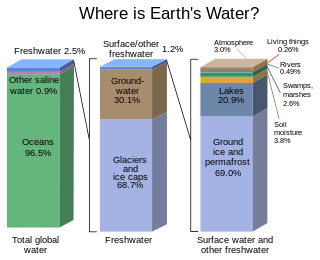
Water resources are natural resources of water that are potentially useful as a source of water supply. 97% of the water on the Earth is salt water and only three percent is fresh water; slightly over two thirds of this is frozen in glaciers and polar ice caps. The remaining unfrozen freshwater is found mainly as groundwater, with only a small fraction present above ground or in the air. Natural sources of fresh water include surface water, under river flow, groundwater and frozen water. Artificial sources of fresh water can include treated wastewater and desalinated seawater.
Water supply and sanitation in Israel are intricately linked to the historical development of Israel. Because rain falls only in the winter, and largely in the northern part of the country, irrigation and water engineering are considered vital to the country's economic survival and growth. Large scale projects to desalinate seawater, direct water from rivers and reservoirs in the north, make optimal use of groundwater, and reclaim flood overflow and sewage have been undertaken. Among them is the National Water Carrier, carrying water from the country's biggest freshwater lake, the Sea of Galilee, to the northern Negev desert through channels, pipes and tunnels. Israel's water demand today outstrips available conventional water resources. Thus, in an average year, Israel relies for about half of its water supply on unconventional water resources, including reclaimed water and desalination. A particularly long drought in 1998–2002 had prompted the government to promote large-scale seawater desalination.
The water resources management system in Uruguay has been influenced by the general sense of water as an abundant resource in the country. Average annual rainfall is 1,182 mm, representing a contribution of 210 km3 annually throughout its territory. In 2002, the per capita renewable water resources was 41,065 cubic meters, way above the world average 8,467 m3 in 2006. Uruguay also shares one of the largest groundwater reserves in the world, the Guarani Aquifer, with Brazil, Argentina, Paraguay. The Guarani aquifer covers 1,200,000 square kilometers and has a storage capacity of 40,000 km3.
With surface water resources of 20 billion m3 (BCM) per year, of which 12 BCM are groundwater recharge, water resources in the Dominican Republic (DR) could be considered abundant. But irregular spatial and seasonal distribution, coupled with high consumption in irrigation and urban water supply, translates into water scarcity. Rapid economic growth and increased urbanization have also affected environmental quality and placed strains on the DR's water resources base. In addition, the DR is exposed to a number of natural hazards, such as hurricanes, storms, floods, Drought, earthquakes, and fires. Global climate change is expected to induce permanent climate shocks to the Caribbean region, which will likely affect the DR in the form of sea level rise, higher surface air and sea temperatures, extreme weather events, increased rainfall intensity and more frequent and more severe "El Niño-like" conditions.
Water supply and sanitation in Jordan is characterized by severe water scarcity, which has been exacerbated by forced immigration as a result of the 1948 Arab–Israeli War, the Six-Day War in 1967, the Gulf War of 1990, the Iraq War of 2003 and the Syrian Civil War since 2011. Jordan is considered as one of the ten most water scarce countries in the world. High population growth, the depletion of groundwater reserves and the impacts of climate change are likely to aggravate the situation in the future.

Beginning early in the 20th century, Monterrey, Mexico began a successful economic metamorphosis and growth pattern that remains an exception in Mexico. This all began with increased investments in irrigation that fueled a boom in agriculture and ranching for this northern Mexican city. The economic growth has fueled income disparity for the 3.86 million residents who live in the Monterrey Metro area (MMA). In addition, the rapid urbanization has taken a large toll on the water resources. In addressing many of this challenges, the city of Monterrey has become a model for sound and effective Integrated urban water management.

Water resources management in Syria is confronted with numerous challenges. First, all of the country's major rivers are shared with neighboring countries, and Syria depends to a large extent on the inflow of water from Turkey through the Euphrates and its tributaries. Second, high population growth and urbanisation increase the pressure on water resources, resulting in localized groundwater depletion and pollution, for example in the Ghouta near Damascus. Third, there is no legal framework for integrated water resources management. Finally, the institutions in charge of water resources management are weak, being both highly centralized and fragmented between sectors, and they often lack the power to enforce regulations. Water resources policies have been focused on the construction of dams, the development of irrigated agriculture and occasional interbasin transfers, such as a pipeline to supply drinking water to Aleppo from the Euphrates. There are 165 dams in Syria with a total storage capacity of 19.6 km³. Demand management through metering, higher tariffs, more efficient irrigation technologies and the reduction of non-revenue water in drinking water supply has received less emphasis than supply management. The government implements a large program for the construction of wastewater treatment plants including the use of reclaimed water for irrigation.
Water resources management in modern Egypt, is a complex process that involves multiple stakeholders who use water for irrigation, municipal and industrial water supply, hydropower generation and navigation. In addition, the waters of the Nile support aquatic ecosystems that are threatened by abstraction and pollution. Egypt also has substantial fossil groundwater resources in the Western Desert.

The Western Cape Water Supply System (WCWSS) is a complex water supply system in the Western Cape region of South Africa, comprising an inter-linked system of six main dams, pipelines, tunnels and distribution networks, and a number of minor dams, some owned and operated by the Department of Water and Sanitation and some by the City of Cape Town.
Water management in Greater Damascus, a metropolitan area with more than 4 million inhabitants, is characterized by numerous challenges, including groundwater overexploitation, increasing water demand, intermittent supply, and pollution. These challenges could be exacerbated by the impact of climate change, since projections indicate that a decrease in rainfall is likely. The quality of residential water supply mirrors social divisions within the metropolitan area, with the poorest neighborhoods receiving the worst service. Irrigation in the rural parts of Greater Damascus, in particular in the Ghouta, still accounts for about 70% of water use in the metropolitan area, with the remainder being used for residential, commercial and industrial use.
Beijing, the capital of China, is characterized by intense water scarcity during the long dry season as well as heavy flooding during the brief wet season. Beijing is one of the most water-scarce cities in the world. Total water use is 3.6 billion cubic meters, compared to renewable fresh water resources of about 3 billion cubic meters. The difference is made up by the overexploitation of groundwater. Two-thirds of the water supply comes from groundwater, one third from surface water. Average rainfall has substantially declined since the 1950s. Furthermore, one of the two main rivers supplying the city, the Yongding River, had to be abandoned as a source of drinking water because of pollution. Water savings in industry and agriculture have compensated for these losses and freed up water for residential uses.
Water scarcity in India is an ongoing water crisis in India that affects nearly 1 million people each year. In addition to affecting the huge rural and urban population, the water scarcity in India also extensively affects the ecosystem and agriculture. India has only 4% of the world’s fresh water resources despite a population of over 1.3 billion people. In addition to the disproportionate availability of freshwater, water scarcity in India also results from drying up of rivers and their reservoirs in the summer months, right before the onset of the monsoons throughout the country. The crisis has especially worsened in the recent years due to climate change which results in delayed monsoons, consequently drying out reservoirs in several regions. Other factors attributed to the shortage of water in India are a lack of proper infrastructure and government oversight and unchecked water pollution.


