| William H. English | |
|---|---|
| Artist | Unknown |
| Year | Unknown |
| Type | Marble |
| Dimensions | 55.88 cm× 60.96 cm× 38.1 cm(22.00 in× 24.00 in× 15.0 in) |
| Location | Indiana Statehouse, Indianapolis, Indiana |
| 39°46′7.54″N86°9′45.54″W / 39.7687611°N 86.1626500°W Coordinates: 39°46′7.54″N86°9′45.54″W / 39.7687611°N 86.1626500°W | |
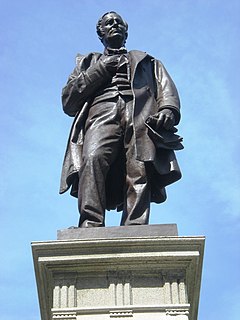
William H. English is a public artwork by an unknown artist, located in a niche on the third floor of the Indiana Statehouse, which is in Indianapolis, Indiana, United States of America.
A niche in classical architecture is an exedra or an apse that has been reduced in size, retaining the half-dome heading usual for an apse. Nero's Domus Aurea was the first semi-private dwelling that possessed rooms that were given richly varied floor plans, shaped with niches and exedras; sheathed in dazzling polished white marble, such curved surfaces concentrated or dispersed the daylight.
The Indiana State House is the state capitol building of the U.S. state of Indiana. Housing the Indiana General Assembly, the office of the Governor of Indiana, the Supreme Court of Indiana, and other state officials, it is located in the state capital of Indianapolis at 200 West Washington Street. Built in 1888, it is the fifth building to house the state government.
Indianapolis, often shortened to Indy, is the state capital and most populous city of the U.S. state of Indiana and the seat of Marion County. According to 2017 estimates from the U.S. Census Bureau, the consolidated population of Indianapolis and Marion County was 872,680. The "balance" population, which excludes semi-autonomous municipalities in Marion County, was 863,002. It is the 17th most populous city in the U.S. The Indianapolis metropolitan area is the 34th most populous metropolitan statistical area in the U.S., with 2,028,614 residents. Its combined statistical area ranks 27th, with a population of 2,411,086. Indianapolis covers 368 square miles (950 km2), making it the 16th largest city by land area in the U.S.
This marble bust is dedicated to Indiana lawmaker William H. English. [1] The carved inscription on the front of the pedestal reads as follows:
Marble is a metamorphic rock composed of recrystallized carbonate minerals, most commonly calcite or dolomite. Marble is typically not foliated, although there are exceptions. In geology, the term "marble" refers to metamorphosed limestone, but its use in stonemasonry more broadly encompasses unmetamorphosed limestone. Marble is commonly used for sculpture and as a building material.
A bust is a sculpted or cast representation of the upper part of the human figure, depicting a person's head and neck, and a variable portion of the chest and shoulders. The piece is normally supported by a plinth. The bust is generally a portrait intended to record the appearance of an individual, but may sometimes represent a type. They may be of any medium used for sculpture, such as marble, bronze, terracotta, plaster, wax or wood.
SPEAKER
OF THE
HOUSE OF REPRESENTATIVES
SESSION OF 1851-52
The sculpture is sitting on top of a large pedestal. He is wearing a tuxedo with a bow tie, vest, jacket, and tuxedo shirt. English has a heavy brow, mustache, and beard. His hair is parted to the proper right. He is facing directly forward. The letters in the inscription on the pedestal are highlighted with gold. The bust rests in a niche with overall dimensions 22 x 24 x 15 in. (with pedestal). [1]
William H. English was the Speaker of House, a political civil servant, native of Lexington, Indiana, and the first manager of English's Opera House and Hotel, which was destroyed in 1948 to make way for a J.C. Penney's department store on Monument Circle. [2]
Lexington is an unincorporated community in Lexington Township, Scott County, in the U.S. state of Indiana, located about 10 miles west of the Ohio River and 28 miles north of Louisville, Kentucky. The town itself was founded before Indiana became the 19th state in 1816 and was located in Jefferson County at the time it was platted. It was the original county seat from 1820 to 1874, before local leaders decided on a more central location at nearby Scottsburg, which created animosity between the residents of the two towns for several decades afterwards.
J. C. Penney Company, Inc. is an American department store chain with 864 locations in 49 U.S. states and Puerto Rico. In addition to selling conventional merchandise, J. C. Penney stores often house several leased departments such as Sephora, Seattle's Best Coffee, salons, auto centers, optical centers, portrait studios, and jewelry repair.
He was a key figure in the development and building of the Soldiers' and Sailors' Monument, located at the center of Indianapolis' Monument Circle. He was a part of the board of commissioners for the erection of the monument. [3] He was connected with the first National Bank of Indianapolis and a historian.[ citation needed ]
The Indiana State Soldiers and Sailors Monument is a 284 ft 6 in (86.72 m) neoclassical monument built on Monument Circle, a circular, brick-paved street that intersects Meridian and Market streets in the center of downtown Indianapolis, Indiana. In the years since its public dedication on May 15, 1902, the monument has become an iconic symbol of Indianapolis, the state capital of Indiana. It was added to the National Register of Historic Places on February 13, 1973 and was included in an expansion of the Indiana World War Memorial Plaza National Historic Landmark District in December 2016. It is located in the Washington Street-Monument Circle Historic District. It is also the largest outdoor memorial and the largest of its kind in Indiana.
William H. English made significant contributions to the development of the city of Indianapolis; the state capitol of Indiana. His birth and death dates are 27 August 1822 – 7 February 1896. This bust may have been placed posthumously.
William H. English is located on the third floor of the Indiana statehouse, directly outside of the entrance to The General Assembly Hall of the Indiana House of Representatives.
The Indiana General Assembly is the state legislature, or legislative branch, of the state of Indiana. It is a bicameral legislature that consists of a lower house, the Indiana House of Representatives, and an upper house, the Indiana Senate. The General Assembly meets annually at the Indiana Statehouse in Indianapolis.
The Indiana House of Representatives is the lower house of the Indiana General Assembly, the state legislature of the United States state of Indiana. The House is composed of 100 members representing an equal number of constituent districts. House members serve two-year terms without term limits. According to the 2010 census, each State House district contains an average of 64,838 people.
The Thomas A. Hendricks Monument is a public artwork by American artist Richard Henry Park and is located on the southeast corner of the Indiana Statehouse grounds in Indianapolis, Indiana. The monument is a tribute to Thomas A. Hendricks, the 21st Vice President of the United States. Hendricks was a former U.S. Representative and U.S. Senator from Indiana. He was the 16th Governor of Indiana and led the campaign to build the Indiana Statehouse.
Otis Bowen is a bronze bust of Dr. Otis Bowen, who was the Governor of Indiana from 1973–1981 and U.S. Secretary of Health and Human Services from 1985–1989 under President Ronald Reagan.
Robert Dale Owen Memorial is a public artwork located at the south entrance of the Indiana Statehouse along Washington Street in Indianapolis, Indiana. The memorial was donated to the state of Indiana and dedicated in 1911 in honor of the Indiana politician, Robert Dale Owen (1807–1877). The bronze portrait bust by Indiana sculptor, Frances Goodwin, has been missing from this memorial since 1970. The memorial's remaining pedestal is made from three stone blocks and includes a commemorative plaque.

Frances Elizabeth Willard is a public artwork designed by American artist Lorado Taft, located in the rotunda of the Indiana State House, in Indianapolis, Indiana, United States. It is a bronze plaque, given by the Women's Christian Temperance Union, commemorating the fiftieth anniversary of Frances Elizabeth Willard's election as President of the WCTU.
Benjamin Harrison is a bust by American artist Richard Peglow, located in the north atrium on the second floor of the Indiana Statehouse, which is in Indianapolis, Indiana, United States. The bust is cast in bronze and depicts President Benjamin Harrison. The bust is placed in front of a grey and black marble shield with six stars tracing around the edge of the shape. The bust and shield are approximately 28 inches (710 mm) wide by 25 inches (640 mm) high and has a depth of 14.5 inches (370 mm). The artwork was cast and placed in the statehouse in 2008 in accordance with Indiana code Section 2. IC 4-20.5-6-12.
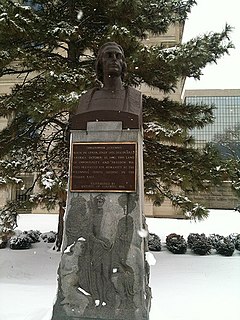
Christopher Columbus is a public artwork by Italian artist Enrico Vittori and located on the grounds of the Indiana Statehouse in Indianapolis, Indiana. The sculpted bronze bust of Christopher Columbus sits atop a pedestal that has relief carvings on its front, left and right sides. The sculpture is installed in the southwest corner of the Indiana Statehouse lawn and was presented in 1920 as a gift from Italian immigrant communities in Indiana.
Calvin Fletcher is a public artwork by an unknown artist, located inside the Indiana Statehouse in Indianapolis, Indiana, United States. The marble bust depicts Calvin Fletcher (1798–1866), a man who settled in Indiana early in the state's history and went on to become an attorney and senator. The bust stands 47.5 inches high, has a width of 20 inches and a depth of 10.25 inches.
The Abraham Lincoln commemorative plaque is a work of public art designed by Marie Stewart in 1906, created by Rudolph Schwarz, and dedicated on 12 February 1907.
George Rogers Clark is a plaster bust made by American artist David McLary. Dated 1985, the sculpture depicts American Revolutionary War hero and frontiersman George Rogers Clark. The bust is located in an alcove on the third floor of the Indiana Statehouse in Indianapolis, United States. The bust measures 32 inches (81 cm) by 20 inches (51 cm) by 15 inches (38 cm) and sets upon a wooden base measuring approximately 6 inches (15 cm) by 19 inches (48 cm) by 24.25 inches (61.6 cm).
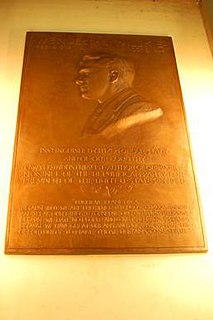
Wendell Willkie plaque is a public sculpture at the Indiana Statehouse in Indianapolis, Indiana and was designed by American sculptor and educator Paul Fjelde. This bronze plaque honors Wendell L. Willkie (1892–1944) who was the Republican Party nominee for the U.S. presidency in 1940. The plaque was placed in the Statehouse rotunda on February 18th, 1950. The inscription on the bottom of the plaque was taken from Willkie's book "One World" which calls for unified world order.
The Indiana Statehouse Public Art Collection, located in Indianapolis, Indiana, consists of more than 40 public artworks that are on display inside and around the grounds of Indiana Statehouse and the Indiana Government Center North and Indiana Government Center South.
Abraham Lincoln is a public artwork by American sculptor and medallist Thomas Dow Jones, located in the Indiana Statehouse, Indianapolis, Indiana, United States. The painted plaster bust of Abraham Lincoln that resides in the Indiana Statehouse is a copy of an 1861 clay bust. Several versions of the bust exist in plaster, marble, and bronze mediums.
The bust of Sherman Minton is a public artwork by American artist Robert Merrell Gage, located on the main floor of the Indiana Statehouse, which is in Indianapolis, Indiana, United States. Cast in bronze in 1956, it was commissioned to honor politician — a United States Senator from Indiana and later an Associate Justice of the Supreme Court of the United States.— and Indiana native Sherman Minton.