| George Washington | |
|---|---|
| Artist | Donald De Lue |
| Year | 1959, dedicated 1987 |
| Type | bronze statue |
| Dimensions | 280 cm× 120 cm× 91 cm(112 in× 46 in× 36 in) |
| Location | Indiana Statehouse, Indianapolis, IN |
| 39°46′3.33″N86°9′45.66″W / 39.7675917°N 86.1626833°W [1] | |
| Owner | State of Indiana |
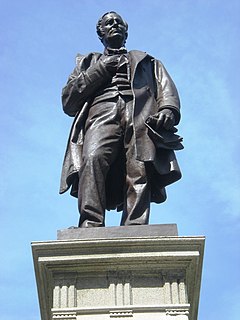
George Washington (alternately titled George Washington as Master Mason) is a public artwork by American sculptor Donald De Lue, located on the grounds of the Indiana Statehouse, in Indianapolis, Indiana, United States. The bronze statue of George Washington that occupies the Indiana Statehouse south lawn is one of several copies of a 1959 original wax cast at the Modern Art Foundry in Long Island, New York. [2]
Americans are nationals and citizens of the United States of America. Although nationals and citizens make up the majority of Americans, some dual citizens, expatriates, and permanent residents may also claim American nationality. The United States is home to people of many different ethnic origins. As a result, American culture and law does not equate nationality with race or ethnicity, but with citizenship and permanent allegiance.
Donald Harcourt De Lue was an American sculptor, best known for his public monuments.
The Indiana Statehouse is the state capitol building of the U.S. state of Indiana. Housing the Indiana General Assembly, the office of the Governor of Indiana, the Supreme Court of Indiana, and other state officials, it is located in the state capital Indianapolis at 200 West Washington Street. Built in 1888, it is the fifth building to house the state government.
The statue depicts Washington dressed in breeches with an apron and medallion decorated with Masonic symbols. Washington holds a tri-cornered hat in the crook of his proper left arm, and a gavel in his proper right hand. He wears an open overcoat with buttons and has a short podium to his proper right. Washington's attire depicts the first President as he may have looked when he laid the cornerstone for the U.S. Capitol in Washington, D.C. [3] The sculpture is mounted upon a stepped, inscribed granite base.
The base of the sculpture is inscribed with the following:
Freemasonry or Masonry consists of fraternal organisations that trace their origins to the local fraternities of stonemasons, which from the end of the fourteenth century regulated the qualifications of stonemasons and their interaction with authorities and clients. The degrees of Freemasonry retain the three grades of medieval craft guilds, those of Apprentice, Journeyman or fellow, and Master Mason. The candidate of these three degrees is progressively taught the meanings of the symbols of Freemasonry, and entrusted with grips, signs and words to signify to other members that he has been so initiated. The initiations are part allegorical morality play and part lecture. The three degrees are offered by Craft Freemasonry. Members of these organisations are known as Freemasons or Masons. There are additional degrees, which vary with locality and jurisdiction, and are usually administered by their own bodies.
The dimensions of the statue are as follows: 9 feet 4 inches (2.84 meters) by 46 inches (120 centimeters) x 36 inches (91 centimeters). The total weight of the statue is 900 pounds (410 kilograms). The granite base is 5 feet (1.5 meters) tall and weighs approximately 9 short tons (8.2 metric tons). The Statehouse's version of De Lue's bronze statue was a gift of the Grand Lodge of Free and Accepted Masons of Indiana, dedicated May 19, 1987. [4] This statue appeared at similar Masonic monuments in the following locations:
Detroit is the largest and most populous city in the U.S. state of Michigan, the largest United States city on the United States–Canada border, and the seat of Wayne County. The municipality of Detroit had a 2017 estimated population of 673,104, making it the 23rd-most populous city in the United States. The metropolitan area, known as Metro Detroit, is home to 4.3 million people, making it the second-largest in the Midwest after the Chicago metropolitan area. Regarded as a major cultural center, Detroit is known for its contributions to music and as a repository for art, architecture and design.
Michigan is a state in the Great Lakes and Midwestern regions of the United States. The state's name, Michigan, originates from the Ojibwe word mishigamaa, meaning "large water" or "large lake". With a population of about 10 million, Michigan is the tenth most populous of the 50 United States, with the 11th most extensive total area, and is the largest state by total area east of the Mississippi River. Its capital is Lansing, and its largest city is Detroit. Metro Detroit is among the nation's most populous and largest metropolitan economies.
Lansing is the capital of the U.S. state of Michigan. It is mostly in Ingham County, although portions of the city extend west into Eaton County and north into Clinton County. The 2010 Census placed the city's population at 114,297, making it the fifth largest city in Michigan. The population of its Metropolitan Statistical Area (MSA) was 464,036, while the even larger Combined Statistical Area (CSA) population, which includes Shiawassee County, was 534,684. It was named the new state capital of Michigan in 1847, ten years after Michigan became a state.
A Smithsonian's Save Outdoor Sculpture survey completed in October 1992 noted the condition as 'well-maintained'. [6]
George Washington as Master Mason was sculpted initially from a wax mold at Donald De Lue's studio in Leonard, New Jersey, and copyrighted in 1959. This sculpture was re-cast in 1986 and dedicated May 19, 1987 by the grand master of the Freemasons of Indiana, J.C. Paxton of Warsaw, Indiana. The total cost of the gift was $100,000. [7] Lieutenant Governor John Mutz accepted the statue on behalf of the state. [8] George Washington as Master Mason was inspired by sculptor Bryant Baker's work, Illustrious Brother George Washington, which also depicts the subject in a similar pose with Masonic iconography.
John Massie Mutz is an American business leader and politician who served as Lieutenant Governor of Indiana, Republican candidate for Governor and president of Lilly Endowment, one of America's largest family foundations.
Percy Bryant Baker better known as Bryant Baker, was a British-born American sculptor. He sculpted a number of busts of famous Americans. In 1910, Queen Alexandra of the United Kingdom commissioned him to create a bust of King Edward VII.
Donald De Lue's monumental sculptures embody patriotic heroism, classical mythology, and biblical themes. De Lue studied at the Boston Museum of Fine Arts School; in Paris with Alfredo Pina after World War I, and in New York with Bryant Baker. [9] He was professionally affiliated with the ANA, National Sculpture Society (president), NIAL, Architecture League, American Artists Professional League, among others. [10] He was also the art committee chairman of the Hall of Fame for Great Americans, New York University, an artist with the Federal Art Project, and advertising editor for American Artist Magazine. [11]
Lorado Zadok Taft was an American sculptor, writer and educator. Taft was born in Elmwood, Illinois, in 1860 and died in his home studio in Chicago in 1936. Taft was the father of US Representative Emily Taft Douglas, father-in-law to her husband, US Senator Paul Douglas, and a distant relative of US President William Howard Taft.

Eve is an outdoor sculpture of the biblical Eve created by Robert William Davidson in 1931. It is currently located in the HITS Building at 410 West 10th Street on the campus of Indiana University-Purdue University Indianapolis (IUPUI). The overall dimensions of this bronze sculpture are 5’ tall, 2’ long, and 1’ wide.
The Thomas A. Hendricks Monument is a public artwork by American artist Richard Henry Park and is located on the southeast corner of the Indiana Statehouse grounds in Indianapolis, Indiana. The monument is a tribute to Thomas A. Hendricks, the 21st Vice President of the United States. Hendricks was a former U.S. Representative and U.S. Senator from Indiana. He was the 16th Governor of Indiana and led the campaign to build the Indiana Statehouse.
Robert Dale Owen Memorial is a public artwork located at the south entrance of the Indiana Statehouse along Washington Street in Indianapolis, Indiana. The memorial was donated to the state of Indiana and dedicated in 1911 in honor of the Indiana politician, Robert Dale Owen (1807–1877). The bronze portrait bust by Indiana sculptor, Frances Goodwin, has been missing from this memorial since 1970. The memorial's remaining pedestal is made from three stone blocks and includes a commemorative plaque.
Frank O'Bannon is a public artwork by American artist Kenneth G. Ryden, located in the Indiana Statehouse rotunda in Indianapolis, Indiana. The 700 pound bronze bust was commissioned by the state to honor the memory of Indiana's 47th Governor, Frank O'Bannon. The piece was cast at the Anderson University Art Foundry in 2005 and presented to the state in February 2006.
Young Abe Lincoln, is a 1962 public artwork by American artist David K. Rubins, located outside of the government center near the Indiana State House, in Indianapolis, Indiana, US. This bronze sculpture is a depiction of a young Abraham Lincoln, an Abraham Lincoln that spent the majority of his formative years in Indiana.
Stephen Neal is a public artwork by Indiana artist Clara Barth Leonard. It is located in the Indiana Statehouse, which is in Indianapolis, Indiana, United States. The subject of the work is Stephen Neal, a member of the Indiana State Legislature and a Judge of the Boone County Circuit Court during the mid-to-late-19th century, as well as being the author of the original draft of the Fourteenth Amendment to the United States Constitution. The bronze bust is located on the second floor of the Indiana Statehouse in a waist-high limestone niche, and faces West towards North Senate Avenue.
Calvin Fletcher is a public artwork by an unknown artist, located inside the Indiana Statehouse in Indianapolis, Indiana, United States. The marble bust depicts Calvin Fletcher (1798–1866), a man who settled in Indiana early in the state's history and went on to become an attorney and senator. The bust stands 47.5 inches high, has a width of 20 inches and a depth of 10.25 inches.
Ashbel Parsons Willard is a piece of public art by American sculptor Henry Dexter, located on the second floor or third level of the Indiana Statehouse, located between Washington Street and Ohio Street in Indianapolis, the capital of Indiana, a U.S. state. The bust is located in a niche outside the central rotunda. It faces north and is on the eastern side of the rotunda.
The Abraham Lincoln commemorative plaque is a work of public art designed by Marie Stewart in 1906, created by Rudolph Schwarz, and dedicated on 12 February 1907.
The Coal Miner is a public artwork by Polish American artist John J. Szaton (1907–1966) which is located in two US State capitals; the original, commissioned in 1963 in Springfield, Illinois, as well as a copy on the west lawn of the Indiana State House in Indianapolis, Indiana The statues commemorate coal miners who had lost their lives in those states' mining industry. The 7-foot (2.1 m) tall statue rests on a 3-foot (0.91 m) square, granite base supported by a cement foundation that is 4–6 inches (100–150 mm) thick.
Workers' Memorial is a sculpture in Indiana, United States by artist Daniel Edwards made to commemorate workers who have died on the job. The memorial consists of three bronze workers standing atop a limestone base. The statue was unveiled in 1995 on April 28, a day on which labor groups in Indianopolis annually commemorate fallen workers. Sponsored by the American Federation of Labor and Congress of Industrial Organizations (AFL-CIO), labor groups paid the entire $40,000 cost of the memorial.
Abraham Lincoln is a public artwork by American sculptor and medallist Thomas Dow Jones, located in the Indiana Statehouse, Indianapolis, Indiana, United States. The painted plaster bust of Abraham Lincoln that resides in the Indiana Statehouse is a copy of an 1861 clay bust. Several versions of the bust exist in plaster, marble, and bronze mediums.
The bust of Sherman Minton is a public artwork by American artist Robert Merrell Gage, located on the main floor of the Indiana Statehouse, which is in Indianapolis, Indiana, United States. Cast in bronze in 1956, it was commissioned to honor politician and Indiana native Sherman Minton.

David Kresz Rubins was an American sculptor and professor. He taught at Herron School of Art in Indianapolis and his various works adorn the Indiana State House, the American Museum of Natural History in New York, and the National Archives building in Washington, D.C.
Stumbling Man is an outdoor sculpture by American artist David K. Rubins (1902–1985) located on the grounds of the Indianapolis Museum of Art (IMA), which is near downtown Indianapolis, Indiana. The sculpture is cast bronze and is in the shape of a man crouched upon the ground.
George Washington is a statue by French sculptor Jean-Antoine Houdon from the late 18th century. Based on a life mask and other measurements of George Washington taken by Houdon, it is considered one of the most accurate depictions of the subject. The original sculpture is located in the rotunda of the Virginia State Capitol in Richmond, Virginia, and has been copied extensively.
Clara Barth Leonard Sorenson Dieman (1877–1959) was an American sculptor, painter and teacher from Indianapolis, Indiana.