| Bust of Sherman Minton | |
|---|---|
| Artist | Robert Merrell Gage |
| Year | 1956 |
| Type | Sculpture |
| Dimensions | 61 cm× 76.8 cm× 32.4 cm(24 in× 30.25 in× 12.75 in) |
| Location | Indiana Statehouse, Indianapolis, Indiana, United States |
| 39°46′7.54″N86°9′45.54″W / 39.7687611°N 86.1626500°W Coordinates: 39°46′7.54″N86°9′45.54″W / 39.7687611°N 86.1626500°W | |
| Owner | State of Indiana |
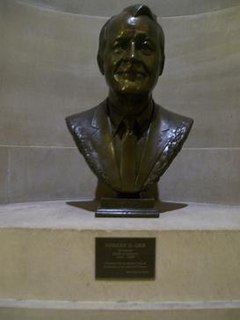
The bust of Sherman Minton is a public artwork by American artist Robert Merrell Gage, located on the main floor of the Indiana Statehouse, which is in Indianapolis, Indiana, United States. Cast in bronze in 1956, it was commissioned to honor politician and Indiana native Sherman Minton.
A bust is a sculpted or cast representation of the upper part of the human figure, depicting a person's head and neck, and a variable portion of the chest and shoulders. The piece is normally supported by a plinth. The bust is generally a portrait intended to record the appearance of an individual, but may sometimes represent a type. They may be of any medium used for sculpture, such as marble, bronze, terracotta, plaster, wax or wood.
Public art is art in any media that has been planned and executed with the intention of being staged in the physical public domain, usually outside and accessible to all. Public art is significant within the art world, amongst curators, commissioning bodies and practitioners of public art, to whom it signifies a working practice of site specificity, community involvement and collaboration. Public art may include any art which is exhibited in a public space including publicly accessible buildings, but often it is not that simple. Rather, the relationship between the content and audience, what the art is saying and to whom, is just as important if not more important than its physical location.
The United States of America (USA), commonly known as the United States or America, is a country comprising 50 states, a federal district, five major self-governing territories, and various possessions. At 3.8 million square miles, the United States is the world's third or fourth largest country by total area and is slightly smaller than the entire continent of Europe's 3.9 million square miles. With a population of over 327 million people, the U.S. is the third most populous country. The capital is Washington, D.C., and the most populous city is New York City. Most of the country is located contiguously in North America between Canada and Mexico.
The bust is made from cast bronze and depicts the subject from the lower shoulders up, clad in a judicial robe. Minton is depicted as middle-aged, mustached, with a moderately receded hairline. His head is rotated slightly to the proper left. Slightly larger than life-size, the piece is 30.25 inches wide at the shoulders, 11.5 inches wide at the head, 24 inches high, and 11.75 inches deep. It is mounted on a stone block in a semi-cylindrical niche. Affixed to the front of the block is a bronze plaque which reads:
A robe is a loose-fitting outer garment. Unlike garments described as capes or cloaks, robes usually have sleeves. The English word robe derives from Middle English robe ("garment"), borrowed from Old French robe, itself taken from the Frankish word *rouba, and is related to the word rob.
| SHERMAN MINTON ASSOCIATE JUSTICE SUPREME COURT oF THE UNITED STATES 1949–1956 THE FIRST JUSTICE APPOINTED TO THE SUPREME COURT oF THE UNITED STATES FROM THE STATE oF INDIANA |
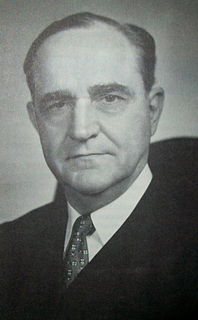
Sherman Minton (October 20, 1890 – April 9, 1965) was primarily noted for being a Democratic United States Senator representing Indiana and an Associate United States Supreme Court justice. The first U.S. Supreme Court justice from Indiana, he was a supporter of New Deal legislation as a senator and an advocate of judicial restraint as a court justice. He retired in 1956 due to poor health. [1]
The Democratic Party is one of the two major contemporary political parties in the United States, along with its rival, the Republican Party. Tracing its heritage back to Thomas Jefferson and James Madison's Democratic-Republican Party, the modern-day Democratic Party was founded around 1828 by supporters of Andrew Jackson, making it the world's oldest active political party.
The New Deal was a series of programs, public work projects, financial reforms, and regulations enacted by President Franklin D. Roosevelt in the United States between 1933 and 1936. It responded to needs for relief, reform, and recovery from the Great Depression. Major federal programs included the Civilian Conservation Corps (CCC), the Civil Works Administration (CWA), the Farm Security Administration (FSA), the National Industrial Recovery Act of 1933 (NIRA) and the Social Security Administration (SSA). They provided support for farmers, the unemployed, youth and the elderly. The New Deal included new constraints and safeguards on the banking industry and efforts to re-inflate the economy after prices had fallen sharply. New Deal programs included both laws passed by Congress as well as presidential executive orders during the first term of the presidency of Franklin D. Roosevelt.
Judicial restraint is a theory of judicial interpretation that encourages judges to limit the exercise of their own power. It asserts that judges should hesitate to strike down laws unless they are obviously unconstitutional, though what counts as obviously unconstitutional is itself a matter of some debate. Judicial restraint is sometimes regarded as the opposite of judicial activism. In deciding questions of constitutional law, judicially restrained jurists go to great lengths to defer to the legislature. Judicially restrained judges respect stare decisis, the principle of upholding established precedent handed down by past judges. This doctrine states how domestic courts will abstain from passing judgement over the acts of a foreign sovereign done in its own territory.
The bust was commissioned shortly after Minton's retirement by then-governor of Indiana George N. Craig, paid for out of the governor's contingency fund. [2] It was dedicated on December 21, 1956 at an unveiling ceremony which featured as speakers both Gov. Craig and William T. Fitzgerald, president of the Indiana State Bar Association at that time, in addition to Minton himself. [3]
In the United States, a governor serves as the chief executive officer and commander-in-chief in each of the fifty states and in the five permanently inhabited territories, functioning as both head of state and head of government therein. As such, governors are responsible for implementing state laws and overseeing the operation of the state executive branch. As state leaders, governors advance and pursue new and revised policies and programs using a variety of tools, among them executive orders, executive budgets, and legislative proposals and vetoes. Governors carry out their management and leadership responsibilities and objectives with the support and assistance of department and agency heads, many of whom they are empowered to appoint. A majority of governors have the authority to appoint state court judges as well, in most cases from a list of names submitted by a nominations committee.
George North Craig was the 39th Governor of the U.S. state of Indiana from 1953 until 1957. A lawyer and veteran of World War II who was promoted to serve in a division command staff, Craig first gained popularity in the state as National Commander of The American Legion. He was a political outsider when he ran for governor and was at odds with more conservative party leadership during his time in office. Although he made significant reforms, his term ended with a high profile bribery scandal when it was found that several high level state employees had been accepting bribes to influence their decision in assigning construction contracts. Craig was personally uninvolved in the scandal but was held responsible for it by the public, ending his political career.
Cast in New York and transported to Indianapolis, [1] the bust was originally housed in a prominent niche outside the governor’s office at the statehouse rotunda, displacing a bust of George Washington, which was moved to an upper floor. A statement by the governor's private secretary at the time suggested that this was simply because the Washington bust was made of plaster and the Minton bust of bronze, and that the Minton bust would be a better aesthetic match for an adjoining bronze piece. [2] A 1976 catalog lists the bust’s location at the statehouse as the southwest corner pier of the central rotunda, facing south. [4] This continues to be its current location as of 2011.
A rotunda is any building with a circular ground plan, and sometimes covered by a dome. It can also refer to a round room within a building. The Pantheon in Rome is a famous rotunda. A Band Rotunda is a circular bandstand, usually with a dome.
George Washington is a statue by French sculptor Jean-Antoine Houdon from the late 18th century. Based on a life mask and other measurements of George Washington taken by Houdon, it is considered one of the most accurate depictions of the subject. The original sculpture is located in the rotunda of the Virginia State Capitol in Richmond, Virginia, and has been copied extensively.
A native of Topeka, Kansas, sculptor Robert Merrell Gage (December 26, 1892 – October 30, 1981, often referred to as Merrell Gage) was noted for his numerous public art commissions. His first such commission was for a statue of Abraham Lincoln that is now on the grounds of the Kansas State Capitol. He eventually became a professor of sculpture at the University of Southern California, and it was during his tenure there that he was commissioned to produce the Sherman Minton bust. [3]
Topeka is the capital city of the U.S. state of Kansas and the seat of Shawnee County. It is along the Kansas River in the central part of Shawnee County, in northeast Kansas, in the Central United States. As of the 2010 census, the city population was 127,473. The Topeka Metropolitan Statistical Area, which includes Shawnee, Jackson, Jefferson, Osage, and Wabaunsee counties, had a population of 233,870 in the 2010 census.
Abraham Lincoln was an American statesman and lawyer who served as the 16th president of the United States from 1861 until his assassination in April 1865. Lincoln led the nation through the American Civil War, its bloodiest war and its greatest moral, constitutional, and political crisis. He preserved the Union, abolished slavery, strengthened the federal government, and modernized the U.S. economy.
The Kansas State Capitol, known also as the Kansas Statehouse, is the building housing the executive and legislative branches of government for the U.S. state of Kansas. Located in the city of Topeka, which has served as the capital of Kansas since the territory became a state in 1861, the building is the second to serve as the Kansas Capitol.
Sherman "Shay" Minton was a United States Senator from Indiana and later an Associate Justice of the Supreme Court of the United States. He was a member of the Democratic Party.
Robert Merrell Gage was an American sculptor, frequently credited or referred to as Merrell Gage.
Linda C. Gugin is a Professor Emeritus of Political Science at Indiana University Southeast, active member of the Indiana Historical Society, and author and coauthor of many books related to legal history. She is a principal biographer of Sherman Minton.
Otis Bowen is a bronze bust of Dr. Otis Bowen, who was the Governor of Indiana from 1973–1981 and U.S. Secretary of Health and Human Services from 1985–1989 under President Ronald Reagan.
Robert Dale Owen Memorial is a public artwork located at the south entrance of the Indiana Statehouse along Washington Street in Indianapolis, Indiana. The memorial was donated to the state of Indiana and dedicated in 1911 in honor of the Indiana politician, Robert Dale Owen (1807–1877). The bronze portrait bust by Indiana sculptor, Frances Goodwin, has been missing from this memorial since 1970. The memorial's remaining pedestal is made from three stone blocks and includes a commemorative plaque.
Sarah T. Bolton is a public artwork by American artist Emma Sangernebo (1877–1969). It is located on the second floor of the rotunda in the Indiana State House, Indianapolis, Indiana, United States. It is a bronze sculptural relief of Indiana poet Sarah Tittle Bolton, née Barrett and contains four lines from Bolton's poem "Indiana".
Frank O'Bannon is a public artwork by American artist Kenneth G. Ryden, located in the Indiana Statehouse rotunda in Indianapolis, Indiana. The 700 pound bronze bust was commissioned by the state to honor the memory of Indiana's 47th Governor, Frank O'Bannon. The piece was cast at the Anderson University Art Foundry in 2005 and presented to the state in February 2006.
Robert D. Orr is a public artwork by American artist Don Ingle which is located on the Indiana State House: Third Floor Rotunda, which is near Indianapolis, Indiana, United States of America. The bust is a bronze political sculpture of Robert D. Orr, the 45th Governor of Indiana. Created in 1987, the bust was a gift by the Rotary International chapter of Evansville, Indiana. The bust measures 30 x 21 x 15 in.; 76.2 x 53.34 x 38.1 cm.

Frances Elizabeth Willard is a public artwork designed by American artist Lorado Taft, located in the rotunda of the Indiana State House, in Indianapolis, Indiana, United States. It is a bronze plaque, given by the Women's Christian Temperance Union, commemorating the fiftieth anniversary of Frances Elizabeth Willard's election as President of the WCTU.
Daniel W. Voorhees is a public artwork by American artist James Paxton Voorhees, located on the second floor alcove of the Indiana Statehouse behind the tourism desk. The statehouse is located in Indianapolis, Indiana, United States. Daniel W. Voorhees, nicknamed the "Tall Sycamore of the Wabash" for his tall stature, large head and broad shoulders, was a distinguished Indiana politician of the 19th century.
Stephen Neal is a public artwork by Indiana artist Clara Barth Leonard. It is located in the Indiana Statehouse, which is in Indianapolis, Indiana, United States. The subject of the work is Stephen Neal, a member of the Indiana State Legislature and a Judge of the Boone County Circuit Court during the mid-to-late-19th century, as well as being the author of the original draft of the Fourteenth Amendment to the United States Constitution. The bronze bust is located on the second floor of the Indiana Statehouse in a waist-high limestone niche, and faces West towards North Senate Avenue.
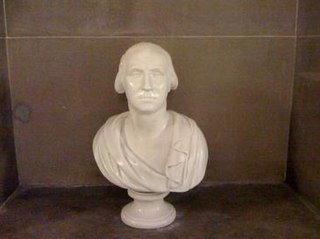
George Washington is a public artwork that is a limited edition copy of an original work by French neoclassical sculptor Jean Antoine Houdon that is on display inside the Indiana Statehouse, which is located in Indianapolis, Indiana, United States. The artwork was cast a solid piece of plaster that has been painted white.
Benjamin Harrison is a bust by American artist Richard Peglow, located in the north atrium on the second floor of the Indiana Statehouse, which is in Indianapolis, Indiana, United States. The bust is cast in bronze and depicts President Benjamin Harrison. The bust is placed in front of a grey and black marble shield with six stars tracing around the edge of the shape. The bust and shield are approximately 28 inches (710 mm) wide by 25 inches (640 mm) high and has a depth of 14.5 inches (370 mm). The artwork was cast and placed in the statehouse in 2008 in accordance with Indiana code Section 2. IC 4-20.5-6-12.
Calvin Fletcher is a public artwork by an unknown artist, located inside the Indiana Statehouse in Indianapolis, Indiana, United States. The marble bust depicts Calvin Fletcher (1798–1866), a man who settled in Indiana early in the state's history and went on to become an attorney and senator. The bust stands 47.5 inches high, has a width of 20 inches and a depth of 10.25 inches.
Ashbel Parsons Willard is a piece of public art by American sculptor Henry Dexter, located on the second floor or third level of the Indiana Statehouse, located between Washington Street and Ohio Street in Indianapolis, the capital of Indiana, a U.S. state. The bust is located in a niche outside the central rotunda. It faces north and is on the eastern side of the rotunda.
The Colonel Richard Owen bust is a public artwork by American artist Belle Kinney Scholz and is located in the Indiana Statehouse in Indianapolis, Indiana. The bronze bust was dedicated in 1913 as a memorial to U.S. Army Colonel Richard Owen. It was funded by contributions from individuals and Confederate veteran associations in recognition of Owen's courtesy to Confederate prisoners of war while he was commandant of Camp Morton, a prison camp in Indianapolis, during the American Civil War. The bust is approximately 70 inches (180 cm) tall, 40 inches (100 cm), and 21 inches (53 cm).
George Rogers Clark is a plaster bust made by American artist David McLary. Dated 1985, the sculpture depicts American Revolutionary War hero and frontiersman George Rogers Clark. The bust is located in an alcove on the third floor of the Indiana Statehouse in Indianapolis, United States. The bust measures 32 inches (81 cm) by 20 inches (51 cm) by 15 inches (38 cm) and sets upon a wooden base measuring approximately 6 inches (15 cm) by 19 inches (48 cm) by 24.25 inches (61.6 cm).
Matthew E. Welsh is a public artwork by American artist Daniel Edwards. It is located on the third floor of the Indiana State House, which is in Indianapolis, Indiana, United States. The bronze bust depicts Matthew E. Welsh, the 41st governor of Indiana (1961–1965). The bust measures 23.5 x 12.75 x 12 inches and has a wooden base which measures 4 x 14.75 x 10.5 inches. In 1996, one year after Welsh's death, the Indianapolis law firm of Bingham, Summers, Welsh & Spilman commissioned artist Daniel Edwards to sculpt the bust of Welsh. The bust was dedicated in a ceremony at the Indiana Statehouse on December 20, 1996.
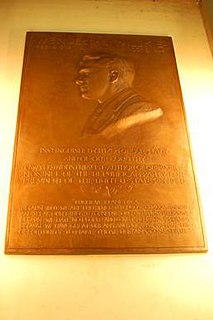
Wendell Willkie plaque is a public sculpture at the Indiana Statehouse in Indianapolis, Indiana and was designed by American sculptor and educator Paul Fjelde. This bronze plaque honors Wendell L. Willkie (1892–1944) who was the Republican Party nominee for the U.S. presidency in 1940. The plaque was placed in the Statehouse rotunda on February 18th, 1950. The inscription on the bottom of the plaque was taken from Willkie's book "One World" which calls for unified world order.
Abraham Lincoln is a public artwork by American sculptor and medallist Thomas Dow Jones, located in the Indiana Statehouse, Indianapolis, Indiana, United States. The painted plaster bust of Abraham Lincoln that resides in the Indiana Statehouse is a copy of an 1861 clay bust. Several versions of the bust exist in plaster, marble, and bronze mediums.
|url= (help)|url= (help)|url= (help)