Ashbel Parsons Willard (bust)

Last updated
Ashbel Parsons Willard
Artist Henry Dexter (sculptor)
Year1860 (1860)
Type plaster bust
Dimensions60 cm× 23 cm× 29 cm(23.5 in× 9 in× 11.5 in)
LocationIndianapolis, IN
Coordinates 39°46′6.95″N86°9′45.08″W / 39.7685972°N 86.1625222°W / 39.7685972; -86.1625222

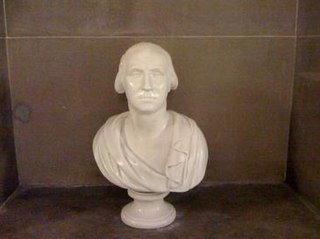
Ashbel Parsons Willard is a piece of public art by American sculptor Henry Dexter, located on the second floor or third level (including the basement) of the Indiana Statehouse, located between Washington Street and Ohio Street in Indianapolis, the capital of Indiana, a U.S. state. The bust is located in a niche outside the central rotunda. It faces north and is on the eastern side of the rotunda.

Public art is art in any media that has been planned and executed with the intention of being staged in the physical public domain, usually outside and accessible to all. Public art is significant within the art world, amongst curators, commissioning bodies and practitioners of public art, to whom it signifies a working practice of site specificity, community involvement and collaboration. Public art may include any art which is exhibited in a public space including publicly accessible buildings, but often it is not that simple. Rather, the relationship between the content and audience, what the art is saying and to whom, is just as important if not more important than its physical location.

United States Federal republic in North America

The United States of America (USA), commonly known as the United States or America, is a country comprising 50 states, a federal district, five major self-governing territories, and various possessions. At 3.8 million square miles, the United States is the world's third or fourth largest country by total area and is slightly smaller than the entire continent of Europe's 3.9 million square miles. With a population of over 327 million people, the U.S. is the third most populous country. The capital is Washington, D.C., and the most populous city is New York City. Most of the country is located contiguously in North America between Canada and Mexico.

Henry Dexter (sculptor)

Henry Dexter (1806–1876) was a prominent American sculptor in the 19th century.

Contents

The sculpture is a plaster cast, which has been painted with many layers of white paint. A maker's mark embossed on the front side of the base states it was made in Boston, Massachusetts. This formerly unknown bust [1] is actually a part of a series of thirty one portrait busts created by the artist Henry Dexter in an 18-month period between 1859-1860. The bust is actually a copy of the original which is part of the Smithsonian's collection. [2] The maker's mark is difficult to read due to the many coats of paint which may be the reason the bust has been unidentified up to this point. The layers of paint have been added over the years, and largely obscure the mark, but it seems to identify 1860 as the date of its manufacture. This date is historically concurrent with the year of Governor Ashbel Parsons Willard's death.

Plaster cast

A plaster cast is a copy made in plaster of another 3-dimensional form. The original from which the cast is taken may be a sculpture, building, a face, a pregnant belly, a fossil or other remains such as fresh or fossilised footprints – particularly in palaeontology.
Boston State capital of Massachusetts, U.S.

Boston is the capital and most populous city of the Commonwealth of Massachusetts in the United States. The city proper covers 48 square miles (124 km2) with an estimated population of 694,583 in 2018, making it also the most populous city in New England. Boston is the seat of Suffolk County as well, although the county government was disbanded on July 1, 1999. The city is the economic and cultural anchor of a substantially larger metropolitan area known as Greater Boston, a metropolitan statistical area (MSA) home to a census-estimated 4.8 million people in 2016 and ranking as the tenth-largest such area in the country. As a combined statistical area (CSA), this wider commuting region is home to some 8.2 million people, making it the sixth most populous in the United States.
Massachusetts State of the United States of America

Massachusetts, officially the Commonwealth of Massachusetts, is the most populous state in the New England region of the northeastern United States. It borders on the Atlantic Ocean to the east, the states of Connecticut and Rhode Island to the south, New Hampshire and Vermont to the north, and New York to the west. The state is named after the Massachusett tribe, which once inhabited the east side of the area, and is one of the original thirteen states. The capital of Massachusetts is Boston, which is also the most populous city in New England. Over 80% of Massachusetts's population lives in the Greater Boston metropolitan area, a region influential upon American history, academia, and industry. Originally dependent on agriculture, fishing and trade, Massachusetts was transformed into a manufacturing center during the Industrial Revolution. During the 20th century, Massachusetts's economy shifted from manufacturing to services. Modern Massachusetts is a global leader in biotechnology, engineering, higher education, finance, and maritime trade.
Description

The sculpture is 23.5 inches (60 cm) from crown to base. The base is 9 inches (23 cm) by 11.5 inches (29 cm) and the circumference of the head is 24.5 inches (62 cm). It has an oval makers mark embossed on the bottom of the front side. The makers mark reads: HENRY DEXTER FECIT, BOSTON 1860, COPY RIGHT SECURED.

The proper right and proper left sides of the bust show signs of wear with the plaster visible along front-facing edges all the way down the base. The bust was likely cast as one whole piece and then painted white to give a uniform and finished look to the work. The rear-facing side has an inscription written in cursive script which reads: Gov. Willard, Ind.. The bust has a hollow cavity and the plaster is approximately 1-2 in. thick throughout the sculpture. The plaster appears to be of highly quality, possibly stucco which is a mixture of lime, marble dust and other organic materials. [3] The bust has a rather stoic facial expression similar to the painting of Governor Willard done by portrait painter George W. Morrison. However, Dexter's portrait gives Willard a fuller mouth and a more narrow nose than the Morrison painting. His hair style is similar in both works, it is parted on the proper left hand side and combed over the crown of the head. His hair has long curling locks that add volume to the sides and back of the head and hang just below his earlobes. This style is in keeping with men's hairstyles in the late 1850s early 1860s. [4]

Historical information

The bust of Ashbel Parsons Willard was executed by Henry Dexter sometime after the letter of introduction from Governor Moses Wisner of Michigan was drafted. The letter is dated April 25, 1860. [5] Dexter traveled by rails to move his supplies so it is safe to assume he arrived in Indianapolis, in late April or early May depending on when he left Michigan. [6] There is no record of his time there, but that time in Governor Willard's life was tumultuous. He was under investigation for defrauding the state and misappropriating funds in the construction of the Northern Indiana State Prison. He was also ailing and his increasingly poor health, due to his lifelong battle with tuberculosis, lead to his early death. He died October 4, 1860, the first Indiana governor to die in office. Willard was also the youngest governor ever elected to the position. [7]

Moses Wisner American politician

Moses Wisner was a politician and soldier from the U.S. state of Michigan.

Michigan State of the United States of America

Michigan is a state in the Great Lakes and Midwestern regions of the United States. The state's name, Michigan, originates from the Ojibwe word mishigamaa, meaning "large water" or "large lake". With a population of about 10 million, Michigan is the tenth most populous of the 50 United States, with the 11th most extensive total area, and is the largest state by total area east of the Mississippi River. Its capital is Lansing, and its largest city is Detroit. Metro Detroit is among the nation's most populous and largest metropolitan economies.

Tuberculosis Infectious disease caused by the bacterium Mycobacterium tuberculosis

Tuberculosis (TB) is an infectious disease usually caused by Mycobacterium tuberculosis (MTB) bacteria. Tuberculosis generally affects the lungs, but can also affect other parts of the body. Most infections do not have symptoms, in which case it is known as latent tuberculosis. About 10% of latent infections progress to active disease which, if left untreated, kills about half of those affected. The classic symptoms of active TB are a chronic cough with blood-containing mucus, fever, night sweats, and weight loss. It was historically called "consumption" due to the weight loss. Infection of other organs can cause a wide range of symptoms.

Dexter had hoped to inspire the state to purchase a copy of his portrait bust, but Willard was unpopular at the time when Dexter modeled him, so it is unknown how the state came to acquire the plaster bust that now sits in the statehouse. The original bust, which has a larger base, 15.5 inches (39 cm) by 10.5 inches (27 cm), is currently in the collection of Smithsonian Institution National Museum of American History. It is part of the catalog listing for the National Portrait Gallery. [2] [6]

Henry Dexter's creation of thirty one portrait busts of governors in the year period between June 1859 and June 24, 1860, recorded some of the most remarkable men in power on the cusp of the American Civil War. Several of the men who modeled for Dexter's busts later went on to be primary council to President Abraham Lincoln and held various military positions in the great conflict between the North and South. [6]

American Civil War Civil war in the United States from 1861 to 1865

The American Civil War was a civil war fought in the United States from 1861 to 1865, between the North (Union) and the South (Confederacy). The most studied and written about episode in U.S. history, the Civil War began primarily as a result of the long-standing controversy over the enslavement of black people. War broke out in April 1861 when secessionist forces attacked Fort Sumter in South Carolina shortly after Abraham Lincoln had been inaugurated as the President of the United States. The loyalists of the Union in the North, which also included some geographically western and southern states, proclaimed support for the Constitution. They faced secessionists of the Confederate States in the South, who advocated for states' rights to uphold slavery.

Abraham Lincoln 16th president of the United States

Abraham Lincoln was an American statesman and lawyer who served as the 16th president of the United States from 1861 until his assassination in April 1865. Lincoln led the nation through the American Civil War, its bloodiest war and its greatest moral, constitutional, and political crisis. He preserved the Union, abolished slavery, strengthened the federal government, and modernized the U.S. economy.

Artist

Portrait of Artist Henry Dexter, Boston. Published posthumously, 1891. 1891 HenryDexter Boston.png
Portrait of Artist Henry Dexter, Boston. Published posthumously, 1891.

Henry Dexter (1806–1876) was a prominent American sculptor in the 19th century. Born in Nelson, New York he was apprenticed to a blacksmith shortly after his father's death when his family moved to Connecticut. Dexter taught himself to paint, but was aided in the process by artist Francis Alexander who was his wife's uncle. [8] He moved to Boston in 1836 and opened his own portrait studio. 2 years later he began to sculpt famous people, starting with the Reverend Dr. Anderson. [9] Dexter was completely self-taught and did not seek to study the European or classical Greek styles of his compatriots, for this reason he is considered among the first true American sculptors. [6]

Henry Dexter sculpted over 200 busts in plaster and marble between the years of 1838 and 1875. Some of his most famous sculptures are his portraits of Charles Dickens and President James Buchanan. His depiction of President Buchanan [10] was later used to model his U.S. postage stamp which was part of a series depicting the presidents of the United States.

Henry Dexter was a patriot who hoped to create a gallery of sculptural works depicting the president of the United States and the governors of every US state in the late 1850s on the cusp of the Civil War. He hoped to achieve a unifying official portrait of this period in America's history. This initiative was self-funded at its conception, utilizing his own moneys Dexter traveled some 20,000 miles with all of his tools for modeling and casting. His initial plan was to model each governor in clay and later plaster and with the hope that individual states would then purchase marble renderings post facto for the sum of $500, [9] thus helping him recuperate his costs. This gigantic undertaking began in 1859 as Dexter first traveled to every state in New England having governors of each state sit for him and sending the modeled clay busts back to his workshop in Boston. He then began to work his way along the Mason-Dixon line and finally across the South. He returned to the North to model the recently deceased Governor William Henry Bissell of Illinois before heading to Wisconsin and presumably Minnesota, Michigan and Indiana between the months of April - June 1860. [6] It is likely that Dexter was in Indiana in late April or early May given a letter of introductory correspondence between Michigan Governor Moses Wisner to Governor Willard dated April 25, 1860. [5] (Governor Willard died in October 1860).

This expedition resulted in thirty one finished busts which were intended to be displayed in the Capitol building in Washington, D.C. However, due to the volatility bred by the recent secession of the Southern states, the totality of the collection was not able to be displayed. By his own admission this endeavor was a failure financially, it left him impoverished for years after his eighteen months of travel across the country. However, historically Dexter's renderings of some of the prominent gubernatorial figures of the United States became a study of many of the most powerful men who were key players in the Civil War. [6] Far from being aware of the long term historical significance of his work Dexter hoped only to accomplish a unifying collection of the nation's administrators.

After his death June 23, 1876, the bulk of his collection of governors was donated to the Smithsonian Institution in 1889. Some of the busts remain with private owners or in the collections of some of the states who purchased copies for their own collections. [6] [9]

See also

Related Research Articles

Robert Laurent American artist

Robert Laurent was an American sculptor, known for his interpretations of the human form. Born in 1890, he died in Cape Neddick, Maine in 1970 at the age of 80.

Ashbel P. Willard American politician

Ashbel Parsons Willard was state senator, the 12th Lieutenant Governor, and the 11th Governor of the U.S. state of Indiana. His terms in office were marked by increasingly severe partisanship leading to the breakup of the state Democratic Party in the years leading up to the American Civil War. His brother-in-law was involved in John Brown's Raid and was executed. Willard went to the south to advocate unsuccessfully for his release, and became despised by southerners who accused him of having a secret involvement in the raid. He died two months before the start of the war while giving a speech on national unity, and was the first governor of Indiana to die in office.

Edmond Thomas Quinn American scsulptor and painter

Edmond Thomas Quinn was an American sculptor and painter. He is best known for his bronze statue of Edwin Booth as Hamlet, which stands at the center of Gramercy Park in New York City. His larger-than-lifesize bronze bust of Victor Herbert stands near The Pond in Central Park, New York City.

Otis Bowen is a bronze bust of Dr. Otis Bowen, who was the Governor of Indiana from 1973–1981 and U.S. Secretary of Health and Human Services from 1985–1989 under President Ronald Reagan.

Robert Dale Owen Memorial is a public artwork located at the south entrance of the Indiana Statehouse along Washington Street in Indianapolis, Indiana. The memorial was donated to the state of Indiana and dedicated in 1911 in honor of the Indiana politician, Robert Dale Owen (1807–1877). The bronze portrait bust by Indiana sculptor, Frances Goodwin, has been missing from this memorial since 1970. The memorial's remaining pedestal is made from three stone blocks and includes a commemorative plaque.

Bust of Frank OBannon bust by Kenneth G. Ryden

Frank O'Bannon is a public artwork by American artist Kenneth G. Ryden, located in the Indiana Statehouse rotunda in Indianapolis, Indiana. The 700 pound bronze bust was commissioned by the state to honor the memory of Indiana's 47th Governor, Frank O'Bannon. The piece was cast at the Anderson University Art Foundry in 2005 and presented to the state in February 2006.

Bust of Robert D. Orr bust by Don Ingle

Robert D. Orr is a public artwork by American artist Don Ingle which is located on the Indiana State House: Third Floor Rotunda, which is near Indianapolis, Indiana, United States of America. The bust is a bronze political sculpture of Robert D. Orr, the 45th Governor of Indiana. Created in 1987, the bust was a gift by the Rotary International chapter of Evansville, Indiana. The bust measures 30 x 21 x 15 in.; 76.2 x 53.34 x 38.1 cm.

<i>Young Abe Lincoln</i> artwork by David K. Rubins

Young Abe Lincoln, is a 1962 public artwork by American artist David K. Rubins, located outside of the government center near the Indiana State House, in Indianapolis, Indiana, US. This bronze sculpture is a depiction of a young Abraham Lincoln, an Abraham Lincoln that spent the majority of his formative years in Indiana.

Bust of Daniel W. Voorhees bust by James Paxton Voorhees

Daniel W. Voorhees is a public artwork by American artist James Paxton Voorhees, located on the second floor alcove of the Indiana Statehouse behind the tourism desk. The statehouse is located in Indianapolis, Indiana, United States. Daniel W. Voorhees, nicknamed the "Tall Sycamore of the Wabash" for his tall stature, large head and broad shoulders, was a distinguished Indiana politician of the 19th century.

Bust of Henry F. Schricker bust by David K. Rubins

Henry F. Schricker, is a public artwork by American artist David K. Rubins, located in the Indiana State House, which is in Indianapolis, Indiana, United States. It is a bronze bust of former Indiana governor Henry F. Schricker. The bust and its base are 49 inches high, 29 inches wide, and 22 inches long. The bust itself is 33.5 inches high on a 15.5 inch high base. It was installed in the southeast alcove of the Indiana State House in 1964 and faces east.

Stephen Neal is a public artwork by Indiana artist Clara Barth Leonard. It is located in the Indiana Statehouse, which is in Indianapolis, Indiana, United States. The subject of the work is Stephen Neal, a member of the Indiana State Legislature and a Judge of the Boone County Circuit Court during the mid-to-late-19th century, as well as being the author of the original draft of the Fourteenth Amendment to the United States Constitution. The bronze bust is located on the second floor of the Indiana Statehouse in a waist-high limestone niche, and faces West towards North Senate Avenue.

<i>George Washington</i> (copy of bust by Houdon) public artwork that is a copy of an original bust created by Jean Antoine Houdon

George Washington is a public artwork that is a limited edition copy of an original work by French neoclassical sculptor Jean Antoine Houdon that is on display inside the Indiana Statehouse, which is located in Indianapolis, Indiana, United States. The artwork was cast a solid piece of plaster that has been painted white.

<i>Christopher Columbus</i> (Vittori) artwork by Enrico Vittori

Christopher Columbus is a public artwork by Italian artist Enrico Vittori and located on the grounds of the Indiana Statehouse in Indianapolis, Indiana. The sculpted bronze bust of Christopher Columbus sits atop a pedestal that has relief carvings on its front, left and right sides. The sculpture is installed in the southwest corner of the Indiana Statehouse lawn and was presented in 1920 as a gift from Italian immigrant communities in Indiana.

Calvin Fletcher is a public artwork by an unknown artist, located inside the Indiana Statehouse in Indianapolis, Indiana, United States. The marble bust depicts Calvin Fletcher (1798–1866), a man who settled in Indiana early in the state's history and went on to become an attorney and senator. The bust stands 47.5 inches high, has a width of 20 inches and a depth of 10.25 inches.

Bust of George Rogers Clark bust by American artist David McLary

George Rogers Clark is a plaster bust made by American artist David McLary. Dated 1985, the sculpture depicts American Revolutionary War hero and frontiersman George Rogers Clark. The bust is located in an alcove on the third floor of the Indiana Statehouse in Indianapolis, United States. The bust measures 32 inches (81 cm) by 20 inches (51 cm) by 15 inches (38 cm) and sets upon a wooden base measuring approximately 6 inches (15 cm) by 19 inches (48 cm) by 24.25 inches (61.6 cm).

Bust of Matthew E. Welsh bust by Daniel Edwards

Matthew E. Welsh is a public artwork by American artist Daniel Edwards. It is located on the third floor of the Indiana State House, which is in Indianapolis, Indiana, United States. The bronze bust depicts Matthew E. Welsh, the 41st governor of Indiana (1961–1965). The bust measures 23.5 x 12.75 x 12 inches and has a wooden base which measures 4 x 14.75 x 10.5 inches. In 1996, one year after Welsh's death, the Indianapolis law firm of Bingham, Summers, Welsh & Spilman commissioned artist Daniel Edwards to sculpt the bust of Welsh. The bust was dedicated in a ceremony at the Indiana Statehouse on December 20, 1996.

<i>Abraham Lincoln</i> (bust by Jones) Thomas Dow Jones statue

Abraham Lincoln is a public artwork by American sculptor and medallist Thomas Dow Jones, located in the Indiana Statehouse, Indianapolis, Indiana, United States. The painted plaster bust of Abraham Lincoln that resides in the Indiana Statehouse is a copy of an 1861 clay bust. Several versions of the bust exist in plaster, marble, and bronze mediums.

Bust of Sherman Minton bust by Robert Merrell Gage

The bust of Sherman Minton is a public artwork by American artist Robert Merrell Gage, located on the main floor of the Indiana Statehouse, which is in Indianapolis, Indiana, United States. Cast in bronze in 1956, it was commissioned to honor politician — a United States Senator from Indiana and later an Associate Justice of the Supreme Court of the United States.— and Indiana native Sherman Minton.

<i>George Washington</i> (Ceracchi) marble bust portrait by Giuseppe Ceracchi

George Washington is a marble bust portrait of George Washington, done in the style of a Roman emperor, by the Italian sculptor Giuseppe Ceracchi. It was created as part of a campaign by Ceracchi to build a larger monument to Washington. The bust was thought by many to be one of the most lifelike. It was later used as a model of Washington for works by other sculptors and engravers.

References

  1. Smithsonian (1976). "Smithsonian Art Inventories Catalog" . Retrieved 11 December 2010.
  2. 1 2 Smithsonian (1889). "National Portrait Gallery" . Retrieved 11 December 2010.
  3. Michael Delahunt. "Plaster description". Archived from the original on 22 November 2010. Retrieved 23 November 2010.
  4. University of Vermont. "Men's Hairstyles 1860" . Retrieved 27 November 2010.
  5. 1 2 Gov. Moses Wisner (1860). "Letter of Introduction for Henry Dexter to Gov. Willard" . Retrieved 24 November 2010 via email pdf. To His Excellency Gov. Willard, Allow me to introduce you to Mr.Dexter an imminent artist who is engaged in producing the busts of all the Governors of the different states.
  6. 1 2 3 4 5 6 7 Albee, John (1898). Henry Dexter, sculptor: A memorial. Cambridge, MA: privately printed.
  7. Haffner, Gerald O. (1980). The Hoosier governor, Ashbel P. Willard, and his times. New Albany, IN: Indiana University Southeast Bookstore.
  8. Falk, Peter (1999). Who was who in American art 1564-1970:400 years of art in America. Madison, CT: Sound View Press. p. 907. ISBN   0-932087-57-4.
  9. 1 2 3 "Henry Dexter papers". The Joseph Downs Collection of Manuscripts and Printed Ephemera. The Winterthur Library. Retrieved 22 November 2010.
  10. "James Buchanan bust". The Smithsonian American Art Museum. Retrieved 23 November 2010.