
John Hancock was an American Founding Father, merchant, statesman, and prominent Patriot of the American Revolution. He served as president of the Second Continental Congress and was the first and third Governor of the Commonwealth of Massachusetts. He is remembered for his large and stylish signature on the United States Declaration of Independence, so much so that in the United States, John Hancock or Hancock has become a colloquialism for a person's signature. He also signed the Articles of Confederation, and used his influence to ensure that Massachusetts ratified the United States Constitution in 1788.

The Quebec Act, 1774 was an Act of the Parliament of Great Britain which set procedures of governance in the Province of Quebec. One of the principal components of the Act was the expansion of the province's territory to take over part of the Indian Reserve, including much of what is now southern Ontario, Illinois, Indiana, Michigan, Ohio, Wisconsin, and parts of Minnesota.
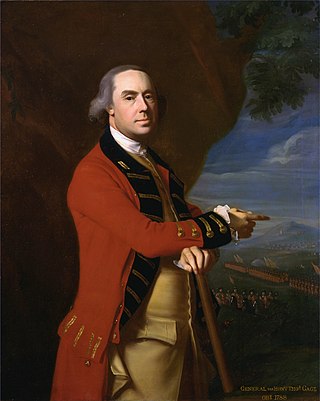
General Thomas Gage was a British Army general officer and colonial official best known for his many years of service in North America, including his role as British commander-in-chief in the early days of the American Revolution.

The Intolerable Acts, sometimes referred to as the Insufferable Acts or Coercive Acts, were a series of five punitive laws passed by the British Parliament in 1774 after the Boston Tea Party. The laws aimed to punish Massachusetts colonists for their defiance in the Tea Party protest of the Tea Act, a tax measure enacted by Parliament in May 1773. In Great Britain, these laws were referred to as the Coercive Acts. They were a key development leading to the outbreak of the American Revolutionary War in April 1775.
The Massachusetts Government Act was passed by the Parliament of Great Britain, receiving royal assent on 20 May 1774. The act effectively abrogated the 1691 charter of the Province of Massachusetts Bay and gave its royally-appointed governor wide-ranging powers. The colonists declared that it altered, by parliamentary fiat, the basic structure of colonial government, and vowed to block its implementation. The act was a major step on the road to the start of the American Revolution in 1775.

The Province of Massachusetts Bay was a colony in New England which became one of the thirteen original states of the United States. It was chartered on October 7, 1691, by William III and Mary II, the joint monarchs of the kingdoms of England, Scotland, and Ireland, and was based in the merging of several earlier British colonies in New England. The charter took effect on May 14, 1692, and included the Massachusetts Bay Colony, the Plymouth Colony, the Province of Maine, Martha's Vineyard, Nantucket, Nova Scotia, and New Brunswick; the Commonwealth of Massachusetts is the direct successor. Maine has been a separate state since 1820, and Nova Scotia and New Brunswick are now Canadian provinces, having been part of the colony only until 1697.

Joseph Warren, a Founding Father of the United States, was an American physician who was one of the most important figures in the Patriot movement in Boston during the early days of the American Revolution, eventually serving as President of the revolutionary Massachusetts Provincial Congress. Warren enlisted Paul Revere and William Dawes on April 18, 1775, to leave Boston and spread the alarm that the British garrison in Boston was setting out to raid the town of Concord and arrest rebel leaders John Hancock and Samuel Adams. Warren participated in the Battles of Lexington and Concord the following day, the opening engagements of the American Revolutionary War.

The Suffolk Resolves was a declaration made on September 9, 1774, by the leaders of Suffolk County, Massachusetts. The declaration rejected the Massachusetts Government Act and resulted in a boycott of imported goods from Britain unless the Intolerable Acts were repealed. The Resolves were recognized by statesman Edmund Burke as a major development in colonial animosity leading to adoption of the United States Declaration of Independence from the Kingdom of Great Britain in 1776, and he urged British conciliation with the American colonies, to little effect. The First Continental Congress endorsed the Resolves on September 17, 1774, and passed the similarly themed Continental Association on October 20, 1774.

The Powder Alarm was a major popular reaction to the removal of gunpowder from a magazine near Boston by British soldiers under orders from General Thomas Gage, royal governor of the Province of Massachusetts Bay, on September 1, 1774. In response to this action, amid rumors that blood had been shed, alarm spread through the countryside to Connecticut and beyond, and American Patriots sprang into action, fearing that war was at hand. Thousands of militiamen began streaming toward Boston and Cambridge, and mob action forced Loyalists and some government officials to flee to the protection of the British Army.

The Boston campaign was the opening campaign of the American Revolutionary War, taking place primarily in the Province of Massachusetts Bay. The campaign began with the Battles of Lexington and Concord on April 19, 1775, in which the local colonial militias interdicted a British government attempt to seize military stores and leaders in Concord, Massachusetts. The entire British expedition suffered significant casualties during a running battle back to Charlestown against an ever-growing number of militia.

The Gunpowder Incident was a conflict early in the American Revolutionary War between Lord Dunmore, the Royal Governor of the Colony of Virginia, and militia led by Patrick Henry. On April 20, 1775, one day after the Battles of Lexington and Concord, Lord Dunmore ordered the removal of the gunpowder from the magazine in Williamsburg, Virginia to a Royal Navy ship.

The Battles of Lexington and Concord was the first major military campaign of the American Revolutionary War, resulting in an American victory and outpouring of militia support for the anti-British cause. The battles were fought on April 19, 1775, in Middlesex County, Province of Massachusetts Bay, within the towns of Lexington, Concord, Lincoln, Menotomy, and Cambridge. They marked the outbreak of armed conflict between the Kingdom of Great Britain and Patriot militias from America's thirteen colonies.

The Hutchinson letters affair was an incident that increased tensions between the colonists of the Province of Massachusetts Bay and the British government prior to the American Revolution.
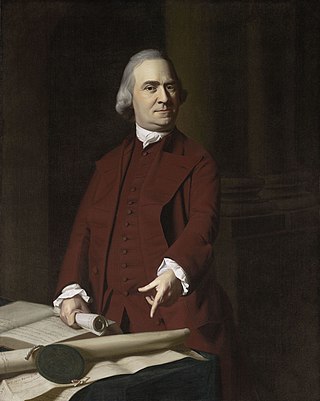
Samuel Adams was an American statesman, political philosopher, and a Founding Father of the United States. He was a politician in colonial Massachusetts, a leader of the movement that became the American Revolution, a signer of the Declaration of Independence and other founding documents, and one of the architects of the principles of American republicanism that shaped the political culture of the United States. He was a second cousin to his fellow Founding Father, President John Adams.

The Massachusetts Provincial Congress (1774–1780) was a provisional government created in the Province of Massachusetts Bay early in the American Revolution. Based on the terms of the colonial charter, it exercised de facto control over the rebellious portions of the province, and after the British withdrawal from Boston in March 1776, the entire province. When Massachusetts Bay declared its independence in 1776, the Congress continued to govern under this arrangement for several years. Increasing calls for constitutional change led to a failed proposal for a constitution produced by the Congress in 1778, and then a successful constitutional convention that produced a constitution for the state in 1780. The Provincial Congress came to an end with elections in October 1780.

Minutemen were members of the organized New England colonial militia companies trained in weaponry, tactics, and military strategies during the American Revolutionary War. They were known for being ready at a minute's notice, hence the name. Minutemen provided a highly mobile, rapidly deployed force that enabled the colonies to respond immediately to military threats. They were an evolution from the prior colonial rapid-response units.

The 1689 Boston revolt was a popular uprising on April 18, 1689 against the rule of Sir Edmund Andros, the governor of the Dominion of New England. A well-organized "mob" of provincial militia and citizens formed in the town of Boston, the capital of the dominion, and arrested dominion officials. Members of the Church of England were also taken into custody if they were believed to sympathize with the administration of the dominion. Neither faction sustained casualties during the revolt. Leaders of the former Massachusetts Bay Colony then reclaimed control of the government. In other colonies, members of governments displaced by the dominion were returned to power.

The Massachusetts Charter of 1691 was a charter that formally established the Province of Massachusetts Bay. Issued by the government of William III and Mary II, the corulers of the Kingdom of England, the charter defined the government of the colony, whose lands were drawn from those previously belonging to the Massachusetts Bay Colony, Plymouth Colony, and portions of the Province of New York. The territorial claims embodied in the charter also encompassed all of present-day Maine, New Brunswick, and Nova Scotia.

The Capture of Fort William and Mary took place in Portsmouth, New Hampshire, on December 14, 1774, when local Patriots led by John Langdon stormed Fort William and Mary guarding the mouth of the busy seaport. They overcame a six-man caretaker detachment and seized the garrison's powder, which was distributed through several towns in the colony for potential use in the looming struggle against Great Britain. On December 15, 1774, patriots led by John Sullivan again raided the fort, this time seizing numerous cannons, later used in the pivotal Battle of Bunker Hill.


