A retrovirus is a type of RNA virus that inserts a copy of its genome into the DNA of a host cell that it invades, thus changing the genome of that cell. Once inside the host cell's cytoplasm, the virus uses its own reverse transcriptase enzyme to produce DNA from its RNA genome, the reverse of the usual pattern, thus retro (backwards). The new DNA is then incorporated into the host cell genome by an integrase enzyme, at which point the retroviral DNA is referred to as a provirus. The host cell then treats the viral DNA as part of its own genome, transcribing and translating the viral genes along with the cell's own genes, producing the proteins required to assemble new copies of the virus.
An RNA virus is a virus that has RNA as its genetic material. This nucleic acid is usually single-stranded RNA (ssRNA) but may be double-stranded RNA (dsRNA). Notable human diseases caused by RNA viruses include the common cold, influenza, SARS, COVID-19, hepatitis C, hepatitis E, West Nile fever, Ebola virus disease, rabies, polio and measles.

A reverse transcriptase (RT) is an enzyme used to generate complementary DNA (cDNA) from an RNA template, a process termed reverse transcription. Reverse transcriptases are used by retroviruses to replicate their genomes, by retrotransposon mobile genetic elements to proliferate within the host genome, by eukaryotic cells to extend the telomeres at the ends of their linear chromosomes, and by some non-retroviruses such as the hepatitis B virus, a member of the Hepadnaviridae, which are dsDNA-RT viruses.

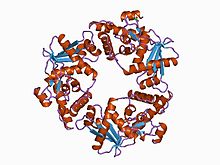
Retroviral integrase (IN) is an enzyme produced by a retrovirus that integrates—forms covalent links between—its DNA into that of the host cell it infects. Retroviral INs are not to be confused with phage integrases (recombinases), such as λ phage integrase, as discussed in site-specific recombination.

Chromosomal crossover, or crossing over, occurs when a child's chromosome is formed from joining together broken chunks of the two parents' chromosomes. Crossover is the exchange of genetic material between two homologous chromosomes non-sister chromatids that results in recombinant chromosomes during sexual reproduction. It is one of the final phases of genetic recombination, which occurs in the pachytene stage of prophase I of meiosis during a process called synapsis. Synapsis begins before the synaptonemal complex develops and is not completed until near the end of prophase I. Crossover usually occurs when matching regions on matching chromosomes break and then reconnect to the other chromosome.

A nuclease is an enzyme capable of cleaving the phosphodiester bonds between nucleotides of nucleic acids. Nucleases variously effect single and double stranded breaks in their target molecules. In living organisms, they are essential machinery for many aspects of DNA repair. Defects in certain nucleases can cause genetic instability or immunodeficiency. Nucleases are also extensively used in molecular cloning.

RecBCD is an enzyme of the E. coli bacterium that initiates recombinational repair from potentially lethal double strand breaks in DNA which may result from ionizing radiation, replication errors, endonucleases, oxidative damage, and a host of other factors. The RecBCD enzyme is both a helicase that unwinds, or separates the strands of DNA, and a nuclease that makes single-stranded nicks in DNA.
Microviridae is a family of bacteriophages with a single-stranded DNA genome. The name of this family is derived from the ancient Greek word μικρός (mikrós), meaning "small". This refers to the size of their genomes, which are among the smallest of the DNA viruses. Enterobacteria, intracellular parasitic bacteria, and spiroplasma serve as natural hosts. There are currently 21 species in this family, divided among six genera and two subfamilies.

Nucleoproteins are any proteins that are structurally associated with nucleic acids, either DNA or RNA. Typical nucleoproteins include ribosomes, nucleosomes and viral nucleocapsid proteins.

Homologous recombination is a type of genetic recombination in which nucleotide sequences are exchanged between two similar or identical molecules of double-stranded or single-stranded nucleic acids. It is most widely used by cells to accurately repair harmful breaks that occur on both strands of DNA, known as double-strand breaks (DSB). Homologous recombination also produces new combinations of DNA sequences during meiosis, the process by which eukaryotes make gamete cells, like sperm and egg cells in animals. These new combinations of DNA represent genetic variation in offspring, which in turn enables populations to adapt during the course of evolution. Homologous recombination is also used in horizontal gene transfer to exchange genetic material between different strains and species of bacteria and viruses.
Cre-Lox recombination is a site-specific recombinase technology, used to carry out deletions, insertions, translocations and inversions at specific sites in the DNA of cells. It allows the DNA modification to be targeted to a specific cell type or be triggered by a specific external stimulus. It is implemented both in eukaryotic and prokaryotic systems. The Cre-lox recombination system has been particularly useful to help neuroscientists to study the brain in which complex cell types and neural circuits come together to generate cognition and behaviors. NIH Blueprint for Neuroscience Research has created several hundreds of Cre driver mouse lines which are currently used by the worldwide neuroscience community.
Recombinases are genetic recombination enzymes.

RNA-dependent RNA polymerase or RNA replicase is an enzyme that catalyzes the replication of RNA from an RNA template. This is in contrast to a typical DNA-dependent RNA polymerase, which catalyzes the transcription of RNA from a DNA template.
P1 is a temperate bacteriophage that infects Escherichia coli and some other bacteria. When undergoing a lysogenic cycle the phage genome exists as a plasmid in the bacterium unlike other phages that integrate into the host DNA. P1 has an icosahedral head containing the DNA attached to a contractile tail with six tail fibers. The P1 phage has gained research interest because it can be used to transfer DNA from one bacterial cell to another in a process known as transduction. As it replicates during its lytic cycle it captures fragments of the host chromosome. If the resulting viral particles are used to infect a different host the captured DNA fragments can be integrated into the new host's genome. This method of in vivo genetic engineering was widely used for many years and is still used today, though to a lesser extent. P1 can also be used to create the P1-derived artificial chromosome cloning vector which can carry relatively large fragments of DNA. P1 encodes a site-specific recombinase, Cre, that is widely used to carry out cell-specific or time-specific DNA recombination by flanking the target DNA with loxP sites.
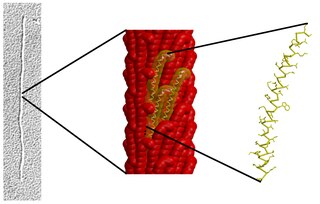
Inovirus is a genus of viruses, in the family Inoviridae. Gram-positive and gram-negative bacteria serve as natural hosts. There are currently many species in this genus including the type species Enterobacteria phage M13. The name of the genus is derived from the Greek word Ίνα meaning 'fibre'.
Spiraviridae is a family of viruses that replicate in hyperthermophilic archaea of the genus Aeropyrum, specifically Aeropyrum pernix. The family contains one genus, Alphaspiravirus, which contains one species, the Aeropyrum coil-shaped virus (ACV). The virions of ACV are non-enveloped and in the shape of hollow cylinders that are formed by a coiling fiber that consists of two intertwining halves of the circular DNA strand inside a capsid. An appendage protrudes from each end of the cylindrical virion. The viral genome is positive-sense, single-stranded DNA ( ssDNA) and encodes for significantly more genes than other known ssDNA viruses. ACV is also unique in that it appears to lack its own enzymes to aid replication, instead likely using the host cell's replisomes. ACV has no known relation to any other archaea-infecting viruses, but it does share its coil-like morphology with some other archaeal viruses, suggesting that such viruses may be an ancient lineage that only infect archaea.

A positive-sense single-stranded RNA virus is a virus that uses positive sense single stranded RNA as its genetic material. Single stranded RNA viruses are classified as positive or negative depending on the sense or polarity of the RNA. The positive-sense viral RNA genome can serve as messenger RNA and can be translated into protein in the host cell. Positive-sense ssRNA viruses belong to Group IV in the Baltimore classification. Positive-sense RNA viruses account for a large fraction of known viruses, including many pathogens such as the hepacivirus C, West Nile virus, dengue virus, SARS and MERS coronaviruses, and SARS-CoV-2 as well as less clinically serious pathogens such as the rhinoviruses that cause the common cold.
Ortervirales is an order that contains single-stranded RNA viruses that replicate through a DNA intermediate and double-stranded DNA viruses that replicate through an RNA intermediate . The name is derived from the reverse of retro.
Riboviria is a realm of viruses that includes all viruses that encode an RNA-dependent polymerase, enzymes that synthesize nucleic acid from an RNA strand. There are two types of RNA-dependent polymerases: RNA-dependent RNA polymerase (RdRP), also called RNA replicase, which produces ribonucleic acid (RNA) from RNA, and RNA-dependent DNA polymerase (RdDP), also called reverse transcriptase, which produces deoxyribonucleic acid (DNA) from RNA. These enzymes are vital for the viral life cycle and most commonly have two functions: playing an essential role in transcribing the virus's genes into messenger RNA (mRNA), and replicating the virus's genes from copies of the viral genome as part of the process of producing new viruses inside of the host cell.
Monodnaviria is a realm of viruses that includes all single-stranded DNA viruses that encode an endonuclease of the HUH superfamily that initiates rolling circle replication of the circular viral genome and all other viruses descended from any such virus. After the viral DNA enters a cell, it is converted to a double-stranded form. The endonuclease then cleaves and bonds to the viral DNA at a specific site, leaving an open end. The host cell's DNA polymerase begins replication of the viral genome from this open end, extending the open end of the cleaved strand while using the uncleaved strand as a template for replication, which progresses in a loop around the circular genome.