Summary
In Federalist No. 72, Alexander Hamilton argues that re-eligibility is essential to executive power. He believed that the Presidency must attract the most ambitious individuals and re-eligibility ensured that they would not attempt to extend their term in office unconstitutionally. While Hamilton hoped for a class of 'disinterested' public servants, he acknowledged the importance of self-interest, stating that "the desire for reward is one of the strongest incentives of human conduct." [2]
Hamilton believed that executives should be eligible to serve as many terms as the American people allow. He argued that limits on re-eligibility would hamper an experienced president to use his past expertise. In addition, Hamilton argued that term limits prevent an executive from using experience gained in emergency situations in other terms and that term limits restrict stability within the executive.
The Twenty-second Amendment to the Constitution imposed the present two-tier term limit on the executive branch. Today, U.S. presidents can only serve two terms, or if a succession has taken place, ten years, as president of the country.

The Federalist Papers is a collection of 85 articles and essays written by Alexander Hamilton, James Madison, and John Jay under the collective pseudonym "Publius" to promote the ratification of the Constitution of the United States. The collection was commonly known as The Federalist until the name The Federalist Papers emerged in the twentieth century.
Federalist No. 10 is an essay written by James Madison as the tenth of The Federalist Papers, a series of essays initiated by Alexander Hamilton arguing for the ratification of the United States Constitution. It was first published in The Daily Advertiser on November 22, 1787, under the name "Publius". Federalist No. 10 is among the most highly regarded of all American political writings.

Federalist No. 9, titled "The Union as a Safeguard Against Domestic Faction and Insurrection", is a political essay by Alexander Hamilton and the eighth of The Federalist Papers. It was first published in the Daily Advertiser and the Independent Journal on November 21, 1787, under the pseudonym Publius, the name under which all The Federalist Papers were published. It expressed ideas that became the foundation of Federalist No. 10, the most influential of The Federalist Papers.
Federalist No. 23, titled "The Necessity of a Government as Energetic as the One Proposed to the Preservation of the Union", is a political essay written by Alexander Hamilton and the twenty-third of The Federalist Papers. It was first published in New York newspapers on December 18, 1787, under the pseudonym Publius, the name under which all The Federalist Papers were published. This entry shifted the focus of the series, beginning an extended analysis of the proposed constitution and its provisions regarding commerce and national defense.
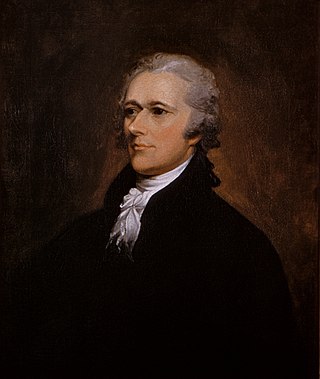
Federalist No. 78 is an essay by Alexander Hamilton, the seventy-eighth of The Federalist Papers. Like all of The Federalist papers, it was published under the pseudonym Publius.
Federalist No. 1, titled "General Introduction", is an essay by Alexander Hamilton. It is the first essay of The Federalist Papers, and it serves as a general outline of the ideas that the writers wished to explore regarding the proposed constitution of the United States. The essay was first published in The Independent Journal on October 27, 1787, under the pseudonym Publius, the name under which all essays of The Federalist Papers were published.
Federalist No. 6, titled "Concerning Dangers from Dissensions Between the States", is a political essay written by Alexander Hamilton and the sixth of The Federalist Papers. It was first published in the Independent Journal on November 14, 1787, under the pseudonym Publius, the name under which all The Federalist Papers were published. It is one of two essays by Hamilton advocating political union to prevent the states from going to war with one another. This argument is continued in Federalist No. 7.
Federalist No. 7, titled "The Same Subject Continued: Concerning Dangers from Dissensions Between the States", is a political essay by Alexander Hamilton and the seventh of The Federalist Papers. It was first published in the Independent Journal on November 17, 1787, under the pseudonym Publius, the name under which all The Federalist Papers were published. It is one of two essays by Hamilton advocating political union to prevent the states from going to war with one another. Federalist No. 7 continues the argument that was developed in Federalist No. 6.
Federalist No. 24, titled "The Powers Necessary to the Common Defense Further Considered", is a political essay written by Alexander Hamilton and the twenty-fourth of The Federalist Papers. It was first published in New York newspapers on December 19, 1787, under the pseudonym Publius, the name under which all The Federalist Papers were published. It is one of two essays by Hamilton arguing in favor of a national standing army during peacetime, along with Federalist No. 25.
Federalist No. 25, titled "The Same Subject Continued: The Powers Necessary to the Common Defense Further Considered", is a political essay written by Alexander Hamilton and the twenty-fifth of The Federalist Papers. It was first published in New York newspapers on December 21, 1787, under the pseudonym Publius, the name under which all The Federalist Papers were published. It is one of two essays by Hamilton arguing in favor of a national standing army during peacetime, along with Federalist No. 24.
Federalist No. 27, titled "The Same Subject Continued: The Idea of Restraining the Legislative Authority in Regard to the Common Defense Considered", is an essay by Alexander Hamilton, the twenty-seventh of The Federalist Papers. It was published on December 25, 1787, under the pseudonym Publius, the name under which all The Federalist papers were published. Federalist No. 27 is the second of three successive essays covering the relationship between legislative authority and military force, preceded by Federalist No. 26, and succeeded by Federalist No. 28.
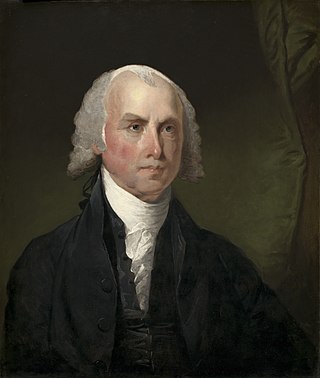
Federalist No. 41, titled "General View of the Powers Conferred by the Constitution", is an essay written by James Madison as the forty-first of The Federalist Papers. These essays were published by Alexander Hamilton, with John Jay and James Madison serving as co-authors, under the pseudonym "Publius." No. 41 was first published by The New York Packet on January 19, 1788 and argues about the necessity of the powers the Constitution vested upon the general government as well as the meaning of the phrase "general welfare".
Federalist No. 67 is an essay by Alexander Hamilton, the sixty-seventh of The Federalist Papers. This essay's title is "The Executive Department" and begins a series of eleven separate papers discussing the powers and limitations of that branch. Federalist No. 67 was published under the pseudonym Publius, like the rest of the Federalist Papers. It was published in the New York Packet on Tuesday, March 11, 1788.
Federalist No. 68 is the 68th essay of The Federalist Papers, and was published on March 12, 1788. It was probably written by Alexander Hamilton under the pseudonym "Publius", the name under which all of the Federalist Papers were published. Since all of them were written under this pseudonym, who wrote what cannot be verified with certainty. Titled "The Mode of Electing the President", No. 68 describes a perspective on the process selecting the chief executive of the United States. In this essay, the author sought to convince the people of New York of the merits of the proposed constitution. Number 68 is the second in a series of 11 essays discussing the powers and limitations of the executive branch and the only one to describe the method of selecting the president.
Federalist No. 70, titled "The Executive Department Further Considered", is an essay written by Alexander Hamilton arguing for a single, robust executive provided for in the United States Constitution. It was originally published on March 15, 1788, in The New York Packet under the pseudonym Publius as part of The Federalist Papers and as the fourth in Hamilton's series of eleven essays discussing executive power.
Federalist No. 71 is an essay by Alexander Hamilton, the seventy-first of The Federalist Papers. It was published on March 18, 1788, under the pseudonym Publius, the name under which all The Federalist papers were published. Its title is "The Duration in Office of the Executive", and it is the fifth in a series of 11 essays discussing the powers and limitations of the executive branch.
Federalist No. 73 is an essay by the 18th-century American statesman Alexander Hamilton. It is the seventy-third of The Federalist Papers, a collection of articles written to promote the ratification of the United States Constitution. It was published on March 21, 1788, under the pseudonym Publius, the name under which all The Federalist papers were published. Its title is "The Provision For The Support of the Executive, and the Veto Power", and it is the seventh in a series of 11 essays discussing the powers and limitations of the Executive branch of the United States government.
Federalist No. 76, written by Alexander Hamilton, was published on April 1, 1788. The Federalist Papers are a series of eighty-five essays written to urge the ratification of the United States Constitution. These letters were written by Alexander Hamilton, James Madison, and John Jay under the name of Publius in the late 1780s. This paper discusses the arrangement of the power of appointment and the system of checks and balances. The title is "The Appointing Power of the Executive", and is the tenth in a series of 11 essays discussing the powers and limitations of the Executive branch. There are three options for entrusting power: a single individual, a select congregation, or an individual with the unanimity of the assembly. Hamilton supported bestowing the president with the nominating power but the ratifying power would be granted to the senate in order to have a process with the least bias.
Federalist No. 77 is an essay by Alexander Hamilton, the seventy-seventh of The Federalist Papers. It was published on April 2, 1788, under the pseudonym Publius, the name under which all The Federalist papers were published. The title is "The Appointing Power Continued and Other Powers of the Executive Considered", and it is the last in a series of 11 essays discussing the powers and limitations of the Executive Branch.
Federalist No. 80 is an essay by Alexander Hamilton, the eightieth of The Federalist Papers. It was published on June 21, 1788 under the pseudonym Publius, the name under which all The Federalist papers were published. It is titled "The Powers of the Judiciary", and it is the third in a series of six essays discussing the powers and limitations of the judicial branch.

