
The Federalist Papers is a collection of 85 articles and essays written by Alexander Hamilton, James Madison, and John Jay under the collective pseudonym "Publius" to promote the ratification of the Constitution of the United States. The collection was commonly known as The Federalist until the name The Federalist Papers emerged in the twentieth century.
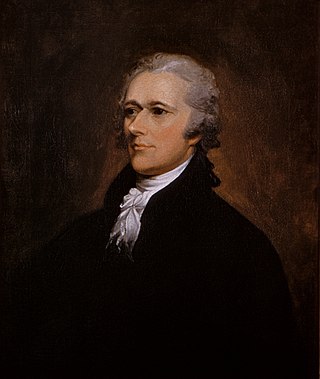
Federalist No. 78 is an essay by Alexander Hamilton, the seventy-eighth of The Federalist Papers. Like all of The Federalist papers, it was published under the pseudonym Publius.

Federalist No. 8, titled "Consequences of Hostilities Between the States", is a political essay by Alexander Hamilton and the eighth of The Federalist Papers. It was first published in the New-York Packet on November 20, 1787, under the pseudonym Publius, the name under which all The Federalist Papers were published. It was a response to critics of a national standing army, and it examines a scenario in which the states of the United States are not unified and military conflict occurs between them.
Federalist No. 11 is an essay by Alexander Hamilton, the eleventh of The Federalist Papers. It was first published in The Independent Journal on November 23, 1787 under the pseudonym Publius, the name under which all The Federalist papers were published. It is titled "The Utility of the Union in Respect to Commercial Relations and a Navy".
Federalist No. 13 is an essay by Alexander Hamilton, the thirteenth of The Federalist Papers. It was first published in The Independent Journal on November 28, 1787, under the pseudonym Publius, the name under which all The Federalist papers were published. It is titled "Advantage of the Union in Respect to Economy in Government".
Federalist No. 24, titled "The Powers Necessary to the Common Defense Further Considered", is a political essay written by Alexander Hamilton and the twenty-fourth of The Federalist Papers. It was first published in New York newspapers on December 19, 1787, under the pseudonym Publius, the name under which all The Federalist Papers were published. It is one of two essays by Hamilton arguing in favor of a national standing army during peacetime, along with Federalist No. 25.
Federalist No. 25, titled "The Same Subject Continued: The Powers Necessary to the Common Defense Further Considered", is a political essay written by Alexander Hamilton and the twenty-fifth of The Federalist Papers. It was first published in New York newspapers on December 21, 1787, under the pseudonym Publius, the name under which all The Federalist Papers were published. It is one of two essays by Hamilton arguing in favor of a national standing army during peacetime, along with Federalist No. 24.
Federalist No. 26, titled "The Idea of Restraining the Legislative Authority in Regard to the Common Defense Considered", is an essay written by Alexander Hamilton in the twenty-sixth of The Federalist Papers. It was published on December 22, 1787, under the pseudonym Publius, the name under which all The Federalist papers were published. Federalist No. 26 expands upon the arguments of a federal military Hamilton made in No. 24 and No. 25, and it is directly continued in No. 27 and No. 28.

Federalist No. 64, titled "The Power of the Senate", is an essay first published in The New York Packet on March 5, 1788, by John Jay as part of the ongoing Federalist Papers. Throughout the Federalist Papers, James Madison, Alexander Hamilton, and Jay emphasize the particular role in the field of foreign affairs (Golove). However, Federalist No. 64 specifically focuses more deeply on the concept of treaties and how they are formed. This essay in the Federalist Papers is very influential, discussing the idea of treaties, the mystery behind the author, and the invalidity of the Anti-Federalists' argument.
Federalist No. 67 is an essay by Alexander Hamilton, the sixty-seventh of The Federalist Papers. This essay's title is "The Executive Department" and begins a series of eleven separate papers discussing the powers and limitations of that branch. Federalist No. 67 was published under the pseudonym Publius, like the rest of the Federalist Papers. It was published in the New York Packet on Tuesday, March 11, 1788.
Federalist No. 68 is the 68th essay of The Federalist Papers, and was published on March 12, 1788. It was probably written by Alexander Hamilton under the pseudonym "Publius", the name under which all of the Federalist Papers were published. Since all of them were written under this pseudonym, who wrote what cannot be verified with certainty. Titled "The Mode of Electing the President", No. 68 describes a perspective on the process selecting the chief executive of the United States. In this essay, the author sought to convince the people of New York of the merits of the proposed constitution. Number 68 is the second in a series of 11 essays discussing the powers and limitations of the executive branch and the only one to describe the method of selecting the president.
Federalist No. 69 is an essay by Alexander Hamilton, the sixty-ninth of The Federalist Papers. It was published on March 14, 1788 under the pseudonym Publius, under which all The Federalist papers were published. The title is "The Real Character of the Executive", and is the third in a series of 11 essays discussing the powers and limitations of the Executive branch in response to the Anti-Federalist Papers, and in comparison to the King of Great Britain's powers.
Federalist No. 70, titled "The Executive Department Further Considered", is an essay written by Alexander Hamilton arguing for a single, robust executive provided for in the United States Constitution. It was originally published on March 15, 1788, in The New York Packet under the pseudonym Publius as part of The Federalist Papers and as the fourth in Hamilton's series of eleven essays discussing executive power.
Federalist No. 71 is an essay by Alexander Hamilton, the seventy-first of The Federalist Papers. It was published on March 18, 1788, under the pseudonym Publius, the name under which all The Federalist papers were published. Its title is "The Duration in Office of the Executive", and it is the fifth in a series of 11 essays discussing the powers and limitations of the executive branch.
Federalist No. 72, titled "The Same Subject Continued, and Re-Eligibility of the Executive Considered", is an essay by Alexander Hamilton. It is the seventy-second essay of The Federalist Papers and the sixth in a series of eleven essays discussing the powers of the Executive branch. The essay was first published in The New York Packet on March 18, 1788, under the pseudonym Publius, the name under which all essays of The Federalist Papers were published.
Federalist No. 73 is an essay by the 18th-century American statesman Alexander Hamilton. It is the seventy-third of The Federalist Papers, a collection of articles written to promote the ratification of the United States Constitution. It was published on March 21, 1788, under the pseudonym Publius, the name under which all The Federalist papers were published. Its title is "The Provision For The Support of the Executive, and the Veto Power", and it is the seventh in a series of 11 essays discussing the powers and limitations of the Executive branch of the United States government.
Federalist No. 75 is an essay by Alexander Hamilton and seventy-fifth in the series of The Federalist Papers. It was published on March 26, 1788 under the pseudonym Publius, the name under which all The Federalist papers were published. Its title is "The Treaty Making Power of the Executive", and it is the ninth in a series of 11 essays discussing the powers and limitations of the Executive branch.
Federalist No. 76, written by Alexander Hamilton, was published on April 1, 1788. The Federalist Papers are a series of eighty-five essays written to urge the ratification of the United States Constitution. These letters were written by Alexander Hamilton, James Madison, and John Jay under the name of Publius in the late 1780s. This paper discusses the arrangement of the power of appointment and the system of checks and balances. The title is "The Appointing Power of the Executive", and is the tenth in a series of 11 essays discussing the powers and limitations of the Executive branch. There are three options for entrusting power: a single individual, a select congregation, or an individual with the unanimity of the assembly. Hamilton supported bestowing the president with the nominating power but the ratifying power would be granted to the senate in order to have a process with the least bias.
Federalist No. 77 is an essay by Alexander Hamilton, the seventy-seventh of The Federalist Papers. It was published on April 2, 1788, under the pseudonym Publius, the name under which all The Federalist papers were published. The title is "The Appointing Power Continued and Other Powers of the Executive Considered", and it is the last in a series of 11 essays discussing the powers and limitations of the Executive Branch.
Federalist No. 80 is an essay by Alexander Hamilton, the eightieth of The Federalist Papers. It was published on June 21, 1788 under the pseudonym Publius, the name under which all The Federalist papers were published. It is titled "The Powers of the Judiciary", and it is the third in a series of six essays discussing the powers and limitations of the judicial branch.


