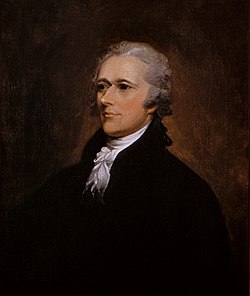
Federalist No. 70, titled "The Executive Department Further Considered",[1] is an essay written by Alexander Hamilton arguing that a unitary executive is consistent with a republican form of government. It was originally published on March 15, 1788, in The New York Packet under the pseudonym Publius as part of The Federalist Papers and as the fourth in Hamilton's series of eleven essays discussing executive power.
As part of the Federalists' effort to encourage the ratification of the Constitution, Hamilton wrote Federalist No. 70 to refute the argument that a unitary executive would be too similar to the British monarchy and to convince the states of the necessity of unity in the executive branch.[2]
Summary
The main subject of Federalist 70-77 is Hamilton's defense of a vigorous Executive. Offering a counterpoint to the view that "a vigorous executive is inconsistent with the genius of republican government", Hamilton proclaims "Energy in the executive is a leading character in the definition of good government".[3] Federalist No. 70 does not go into detail about the separation of powers.[4]
Historical background
Resistance to a "supreme executive magistracy"[1] began well before the emergence of the Anti-Federalist Papers. Most state constitutions, in a reaction to colonial rule, were primarily concerned with a declaration of rights and weakening executive power, and so the Articles of Confederation had not provided for a separate executive branch.[5][6]
During the Constitutional Convention, some of the delegates proposed three leaders instead of one. Edmund Randolph, who presented the Virginia Plan to the Convention in May 1787, was the most outspoken opponent of the unitary executive, arguing that it would be unpopular with the people and could easily become monarchical.[7]
Others, including Hamilton, argued that one strong leader would be more decisive and accountable. James Wilson, seconded by Charles Pinckney, proposed "a national executive to consist of a single person".[8][9][10]
Although several delegates opposed the unitary executive proposed by Wilson, the single executive was approved by a vote of 7 to 3.[11] According to some historians, Wilson's opponents may have prevailed if George Washington had not attended the convention in person.[12]
Philosophical influences
Jean-Louis de Lolme, quoted in Federalist No. 70 as saying, "the executive power is more easily confined when it is ONE".
In Federalist No. 70, Hamilton cites an influential but lesser-known writer Jean-Louis de Lolme to support his argument that a unitary executive will have the greatest accountability to the people.[13][pageneeded]
Harvey Mansfield speculated that David Hume, John Locke and Montesquieu, although not cited by name on Federalist No. 70, may be counted among the "politicians and statesmen who are the most celebrated for the soundness of their principles and [...] have declared in favor of a single executive and a numerous legislature".[14][15]
Hamilton's argument for a unitary executive
In contrast to Federalist No. 68's description of the Office of the Presidency as a "trust...confided" by the people through elections, Federalist No. 70 emphasizes the unitary structure of the executive. The strong executive must be unitary, Hamilton says, because "unity is conducive to energy...[d]ecision, activity, secrecy, and dispatch will generally characterize the proceedings of one man in a much more eminent degree than the proceedings of any greater number."[16] Although Hamilton does not provide a specific definition for "executive power", the inclusion of "unity" is widely understood to be a reference to the Vesting Clause.[a][17][18][19]
In other essays Hamilton discusses in more detail the three other ingredients of energy mentioned in Federalist No. 71: duration, an adequate provision for its support (salary) and competent powers.[20]
Alexander Hamilton wrote Federalist No. 70 to defend the unitary structure of the executive from critics who compared it to a monarchy by arguing that unity was a necessary ingredient of energy.[4] Energy in the executive, he said, is "the leading character in the definition of good government"[13][21] because it is "essential to the protection of the community against foreign attacks...to the steady administration of the laws; to the protection of property... to the security of liberty against the enterprises and assaults of ambition, of faction, and of anarchy".[22] He argued that "decision, activity, secrecy, dispatch" are weakened or diminished when power is shared by multiple leaders.[23]
"Foreign attacks"
The core argument of Federalist No. 70 was that a unitary executive was a necessary ingredient for a quick, decisive executive to conduct war.[24][pageneeded]
"Administration of laws"
Responding to modern debates about the nature of "executive power" Steven Calabresi and Saikrishna Prakash point to Hamilton's comment that "energy in the executive... is not less essential to the steady administration of laws", and his argument that an "artful cabal" forming in a plural executive would "enervate the whole system of administration".[25]
Accountability
Hamilton, in response to opponents of the unitary executive, argues in Federalist No. 70 that a plural executive leads to a lack of accountability.[26] Hamilton bolsters his argument by claiming that misconduct and disagreements among members of the council of Rome contributed to the Roman Empire's decline.[2][27] He warns that America should be more afraid of reproducing the plural executive structure of Rome than of the "ambition of a single individual."[1]
According to Hamilton, a unitary executive is best-suited to promoting accountability in government because it is easier to point blame at one person than to distinguish fault among members of a group. Because a unitary executive cannot "cloak" his failings by blaming council members, he has a strong incentive towards good behavior in office. Hamilton concludes the essay by reminding us that "the UNITY of the executive of this State was one of the best of the distinguishing features of our constitution."[28][pageneeded]
Support
Hamiltonian support can be defined as a presidential salary, which insulates government officials from corruption by attracting capable, honest men to office.[4][29] According to Hamilton, public service does not provide men with fame or glory, so ample pay is necessary to attract talented politicians.[29] Hamilton further expands upon his arguments for executive support in his essay Federalist No. 73.[citation needed]
Contemporaneous opposition to the unitary executive
The Anti-Federalist Papers and opposition to the Constitution
While most of the Anti-Federalists' arguments did concern the presidency, some Anti-Federalist publications did directly contest Hamilton's position in Federalist 70 for unity in the executive branch.[30][31]
In response to the exclusion of an executive council in the Constitution, Mason published his "Objections to the Constitution" on November 22, 1787, in the Virginia Journal.[32] In this manuscript, originally written on the back of an early draft of the Constitution, Mason warned that the lack of a council would make for an unadvised president, who would act within the interests of friends, rather than the people at large:[32]
The President of the United States has no Constitutional Council, a thing unknown in any safe and regular government. He will therefore be unsupported by proper information and advice, and will generally be directed by minions and favorites...[32]
Richard Henry Lee, another prominent Anti-Federalist, exchanged letters with Mason, in which he too expressed concern about the unitary executive, supporting the constitutional addition of a privy council.[30][33] In Anti-Federalist No. 74, titled "The President as a Military King," Philadelphiensis (likely, Benjamin Workman) wrote primarily against the president's military powers, but added that the lack of a constitutional executive council would add to the danger of a powerful presidency:
And to complete his uncontrolled sway, [the President] is neither restrained nor assisted by a privy council, which is a novelty in government. I challenge the politicians of the whole continent to find in any period of history a monarch more absolute. . . .[34]
On December 18, 1787, after the Convention of Pennsylvania, which ultimately ratified the Constitution, the minority published its reasons for dissent to its constituents.[35] In this address, written most likely by Samuel Bryan and signed by twenty-one members of the minority, the lack of an executive council is enumerated as the twelfth of fourteen reasons for dissent:
12. That the legislative, executive, and judicial powers be kept separate; and to this end that a constitutional council be appointed, to advise and assist the president, who shall be responsible for the advice they give, hereby the senators would be relieved from almost constant attendance; and also that the judges be made completely independent.[35]
Though he was in England at the time of the Anti-Federalist Papers, Thomas Paine, whose pamphlet Common Sense served as motivation for independence from British rule during the American Revolution, also opposed the unitary executive.[36] While this position was already evidenced from his role as Clerk to the Pennsylvania Assembly during the writing of Pennsylvania's 1776 Constitution,[37] he clearly stated it in a letter to George Washington in 1796.[36] In this letter, Paine argued for a plural executive on the grounds that a unitary executive would become head of a party and that a republic should not debase itself by obeying an individual.[36]
Applications and modern relevance
The war on terror
Federalist No.70 as a justification for executive power
John Yoo, legal advisor to the George W. Bush administration, used Federalist No.70 to defend the President's foreign policy
As the Bush Administration's Deputy Assistant Attorney General, John Yoo argued that "centralization of authority in the President alone", meaning the Constitution's vesting of executive power in a single president by Article II of the United States Constitution, ensured a "unity in purpose [...] where a unitary executive can evaluate threats, consider policy choices, and mobilize military and diplomatic resources with a speed and energy that is far superior to any other branch."[38]
Yoo has also cited Federalist No. 70 in his support of the President's right to unilaterally conduct operations against terrorists without congressional consent.[38][20] He claims that this power applies to operations against both individuals and states.[38][20]
President George W. Bush explicitly invoked the discourse of Federalist No. 70 in declaring that he was allowed to operate outside of the law when it conflicted with his prerogatives as the head of "the unitary executive branch."[4][39][40] For example, when signing the 2005 Detainee Treatment Act, Bush applied Hamilton's unitary executive theory to claim the right to work outside the provisions of the Act when they conflicted with his responsibilities as Commander in Chief.[39][40]
President Obama has also used signing statements to expand his executive power, specifically by issuing a 2011 statement on an omnibus year-end spending bill.[40][41] It has been speculated that this statement was made to nullify provisions of the bill that limited Obama's ability to deal with prisoners at Guantanamo Bay, thus expanding Obama's executive power.[41] This action has been explicitly compared to Bush's 2005 signing of the Detainee Treatment Act.[41]
Controversy
Critics of the Bush Administration have argued that any executive, as envisioned by Alexander Hamilton in Federalist No. 70, must act within the limits imposed by other provisions of the United States Constitution[4] and that the concept of the unitary executive does not allow the president to work outside laws passed by Congress, even when they conflict with national security interests.[39] President Bush could have asked Congress to amend the Foreign Intelligence Surveillance Act or retroactively obtained warrants under the existing law. His decision to conduct warrantless electronic surveillance in secret was criticized by his own staff and Attorney General John Ashcroft.[42] President Obama has been similarly criticized for operating outside the law, despite statements at the beginning of his presidency which showed a desire to limit the use of signing statements to expand executive power.[40][43][44]
Judicial applications
Executive unity
Recently, Federalist No. 70 has become associated with Unitary Executive Theory, and has been invoked to support the claim that the president should have primary responsibility over the entire executive branch. This theory was particularly relevant to Justice Antonin Scalia's 1988 dissent in the Supreme Court Case Morrison v. Olson, in which he argued that an investigation of the executive branch by independent counsel was unconstitutional because criminal prosecution was purely an executive power, held in its entirety by the president.[45] Scalia also cited Federalist No. 70 in his decision on Printz v. United States. Printz v. United States concerned the constitutionality of the Brady Handgun Violence Prevention Act, a federal law that would have obligated state law enforcement officers to help enforce federal gun regulations.[46][47] Scalia argued:
The Brady Act effectively transfers this responsibility to thousands of CLEOs [chief law enforcement officers] in the 50 States, who are left to implement the program without meaningful Presidential control (if indeed meaningful Presidential control is possible without the power to appoint and remove). The insistence of the Framers upon unity in the Federal Executive--to ensure both vigor and accountability--is well known. See The Federalist No. 70.[46]
Executive power
Federalist No. 70 has been cited in several Supreme Court dissents as a justification for the expansion of executive power.[48][49] For example, in his 1952 dissenting opinion in Youngstown Sheet & Tube Co. v. Sawyer, chief justice Fred M. Vinson wrote:
This comprehensive grant of the executive power to a single person was bestowed soon after the country had thrown the yoke of monarchy… Hamilton added: 'Energy in the Executive is a leading character in the definition of good government. It is essential to the protection of the community against foreign attacks; it is not less essential to the steady administration of the law, to the protection of property against those irregular and high-handed combinations which sometimes interrupt the ordinary course of justice...' It is thus apparent that the Presidency was deliberately fashioned as an office of power and independence. Of course, the Framers created no autocrat capable of arrogating any power unto himself at any time.[49]
Vinson referenced Federalist No. 70's arguments about energy in the executive to argue that the president should be allowed to seize private property in a time of national crisis.[50] In a more recent 2004 case, Hamdi v. Rumsfeld, Justice Clarence Thomas used Federalist No. 70 to make the case that the president should have the power to suspend Habeas Corpus for American citizens in order to fight the war on terror.[51][52]
In both cases, the majority of the court was not persuaded that the expansions in executive power in question were justified.[48][49][52]
Presidential accountability
Federalist No. 70 has also been cited by the Supreme Court as an authority on the importance of presidential accountability.[53] In its 1997 opinion in Clinton v. Jones, the court weighed whether or not a sitting president could delay addressing civil litigation until the end of his or her term.[53][54] The court cited Federalist No. 70, stating that the president must be held accountable for his or her actions, and thus cannot be granted immunity from civil litigation.[55] However, in the 2010 case of Free Enterprise Fund v. Public Company Accounting Oversight Board, the court cited the need for executive accountability as a basis to expand presidential power.[56] Writing the majority opinion, Chief Justice John Roberts stated:
The Constitution that makes the President accountable to the people for executing the laws also gives him the power to do so. That power includes, as a general matter, the authority to remove those who assist him in carrying out his duties. Without such power, the President could not be held fully accountable for discharging his own responsibilities; the buck would stop somewhere else. Such diffusion of authority "would greatly diminish the intended and necessary responsibility of the chief magistrate himself." The Federalist No. 70, at 478.[56]
Roberts argued that the act in question deprived the president of the ability to hold members of an independent board accountable, thus freeing him or her of responsibility over the independent board's actions and depriving the people of their ability to hold the president accountable.[56][57]
12Coenen, Dan T. (2006). "A Rhetoric for Ratification: The Argument of "The Federalist" and Its Impact on Constitutional Interpretation". Duke Law Journal. 56 (2): 469–543. JSTOR40040551. SSRN943412. GaleA157589903.
↑Mansfield, Harvey C. (1989). Taming the Price. Alexander Hamilton defined his task in The Federalist as disproving the idea 'that a vigorous executive is inconsistent with the genius of republican government' (Federalist 70).
↑Beeman, Richard (2009). Plain, Honest Men: The Making of the American Constitution. Random House Publishing Group. ISBN978-1-58836-726-6. It was in this atmosphere of powerful memories of a tyrannical king, tempered by the realization that governments did occasionally need to speak for the people with a single voice, that the Founding Fathers began to imagine the character and authority of their new national chief executive.
↑Hoff, Samuel B. (1987). "A Bicentennial Assessment of Hamilton's Energetic Executive". Presidential Studies Quarterly. 17 (4): 725–739. JSTOR27550481.
↑Beeman (2009), p. 128: While Randolph agreed with Wilson that the executive branch needed to have “vigor, dispatch, and responsibility,” he was dead set against the accumulation of executive power in the hands of a single person. With images of King George III still imprinted on his memory, he believed that a unitary executive contained within it “the foetus of monarchy.”
↑Beeman (2009), p. 128: Had Washington been absent, it is entirely possible that the framers of the Constitution would have created a multiple executive.
12Corwin, Edward Samuel. "President, office and powers." (1948): [Hamilton] expressed entire agreement with De Lolme's contention that "the executive power is more easily confined when it is ONE"; that it is far more safe there should be a single object for the jealousy and watchfulness of the people, and, in a word, that all multiplication of the Executive is rather dangerous than friendly to liberty. "
↑Weaver, David R. (1997). "Leadership, Locke, and the Federalist". American Journal of Political Science. 41 (2): 420–446. doi:10.2307/2111771. JSTOR2111771.
↑Weaver, David R. (1997). "Leadership, Locke, and the Federalist". American Journal of Political Science. 41 (2): 420–446. doi:10.2307/2111771. JSTOR2111771.
↑Lessig, Lawrence; Sunstein, Cass R. (1994). "President and Administration". Columbia Law Review. 94 (1): 54. The Vesting Clause of Article II designates the President as the holder of "the executive power"—not a council, not a triumvirate, but a single person. The balance of Article II defines what that executive power is. More specifically, it defines what executive powers the President can exercise as a matter of constitutional prerogative; other powers Congress can grant if it thinks proper."
↑Loss, Richard (1982). "Hamilton and the Modern Presidency: Continuity or Discontinuity?". Presidential Studies Quarterly. 12. JSTOR27547773. Roosevelt, Wilson and Corwin abandoned Hamilton's general understanding of political power, which upheld natural law Christianity as a basis of moral rights and duties, moderation and, above all, virtue. Their theories vulgarized and corrupted Hamilton's understanding of the Presidency because Roosevelt, Wilson and Corwin reduced in a separation Hamilton's complex theory to a quest for presidential vigor or power merely. A further conclusion is that Corwin, the originator of the continuity thesis and a careful student of Hamilton's writings, hoped to make constitutional interpretation and presidential action more responsible by anchoring the modern theory of presidential power in Hamilton's thought.
↑Pffifner (2011): [Hamilton] contrasted the administrative function of the executive, and its need for unity, with the proper function of Congress, which was to provide "deliberation and wisdom" in the making of laws. In the decision about whether to go to war, the slow deliberation and wisdom of the many people in the legislature were beneficial. To conduct war, however, a single leader who could act quickly and decisively, with "[d]ecision, activity, secrecy, and dispatch," was necessary. Thus, hierarchical control and discipline are the marks of effective administration, particularly in national security.
↑Calabresi, Stephen; Prakash, Saikrishna (1994). "The President's power to execute laws". Yale Law Journal. 104 (3): 541.
↑Prakash (1993), p.999: Defending the Constitution's creation of a unitary executive, Hamilton wrote [in Federalist No. 70] ... that "the executive power is more easily confined when it is one."
↑Pffifner (2011): "Unity is also necessary for accountability, and with a plural executive, 'there would be no responsibility whatever in the executive department, an idea inadmissible in a free government.' Any council would be a "clog upon" the executive and a "cloak to his faults." Hamilton concluded Federalist No. 70 by asserting that 'the UNITY of the executive of this State was one of the best of the distinguishing features of our constitution."
12Bilmes, Linda J. (December 2011). "Federalist Nos. 67-77 How Would Publius Envision the Civil Service Today?". Public Administration Review. 71: s98 –s104. doi:10.1111/j.1540-6210.2011.02468.x. JSTOR41317423.
12Wrabley, Raymond B. (1991). "Anti-Federalism and the Presidency". Presidential Studies Quarterly. 21 (3): 459–470. JSTOR27550766.
↑Riccards, Michael P. (1977). "The Presidency and the Ratification Controversy". Presidential Studies Quarterly. 7 (1): 37–46. JSTOR27547327.
123Mason, George. "Objections to the Constitution of Government formed by the Convention." The Essential Antifederalist. By W. B. Allen, Gordon Lloyd, and Margie Lloyd. Lanham: UP of America, 1985. 12. Print.[pageneeded][verification needed]
↑Lee, Richard Henry. The Essential Antifederalist. By W. B. Allen, Gordon Lloyd, and Margie Lloyd. Lanham: UP of America, 1985. 12. Print.[pageneeded][verification needed]
↑Philadelphiensis (2009). "The President as Military King". The Complete Federalist and Anti-Federalist Papers. CreateSpace Independent Publishing Platform. p.704. ISBN978-1-4495-7883-1.
12"The Address and Reasons for Dissent of the Minority of the Convention of Pennsylvania." The Essential Antifederalist. By W. B. Allen, Gordon Lloyd, and Margie Lloyd. Lanham: UP of America, 1985. 12. Print.[pageneeded][verification needed]
123Crouch, Jeffrey; Rozell, Mark J.; Sollenberger, Mitchel A. (December 2013). "The Law: President Obama's Signing Statements and the Expansion of Executive Power: President Obama". Presidential Studies Quarterly. 43 (4): 883–899. doi:10.1111/psq.12071. hdl:2027.42/100285. JSTOR43285355. GaleA350575074.
↑Pfiffner (2011): In the case of electronic surveillance without warrants, President Bush undertook his actions secretly and modified his Terrorist Surveillance Program only after his attorney general, John Ashcroft, and several other high-level political appointees in the Justice Department threatened to resign.
12Simon, Kelly E. (Spring 2003). "Hamdi v. Rumsfeld". Georgetown Immigration Law Journal. 17 (3): 511–514.
123343 U.S. 579; 72 S. Ct. 863; 96 L. Ed. 1153; 1952 U.S. LEXIS 2625; 21 Lab. Cas. (CCH) P67,008; 1952 Trade Cas. (CCH) P67,293; 62 Ohio L. Abs. 417; 47 Ohio Op. 430; 26 A.L.R.2d 1378; 30 L.R.R.M. 2172. LexisNexis Academic. Web. Date Accessed: 2014/04/13.
↑Westin, Alan F. (1990). The Anatomy of a Constitutional Law Case: Youngstown Sheet and Tube Co. V. Sawyer (the Steel Seizure Decision). Columbia University Press. ISBN978-0-231-07334-9.[pageneeded]
123130 S. Ct. 3138; 177 L. Ed. 2d 706; 2010 U.S. LEXIS 5524; 78 U.S.L.W. 4766; 22 Fla. L. Weekly Fed. S 685. LexisNexis Academic. Web. Date Accessed: 2014/04/13.
Mayer, Jane (2009). The Dark Side: The Inside Story of How The War on Terror Turned into a War on American Ideals. Knopf Doubleday Publishing Group. ISBN978-0-307-45650-2.
This page is based on this Wikipedia article Text is available under the CC BY-SA 4.0 license; additional terms may apply. Images, videos and audio are available under their respective licenses.