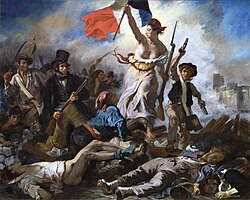
The revolutions of 1848, also known as the springtime of the peoples,[2][a] were a series of revolutions throughout Europe that spanned almost two years, between January 1848 and October 1849. They remain the most widespread revolutionary wave in European history to date.[3]
The revolutions varied widely in their aims but generally opposed conservative systems, such as absolute monarchy and feudalism, and sought to establish nation states, founded on constitutionalism and popular sovereignty. The revolutionary wave began with the revolution in Sicily in January and spread across Europe after the revolution in France in February 1848.[4] Over fifty countries were affected, but with no significant coordination or cooperation among their respective revolutionaries. Some of the major political contributing factors were widespread dissatisfaction with political leadership, demands for more participation in government and democracy, for freedom of the press, and by the working class for economic rights, and the rise of nationalism.[5] Other economic factors, such as the European potato failure, triggered mass starvation, migration, and civil unrest.[6]
The uprisings were led by temporary coalitions of workers and reformers, including figures from the middle and upper classes (the bourgeoisie); however, these coalitions did not hold together for long. Many of the revolutions were quickly suppressed, as tens of thousands of people were killed, and even more were forced into exile. Despite this, significant lasting reforms included the abolition of serfdom in Austria and Hungary, the end of absolute monarchy in Denmark, and the introduction of representative democracy in the Netherlands. The revolutions were most prominent in France, Italy, the Austrian Empire, and the states of the German Confederation that would make up the German Empire in the late 19th and early 20th centuries. The wave of uprisings ended in October 1849.
Background
The revolutions were shaped by a wide variety of causes, which were linked to the short- and long-term socioeconomic transformations brought about by industrialization and the political legacy of the French Revolution.[7] These included the adoption of modern agricultural practices and subsequent rapid population growth, the intensification of industrialization and urbanization, the repressive political environment established in reaction to the French Revolution, and the spread of ideologies opposed to repressive governments, including liberalism, radicalism, and nationalism.[7] In addition to longer-term trends, an acute economic crisis between 1845 and 1847, resulting from the combination of a food crisis and an industrial recession, led to significant civil unrest and revolutionary agitation.[8] According to Jonathan Sperber, the failure of governments to adjust to popular demands for reform in the wake of these crises provided the immediate trigger for the revolutions, and by the end of 1847, a revolution in Europe had become widely anticipated.[9]
Social discontent and conflict
In rural areas
Galician Massacre (Polish: Rzeź galicyjska) by Jan Lewicki depicts the fictional rewarding of Polish peasants by Austrian authorities for massacring their lords, who had attempted an uprising to reestablish an independent Polish state.
According to Jonathan Sperber, conflict over agricultural land rights was the most prevalent form of social conflict in the pre-revolutionary period.[11] The abolition of feudalism in parts of Western and Central Europe (especially in France) in the wake of the French Revolutionary and Napoleonic Wars had major ramifications for the rural populace. Customary rights that peasants had once held on common land, especially to acquire wood from communal forests, were increasingly lost with the enclosure and privatization of the commons.[12] These processes were often aided by modernizing states, such as France, which, with the enactment of the Forest Code of 1827, legally abolished peasants' rights to forests and the wood within them.[13]
Peasants resorted to both legal and violent means to reclaim their land rights. Lawsuits were frequently filed by peasants against landowners, and could remain active for decades;[14] one such lawsuit in Sicily was first brought in 1829 and not settled until 1896.[15] Peasants also stole wood from privatized forests or occupied them to reassert their land rights by force.[14] Wood theft in particular was widespread in parts of Germany. Between the 1820s and 1840s, the number of those convicted of wood theft in the Bavarian Palatinate increased from 37,500 in 1821–22 to 185,000 in 1846–47, accounting for a third of the population.[16] In France, opposition to the Forest Code led to the "War of the Maidens" from 1829 to 1832, in which peasants disguised in women's clothes violently resisted the Code's implementation in the department of Ariège.[17] Unrest among the peasantry was also widespread in regions that retained feudalism, as in parts of Central Europe and most of Eastern Europe, though this had been commonplace for several centuries.[18] Disputes and revolts were directed variously at oppressive lords, taxation and military conscription by the state, and religious authorities.[19] The largest pre-revolutionary peasant uprising against feudal lords occurred in Austrian Galicia in 1846, which put an end to the Kraków Uprising by the Polish nobility.[19]
Among urban workers
Silk weavers in Lyonrevolted in 1831 and 1834 in response to the refusal of their employers to pay agreed rates for their labour. Their motto was "Live working or die fighting!" (French: Vivre en travaillant, mourir en combattant).
Rapid population growth was the most serious issue affecting urban workers, as migration into the cities due to poor conditions in the countryside led to a major oversaturation of labour markets and a decline in real wages among workers, while the cost of living continued to increase.[21] Poor workers became more vulnerable to economic shocks, and the inability to afford foodstuffs other than potatoes and bread proved catastrophic amid a major food crisis affecting both between 1845 and 1847.[22]Industrialization and the transition from the traditional economy to capitalist production also negatively affected urban workers, leading to a decline in their standard of living and social status.[23] Most workers in 1848 were artisans who worked in the trades, while there were relatively few factory workers.[24]Mechanization threatened some trades, such as the textile industry and metalworking, leading to a growing sense of insecurity among artisans, who felt their livelihoods and economic agency threatened.[25]
The most prevalent disputes, however, were between employers and workers. Master craftsmen and journeymen came into increasing conflict as the guild system was weakened across Europe in the early nineteenth century. Under the new economy, master craftsmen began to accumulate wealth and were able to hire more workers, many of whom were unemployed due to the massive surplus of artisans.[26] At the same time, masters sought to prevent the growing number of journeymen and apprentices from ever advancing to become masters to protect their economic interests from growing competition.[27] Master craftsmen could also be threatened by transition, however, especially within the proto-industrial putting-out system, in which self-employed artisans were contracted by capitalist merchants to manufacture finished products.[28] Conflict between merchants and artisans, especially in the textile industry, was primarily over payment disputes, as merchants frequently underpaid outworkers for their finished products to maximize profit.[29] These disputes led to civil unrest, including uprisings by weavers in Lyon in 1831 and 1834, and in Silesia in 1844.[30] Deep frustration among artisans continued into 1848, as they demanded the right of association to reclaim economic agency lost during the transition, both in novel forms such as early trade unions, cooperatives, and mutual benefit societies, as in France, or a return to the guild system, as in Germany.[31]
Among the educated
The educated middle class was also affected by a decline in living standards. Across Western Europe, industrialization had increased the demand for professionals to support the new industries.[32] Societal expectations also began to favor education and careerism as means to achieve upward mobility, especially after the French Revolution. As a result, more young men across Europe enrolled in universities, expecting, according to Lenore O'Boyle, that "the diploma might do what a title of nobility had once done"[33] and they would achieve positions of leadership in society.[34] In the more industrialized economies of Britain and the United States, more educated men were able to find work in private businesses, and consequently, there was little to no revolutionary agitation among them in 1848. In mainland Europe, however, where the pace of industrialization lagged, the only available professional careers were in the civil service, which could not open enough positions to meet demand.[34]
The lack of work led to dissatisfaction among the educated, who felt that they were unable to live as their status demanded.[35] This issue was most pronounced in Germany, where overcrowding in professional careers was so severe that it gave rise to what sociologist Wilhelm Heinrich Riehl termed an "intellectual proletariat" of "underpaid and aspiring lower civil servants, journalists, and schoolteachers". The intellectual proletariat was so numerous in Germany that, according to Riehl, they, not manual labourers, comprised "the real proletariat".[36] Apart from the overcrowding of the professions, the middle class was also often deliberately excluded from political life and the bureaucracy by the state. Positions in the bureaucracy were restricted to those who could afford the education required for them, and, especially in France and the Austrian Empire, aristocrats remained influential, hindering career advancement.[37] Professionals who could not find work turned to journalism as "the last refuge of those who had failed in other middle-class or professional careers", and were able to channel their frustration into political agitation, eventually becoming leaders in the revolutions in 1848.[38]
Revolutionary politics
Ideology
An anti-clerical and anti-aristocratic print, published in Germany in 1845. The text reads: "Eyes Open!!!—Neither the nobility, nor the clergy will oppress us any longer; they have broken the backs of the people for too long."
New political ideologies were emerging in the 1840s that would go on to influence the revolutions in 1848, with liberalism, radicalism, and nationalism being the principal opposition movements to European governments.
Liberals formed a distinct political force in the 19th century but varied widely in their beliefs.[40] Generally, liberals supported equality before the law and the protection of civil liberties, such as the freedoms of speech, the press, association, religion, and especially to own property, and favoured constitutions to achieve such.[41] They opposed both absolute monarchies and radical republics, which they viewed as equally despotic, and favoured constitutional monarchies as a balance between the two extremes.[42] They favoured popular sovereignty, but made a distinction between "the people" and "the rabble". To that end, liberalism generally sought a restriction of the franchise to male property-owners.[43] Liberals were reluctant to engage in revolution or seek popular support due to their fears of a radical takeover and violent mob rule, as they had experienced during the French Revolution under the Jacobins and the Reign of Terror.[44] Liberals saw gradual, political reforms and economic development through parliaments, free markets, industrialization, and public education as means by which societal equality could be achieved, as more men could become property-owners and enter into political life.[45] When liberals gained power, as in the July Monarchy in France after 1830, they trended toward conservatism, and their restriction of political life alienated wide swaths of the population, bringing them into conflict with the radical left.[46]
Radicalism generally represented the loose and ill-defined coalition of democrats and socialists.[47] Radicals differed from moderate liberals in their support for democracy and universal manhood suffrage, extending the franchise to all adult men.[48] Both liberals and radicals shared in their opposition to "backwards" institutions, and especially in their anti-clericalism, which was considered synonymous with liberal and left-wing thought, though radicals were notably more violent in their opposition.[49] While liberals were generally more concerned with political and legal questions and sought the expansion of civil liberties,[50] radicals placed greater weight on the "social question", or the question of how to address the growth and precarity of the working poor in the capitalist economy.[51] Radicals were divided as to how to address the social question; Radical democrats generally sought, as Sperber writes, "to rectify the disproportion between capital and labour" through regulation and state intervention, whereas socialists sought the abolition of capitalism and economic redistribution.[52] Some radical democrats were economic liberals who tended to support political reform, especially universal manhood suffrage, over economic reform, and did not support government intervention of any sort.[53][b] Both democrats and socialists were, however, united in their desire to overthrow the existing regimes through revolution.[54]
"Nationalism" promoted the unity and primacy of people bound by some mix of common language, culture, religion, shared history and destiny, and immediate geography.[55] There were also irredentist movements. Nationalism had developed a broader appeal during the pre-1848 period, as seen in the František Palacký's 1836 History of the Czech Nation, which emphasized a national lineage of conflict with the Germans, or the popular patriotic Liederkranz (song-circles) that were held across Germany: patriotic and belligerent songs about Schleswig had dominated the Würzburg national song festival in 1845.[56]
Expression and participation
The beginning of the campagne des banquets in France on 9 July 1847. Public festivities such as banquets were a common form of political participation in the pre-revolutionary period.
Political participation was increasing in the pre-revolutionary period, though it was limited in scope, and what forms existed were heavily restricted by state authorities.[57] Where elections were held, very few people could vote or run for office due to strict property requirements (in France, the franchise was less than 250,000 voters),[58] and the government interfered heavily in the election process such that "governments did not lose elections", though they remained important indicators of the government's power.[59]
Outside of elections, the most basic form of political participation and expression, and the means by which political awareness as a whole was expanding, was in the reading, writing, and publishing of newspapers.[57] Papers such as the Rheinische Zeitung (edited by Karl Marx) in Germany and La Réforme in France became outlets for oppositional thought; absent formal political parties and organizations, which were largely banned, their editorial staff also became political leaders.[60] Informal political organizations existed to a degree in informal social circles, such as reading clubs, coffeehouses, and Masonic lodges.[61] Formal political organizations existed as illegal secret societies, many of which attempted to organize unsuccessful uprisings in the pre-revolutionary period, such as the Young Europe organizations of Giuseppe Mazzini and the several Carbonari societies.[62]Mass politics was carried out through public celebrations, such as festivals and banquets, which were organized as de facto political rallies to circumvent state restrictions on them.[60]
Although it was becoming more accessible, "politics", or the effort to affect changes in political structure, the economy, and society in a "consciously pre-chosen, expressly articulated direction", was still practised only by the educated.[63] Most people were entirely disconnected from politics before 1848,[64] and discontented peasants and workers who engaged in social conflict largely sought immediate economic remediation over political change.[65] However, though the lower classes were often not politically minded, they supported revolution to advance their material conditions.[66] Incidents of social unrest could also have political undertones, as with the Canut revolts, where class conflict between workers and merchants coincided with efforts to affect political change.[67] During the revolutions of 1848, these demands continued to develop, and previously "apolitical" social conflicts and demands for social reform would become politicized.[68]
According to economic historians Helge Berger and Mark Spoerer, the most immediate cause of the revolutions of 1848 was the multitudinous economic crisis between 1845 and 1847.[8] The crisis began with a major food crisis in Europe in 1845. Phytophthora infestans, the microorganism responsible for potato blight, arrived in Europe from North America around 1840 and spread rapidly during a period of unusually wet weather in 1845, devastating harvests across Northern Europe.[69] Potatoes had become a staple food due to their high nutritional value and affordability, and were being grown on a large scale to feed growing populations, especially in Northern Europe.[70] The effects of the potato blight were most severe in Ireland, where the Great Famine directly killed over an eighth of the population, or over 1 million people out of a population of 8 million. Other countries, including Scotland, Belgium, and the Netherlands saw similar damage to crops, with 60,000 deaths in the Netherlands due to the potato blight.[71] Drought conditions in 1846 stopped the spread of the potato blight but damaged grain harvests, resulting in a sharp increase in food prices across the continent, and consequently virtually all foodstuffs became unaffordable for the poor.[72] Food riots erupted across Europe as the poor attempted by force to stave off starvation, with over 400 such riots in France between 1846 and 1847 and 164 riots in the German states in 1847.[73][c]
Although severe famine was averted in most countries through strong government intervention, the rising cost of food, coupled with poor cotton harvests from the Southern United States necessary for textile manufacture, led to a major industrial recession in 1847.[74] Unemployment and pauperism spread rampantly among urban communities: according to Christopher Clark, by 1847 a fifth of the population in Friesland in the Netherlands were receiving relief from the state, or 47,482 out of 245,000 people; and in the same period, "the number of residents officially classified as poor in German towns could swell to two thirds or even three fourths of the population".[75] Berger and Spoerer found a strong correlation among the countries that were most deeply affected by the industrial shock of 1847 and those that underwent a revolution in 1848.[76][d]
Chronology
"Springtime of the peoples" (January–May 1848)
Map of Europe during the revolutions, showing major events, revolutionary centres, reactionary troop movements, and states with abdications and national conflicts.
The revolutionary events in 1848 began after the "February Revolution" in France, which overthrew the July Monarchy and led to the establishment of the French Second Republic. The revolution in France was not the first to occur, as a revolution had already occurred in January in the Kingdom of the Two Sicilies. In previous years, the Greater Poland uprising in 1846 and the Sonderbund War in Switzerland in 1847 had also seen similarly violent struggles for political reform.[78] However, the revolution in France held far greater import among contemporaries due to the central role of France in European politics after the French Revolution, and the belief that the events in France were a portent for the rest of Europe.[79] Over the course of one week, news of the revolution in France spread rapidly throughout the continent and was met with excitement by reformers and deep anxiety by reactionaries:[80] in Vienna, the news came "like a thunder-bolt from a clear sky, and caused a shock which vibrated though every nerve of her political system",[81] and Klemens von Metternich, upon receiving word of the revolutions, exclaimed, in French, "well, my dear, it's all over!" (Eh bien, mon cher, tout est fini!)[82]
Within weeks of the revolution in France, similar uprisings occurred in Munich, Vienna, Budapest, Venice, Krakow, Milan, and Berlin through early-to-mid March.[83] As the revolutions spread, reformers across Europe demanded the formation of a representative parliament, the freedom of the press, freedom of association, universal manhood suffrage, and the arming of the people under a national guard.[84] Faced with overwhelming political pressure, governments capitulated without offering significant resistance, and granted various political concessions.[85]In Austria, after violent clashes in Vienna from 13 to 15 March, Metternich was forced to resign and went into exile, and Emperor Ferdinand I pledged to grant an imperial constitution.[86] Revolution broke out in Hungary shortly afterward, and the Diet of Hungary successfully appealed for Hungarian national sovereignty within the Habsburg monarchy.[87] When the news from Vienna reached Austrian-ruled northern Italy some days later, revolutionary governments were declared in Milan and Venice, and the Kingdom of Piedmont–Sardinia declared war on Austria, beginning the First Italian War of Independence.[88]In Prussia, after a brief but deadly spate of barricade fighting in Berlin on 18 March, King Frederick William IV ordered the army to withdraw, appointed a liberal ministry, and committed Prussia to the cause of German national unification.[89]
Early achievements and conflicts
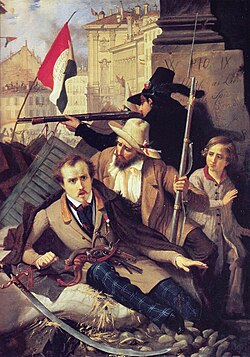
Revolutionary barricades in Vienna in May 1848, flying the flag of Germany
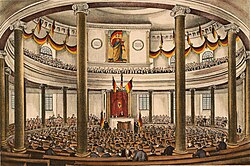
The earliest months of the revolutions were characterized by profound political change across Europe. Elections were held under broad franchises through the spring of 1848 for newly established or reformed parliaments.[90][e] These included, among many others, the French Constituent Assembly, which replaced the unrepresentative Chamber of Deputies, the Austrian Reichstag, the Hungarian Diet, and five other national parliaments within the Austrian Empire, and the Frankfurt National Assembly, the first national parliament representing all of Germany.[92]
Political participation increased substantially among the people as press censorship was relaxed and restrictions on association were lifted under the new constitutions. Political clubs and newspapers massively increased in number, extending political awareness to far more people than in the pre-revolutionary period.[93] A labour movement also began to develop during the early revolutions, though workers' associations were less organized and widespread compared to political clubs.[94] To quell labour unrest in the aftermath of the revolution in France, the French provisional government announced the establishment of publicly-run national workshops to provide work for the unemployed, and formed the Luxembourg Commission,[f] consisting of several worker's associations, to draft economic reforms.[95]
A "revolutionary psychosis"[96] was felt across Europe during the earliest phase of the revolutions as people celebrated the accomplishments of the "springtime of the peoples". Even in the smallest provincial towns in Germany "there were illuminations, festive parades by the riflemen’s associations, banquets of local notables, and embracing in the streets".[97] A "wave of fraternization" was also felt, "uniting the most implausible elements"; in France "priests blessed the planting of trees of liberty", in Transylvania "Romanians and Hungarians [...] embraced each other", and in Mainz "Protestants, Catholics, and Jews [...] all came to the Rhineland city's cathedral to celebrate jointly the great tidings of liberty."[98]
The early revolutions, however, also saw widespread violence and a major increase in social conflict, as people of all backgrounds sought to affect a social revolution and further their position or to violently seek revenge for various grievances.[99] In urban centres, rioters ransacked the homes and offices of their employers, broke machines and destroyed factories and workshops, and attacked tax collectors and customs officials. In the countryside, peasants occupied and exploited lost common land; where feudalism remained, peasants attacked their lords and destroyed records of their obligations, and where it was abolished, they attacked government officials (especially foresters).[100]
National conflicts also began to emerge in the late spring of 1848, especially in Germany and the multi-ethnic Austrian Empire. Efforts toward German national unification led to conflict with other nationalities within German territory, including Poles, Danes, and Czechs.[101] In the Grand Duchy of Posen in eastern Prussia, an uprising by Polish nationalists led to conflict between Germans and Poles, despite earlier German support for Polish independence; the uprising was suppressed by Prussian troops by April.[102] In Schleswig, the German population revolted against efforts by Denmark to annex the duchy, and were supported by the German states, leading to the First Schleswig War.[103] Some maximalist German nationalists also sought to extend the German nation to the crown lands of the Habsburg monarchy, including the German Archduchy of Austria as well as Czech Bohemia, Slovenian Carniola, and Italian Trieste and Trentino.[104] National conflicts pervaded throughout the entire Habsburg monarchy, especially in Hungary, where non-Magyars (especially Croats and Romanians) resisted attempts to form a homogeneous Hungarian nation, as well as in Galicia between Poles and Ruthenians, and Bohemia between Czechs and Germans.[105]
Counter-revolution (May–December 1848)
A soldier of the French Mobile Guard takes down the red flag from a barricade during the June Days
In the summer of 1848, serious divisions emerged in France between radical workers and the moderate government. In the early spring, the provisional government had been able to rely on their support, agreeing to their demands for the right to work and the "organization of labour" through the formation of the national workshops.[106] However, after the conservative victory in the Constituent Assembly elections on 23 April and the radical attempt to overthrow the Assembly on 15 May, the new French government came under pressure to close them.[107] After 15 May, the government also began to repress the left by jailing its leaders, closing its clubs and newspapers, and dissolving the Luxembourg Commission.[108] On 21 June, the national workshops were closed, leading to a major insurrection by workers against the government, known as the "June Days". The uprising was suppressed with significant bloodshed by General Louis-Eugène Cavaignac, who was vested with dictatorial powers by the Constituent Assembly to restore order, targeting both the insurgents and the left-wing opposition in general.[109]
The counter-revolution in the Austrian Empire was carried out largely by the army and conservatives in the Habsburg court.[110] The first Habsburg victories were against the June Uprising in Prague, provoked by the reactionary Alfred I, Prince of Windisch-Grätz.[111] The uprising was suppressed when the city was bombarded with artillery, despite attempts at conciliation by the liberal government of Baron Franz von Pillersdorf.[112] More crucially in northern Italy, the army under Joseph Radetzky defeated the disorganized Piedmontese army at the Battle of Custoza in July, leaving Austria in near-total control of its Italian provinces.[113] As conservatives gained strength, they mobilized Josip Jelačić, the Ban of Croatia, to invade Hungary and put an end to its sovereignty.[114] The beginning of the Hungarian War of Independence on 11 September led to the Vienna Uprising in October, during which radicals occupied the city for three weeks, until they were crushed by the forces of Jelačić and Windisch-Grätz on 31 October.[115]
Caricature in the Satyrische Zeitbilder No. 28 of 1848 showing King Frederick William IV and Marshal Friedrich von Wrangel, commander-in-chief of the Prussian army, trying to close the door on delegates carrying the Constitution. The caption reads, "No sheet of paper shall come between me and my people."
In Germany, the counter-revolution began in the early autumn of 1848 with the reaction to the Armistice of Malmö, signed between Prussia and Denmark to temporarily suspend the Schleswig War. Although Prussia's unilateral action undermined the Frankfurt parliament's supremacy, it was forced to accept the armistice due to the threat of a war with the great powers, especially Russia.[116] Widespread anger at the Frankfurt parliament's "betrayal" of the German revolution, combined with frustration among the lower classes at the slow pace of reform, led to the outbreak of renewed uprisings in western Germany in September.[117] The radical uprisings were crushed by the German states, with the support of the central government established by the Frankfurt parliament.[118] With the execution of parliamentary deputy Robert Blum by Austrian troops at the end of the October uprising, the Frankfurt parliament's claims of exercising authority over any part of Germany were further discredited.[119]
By the end of 1848, the springtime of the peoples was effectively over, and decidedly conservative governments had come into power across Europe. In Prussia, Frederick William IV, with the support of the army, carried out a coup d'état, dismissing the liberal ministers he appointed in the spring and imposing a conservative constitution.[120] In Austria, Emperor Ferdinand I was made to abdicate in favour of his nephew Franz Joseph I, under the expectation that he would not be beholden to the constitutionalist concessions made during the revolutions.[121] In France, Louis Napoléon Bonaparte, nephew of the last French emperor, was elected president, in large part with the backing of conservatives, who expected him to restore public order in the wake of the June Days.[122]
At the end of 1848, the revolutions were over where they had begun, with the major centres in Paris, Vienna, Berlin, and Milan largely pacified. However, the expansion of political activity in 1848 allowed for radicals to begin organizing in new regions outside of the major cities.[123] In France and Germany, left-wing organizations turned to the provinces, achieving greater support among rural workers in parliamentary elections in 1849.[124] Meanwhile, in central Italy and Hungary, the revolutions gained new strength, and established new regimes to contest the old order.
In central Italy, radicals gained power in the Grand Duchy of Tuscany and the Papal States, proclaiming the Tuscan Republic and the Roman Republic in February. Together with Piedmont–Sardinia, where radicals won the parliamentary elections, the new revolutionary governments in Italy began to make plans for an all-Italian constituent assembly, as had been formed in Germany, and resumed the war with Austria.[125] Piedmont–Sardinia was again decisively defeated by Austria at the Battle of Novara in March, resulting in the abdication of Piedmontese King Charles Albert and the end of the war in August.[126]
Counter-revolution continued in the Habsburg empire under the new emperor Franz Joseph, with the imperial government dissolving the Reichstag and rejecting its constitutional proposal in favour of the imposed March Constitution. The new constitution applied to the entire empire, ending Hungary's autonomy and mandating its partition into several military districts.[127] In response, Hungary declared full independence from the Habsburg empire and dethroned Franz Joseph as King of Hungary.[128] Through the spring, Hungary launched a military campaign that led to the recapture of almost all of Hungary's territory from Habsburg forces.[129] Facing a new crisis in Hungary, the Habsburg empire appealed for Russia's intervention in "the holy struggle against anarchy".[130] Russia mobilized 200,000 troops to invade Hungary, combined with 175,000 Habsburg troops, against the 170,000 troops of Hungary, many of whom were ill-equipped and exhausted.[131] For Russia's support, Austria offered no concessions, and Russia demanded none.[132]
The Surrender at Világos of the Hungarian revolutionaries on 13 August. The last Hungarian forces surrendered by October at the fortress of Komárom.
In Germany, after much deliberation, the Frankfurt National Assembly agreed to the Frankfurt Constitution for the new German Empire in March 1849, and elected Frederick William IV to serve as Emperor of the Germans. However, he rejected the crown on the basis that the Assembly did not have the authority to confer it, and he further denounced the Frankfurt Constitution, refusing any restrictions on his monarchical powers.[133] In response, a new wave of uprisings swept through Germany during the Imperial Constitution campaign as radicals, working largely among the lower classes, sought to force the acceptance of the Frankfurt Constitution. The campaign, lasting between May and July 1849, ultimately ended in defeat, ending the German revolutions.[134]
After the summer of 1849, the last remaining revolutionary regimes were in Rome, Venice, and Hungary. The revolutionary Roman Republic was defeated in July after the intervention of France, and Venice surrendered in August after enduring more than a year of siege and isolation.[135] With the entry of Russia into the war, Hungary, the last revolutionary state, was placed on the defensive, suffering numerous defeats between late June and August. On 13 August, Hungary surrendered to Austria and Russia, formally ending the war of independence; the last Hungarian holdouts at the fortress of Komárom surrendered between 2 and 5 October, marking the end of the revolutions of 1848.[136]
The first of the numerous revolutions to occur in 1848 in Italy came in Palermo, Sicily, starting in January 1848.[137] There had been several previous revolts against Bourbon rule; this one produced an independent state that lasted only 16 months before the Bourbons were restored to the throne. During those months, the constitution was quite advanced for its time in liberal democratic terms, as was the proposal of a unified Italian confederation of states.[138] The revolt's failure was reversed 12 years later as the Bourbon Kingdom of the Two Sicilies collapsed in 1860–61 with the unification of Italy.[139]
In the Duchy of Modena and Reggio, Duke Francis V attempted to respond militarily to the first attempts at armed revolt, but faced with the approach of Bolognese volunteers to support the insurgents, to avoid bloodshed, he preferred to leave the city, promising a constitution and amnesties. On 21 March 1848, he left for Bolzano. A provisional government was established in Modena. In the Papal States, an internal revolt ousted Pope Pius IX from his temporal powers and led to the establishment of the Roman Republic.
The municipalities of Menton and Roquebrune united and obtained independence from the Principality of Monaco, becoming a protectorate of the Kingdom of Sardinia, and would eventually join Sardinia in 1861.[141]
France, ruled by the July Monarchy since the July Revolution in 1830, had been under growing pressure to enact reforms and expand its highly restrictive electoral franchise since the economic crisis of 1845–47.[143] Discontent at the regime stemmed from its conservatism and inflexibility, particularly under the government of François Guizot, as well as a sentiment that the July Monarchy did not represent the revolutionary spirit of 1830. This disappointment, coupled with memories of the French Revolution and Napoleon, led to widespread support for republicanism and democracy in the otherwise liberal July Monarchy.[144]
After Guizot's government won a majority in the Chamber of Deputies in 1846 and continued to block attempts at reform, liberals and moderate republicans organized a banquet campaign beginning in July 1847 to advocate for an expansion of the franchise.[145] One banquet to be scheduled in the working-class 12th arrondissement of Paris was banned by Guizot's government due to the threat of violence, leading to protests on 22 February by workers and students.[146] The protests quickly escalated into a revolution, especially after the army's massacre of 65 demonstrators on 23 February. This culminated on 24 February, when King Louis Philippe I abdicated and fled the country.[147]
With the fall of the July Monarchy, a provisional government was formed to rule the country, and the French Second Republic was proclaimed. The provisional government consisted of a coalition of seven moderate republicans, including Alphonse de Lamartine and François Arago, and four socialists, including Louis Blanc and Alexandre Ledru-Rollin.[148] Shortly after taking power, the provisional government instituted universal manhood suffrage and abolished slavery and the death penalty. To satisfy the workers, it recognized the right to work, established the national workshops (ateliers nationaux) for the unemployed, and formed the Luxembourg Commission[f] under Blanc to draft economic reforms.[149] Some actions proved unpopular in the provinces, such as the "commissioners of the republic" appointed under Ledru-Rollin as part of the regime change, whose conduct was criticized as dictatorial, and the 45 percent increase in the property tax to pay for the government's growing expenses.[150]
Barricades on the rue Saint-Maur-Popincourt on 25 June 1848, during the June Days uprising. This is the first photograph of a barricade.
After the Constituent Assembly elections on 23 April, which returned a conservative majority, the provisional government was replaced by the more moderate Executive Commission, led by François Arago and largely excluding socialists.[151] After the demonstration of 15 May, the Executive Commission, under pressure from the Constituent Assembly, moved to close the national workshops; attempts at providing alternative sources of work were abandoned, such that the only possibility for workers was to enlist in the army or be dismissed.[107] Facing possible destitution, workers launched the June Days uprising between 22 and 26 June, involving 40,000 to 50,000 insurgents in violent barricade fighting across Paris. The uprising was suppressed by General Louis-Eugène Cavaignac, who was made France's head of state after the Executive Commission resigned on 24 June.[109]
The first French presidential elections were held on 10 December after the adoption of the French Constitution of 1848 on 14 November. The two leading candidates were Cavaignac and Louis Napoléon Bonaparte, the nephew of Napoleon, who returned from exile in England after winning in by-elections to the Constituent Assembly in September.[152] In the presidential election, Bonaparte won in a landslide victory with 75 percent of the vote. Bonaparte appealed to a broad coalition, consisting of conservatives, who assumed he would be easily influenced and could maintain order; peasants, who resented the government for the tax increases issued earlier in the year, and among whom he could count on name recognition; and urban workers, who opposed Cavaignac for his role in the June Days.[153]
The revolution in France finally ended in December 1851, when Bonaparte launched a coup d'état to remain in office when he could not run for re-election. The left-wing Republican Solidarity organization, with around 100,000 members, launched an uprising in the provinces to prevent the seizure of power, which was suppressed within days. The following year, Bonaparte crowned himself as emperor of the Second French Empire, taking the name Napoleon III.[154]
The success of the revolution in France provided the impetus for the German revolutions. The first revolutionary events were in southwestern Germany, with popular demonstrations in Baden beginning on 27 February, followed by the rest of the small- to medium-sized German states.[155][g] Across Germany, the "March demands" (Märzforderungen) were issued, calling for "a people's army with freely elected officers; unconditional freedom of the press; trial by jury according to the English model; and the immediate creation of a German parliament".[156] Weeks later, the revolution spread to the Austrian capital of Vienna from 13 to 15 March and the Prussian capital of Berlin from 18 to 19 March, and was successful in both.[157]
The popular revolutions in March 1848 were followed by a period of political legitimation and institutionalization. On 31 March, middle-class reformers met in the ad hoc "pre-parliament" to draft plans for the future German parliament; its programme was adopted by the Confederal Bundestag, which called for elections under universal manhood suffrage in all of the German states.[158] The Frankfurt National Assembly sat for the first time on 18 May, with the task of drafting a German constitution. It appointed the "Provisional Central Power" to act as a national government, with Archduke John of Austria as Imperial Regent.[159] As the Assembly and the Central Power had no means of enforcing its authority, it relied on the cooperation of the German states, particularly Austria and Prussia.[160]
Division and sometimes violent conflict between liberals and radicals over numerous issues characterized the German revolutions from their onset.[161] One immediate point of contention was whether Germany should be a republic or a constitutional monarchy; the pre-parliament had voted to support the latter, leading to the Hecker uprising in Baden by the radical republicans Friedrich Hecker and Gustav Struve in April 1848.[162] The reliance of the liberal Frankfurt National Assembly and Central Power on the states to suppress radical uprisings, such as in April, worsened divisions and demonstrated the weakness of the national government.[163] Another major point of contention was the "national question" of German unification. This included whether the German nation should include Austria (the "German question"), and whether it should include non-German lands. Conflicts between Germans and other nationalities occurred in Bohemia against Czechs, Posen (now Poznań) against Poles (in the Greater Poland uprising), and Schleswig–Holstein against Danes (in the First Schleswig War).[164]
Cariacature of Frederick William IV, satirizing his rejection of the imperial crown offered by the Frankfurt National Assembly; he privately likened the crown to "a dog collar, binding [him] to the revolution of '48'".
In March 1849, despite divisions between liberals and radicals, the Frankfurt National Assembly concluded its work, presenting the Frankfurt Constitution for the German Empire. Under the new constitution, the empire would be governed as a federal constitutional monarchy with significant democratic concessions, including universal manhood suffrage and the protection of minority rights, and ruled by the King of Prussia as hereditary Emperor of the Germans.[166] Austria, emboldened by the success of its counter-revolution, was excluded due to its insistence that all Habsburg territory be incorporated into the empire.[167] Frederick William IV of Prussia ultimately rejected the crown, as he did not recognize the authority of the Frankfurt National Assembly, as well as the constitution, believing, under the divine right of kings, that his rule could not be restricted by one.[165]
The rejection of the imperial crown led to the Imperial Constitution campaign, the final act of the German revolutions. Uprisings again broke out across Germany in May 1849 in an effort to force the implementation of the constitution on the German states. The uprisings had wide support among radicalized workers, bourgeoisie, and soldiers, who were coordinated by highly-developed political organizations.[168] Compared to the regular armies they faced, however, the revolutionaries were poorly armed and organized, and were quickly defeated in combat.[169] The uprising in Baden endured the longest, owing to significant support among the troops.[170] It finally capitulated on 23 July 1849, marking the end of the German revolutions.[171]
Denmark had been governed by a system of absolute monarchy (King's Law) since the 17th century. King Christian VIII, a moderate reformer but still an absolutist, died in January 1848 during a period of rising opposition from farmers and liberals. The demands for a constitutional monarchy, led by the National Liberals, ended with a popular march to Christiansborg on 21 March. The new king, Frederick VII, met the liberals' demands and installed a new Cabinet that included prominent leaders of the National Liberal Party.[172]
The national-liberal movement wanted to abolish absolutism, but retain a strongly centralized state. The king accepted a new constitution, agreeing to share power with a bicameral parliament called the Rigsdag. It is said that the Danish king's first words after signing away his absolute power were, "that was nice, now I can sleep in the mornings".[173] Although army officers were dissatisfied, they accepted the new arrangement. In contrast to the rest of Europe, this was not overturned by reactionaries.[172] The liberal constitution did not extend to Schleswig, leaving the Schleswig-Holstein Question unanswered.
The Duchy of Schleswig, a region containing both Danes (a North Germanic population) and Germans (a West Germanic population), was a part of the Danish monarchy, but remained a duchy separate from the Kingdom of Denmark. Spurred by pan-Germanist sentiment, the Germans of Schleswig took up arms against a proposal from the National Liberal government in Copenhagen, which would have fully integrated the duchy into Denmark.
The German population in Schleswig and Holstein revolted, inspired by the Protestant clergy. The German states sent in an army, but Danish victories in 1849 led to the Treaty of Berlin (1850) and the London Protocol (1852). They reaffirmed the sovereignty of the King of Denmark, while prohibiting union with Denmark. The violation of the latter provision led to renewed warfare in 1863 and the Prussian victory in 1864.
From March 1848 through July 1849, the Habsburg Austrian Empire was threatened by revolutionary movements, which often had a nationalist character. The empire, ruled from Vienna, included German-speaking Austrians, Hungarians, Czechs, Poles, Croats, Ukrainians, Romanians, Rusyns, Slovaks, Slovenes, Serbs and Italians, all of whom attempted in the course of the revolution to achieve either autonomy, independence, or even hegemony over other nationalities.[citation needed] The nationalist picture was further complicated by the simultaneous events in the German states, which moved toward greater German national unity.
On 15 April, Emperor Ferdinand I declared himself a "constitutional monarch", despite there not yet being a constitution. He charged Baron Franz von Pillersdorf with drafting one, and it was passed on 25 April 1848. This constitution, called the Pillersdorf Constitution, applied to the whole of the Habsburg monarchy, except for Hungary. The constitution established the Reichstag, a short-lived unicameral parliamentary body. The Reichstag had two goals: to reform the feudal system and to draft a new constitution. It succeeded in its first goal, abolishing serfdom by a patent issued together with the Emperor on 7 September 1848. In the midst of its work, the Reichstag was relocated to Kroměříž (German: Kremsier) in Moravia due to the Vienna Uprising in October 1848. The Reichstag was due to present its liberal constitution, the Kremsier Constitution, on the anniversary of the revolution in 1849, but the abdication of Ferdinand I in favor of his more conservative nephew Franz Joseph I in December 1848 prevented such. As the revolutions came to an end in Europe, the Austrian army dissolved the Reichstag on 7 March 1849, and the imperial government promulgated the March Constitution, which strengthened the powers of the emperor.[174]
Hungarian hussars in battle during the Hungarian Revolution
The Hungarian Revolution of 1848 was the longest in Europe, crushed in August 1849 by the Austrian and Russian armies. Nevertheless, it had a major effect in freeing the serfs.[175] It began on 15 March 1848, when Hungarian patriots organized mass demonstrations in Pest and Buda (today Budapest) which forced the imperial governor to accept their 12 points of demands. The 12 points included demands for freedom of the press, an independent Hungarian ministry residing in Buda–Pest and responsible to a popularly elected parliament, the formation of a National Guard, complete civil and religious equality, trial by jury, a national bank, a Hungarian army, the withdrawal of foreign (Austrian) troops from Hungary, the freeing of political prisoners, and union with Transylvania.[176] On that morning, the demands were read aloud along with poetry by Sándor Petőfi with the simple lines of "We swear by the God of the Hungarians; we swear, we shall be slaves no more".[177]Lajos Kossuth and other liberal nobles in the Hungarian Diet appealed to the Habsburg court with demands for representative government and civil liberties.[178] These events resulted in Klemens von Metternich, the Austrian chancellor and foreign minister, resigning. The demands of the Diet were agreed upon on 18 March by Emperor Ferdinand I. Although Hungary would remain part of the monarchy through personal union with the emperor, a constitutional government would be founded. The Diet then passed the April laws that established equality before the law, a legislature, a hereditary constitutional monarchy, and an end to the transfer and restrictions of land use.[178]
The revolution grew into a war for independence from the Habsburg monarchy when Josip Jelačić, Ban of Croatia, crossed the border to restore their control.[179] The new government, led by Lajos Kossuth, was initially successful against the Habsburg forces. Although Hungary took a national united stand for its freedom, some minorities of the Kingdom of Hungary, including the Serbs of Vojvodina, the Romanians of Transylvania, and some Slovaks of Upper Hungary, supported the Habsburg Emperor and fought against the Hungarian Revolutionary Army. Eventually, after one and a half years of fighting, the revolution was crushed when Russian Tsar Nicholas I marched into Hungary with over 300,000 troops.[180] As a result of the defeat, Hungary was thus placed under brutal martial law. The leading rebels like Kossuth went into exile or were executed, the latter including former prime minister Batthyány and the Thirteen Martyrs of Arad. In the long run, the passive resistance following the revolution, along with the crushing Austrian defeat in the 1866 Austro-Prussian War, led to the Austro-Hungarian Compromise (1867), which marked the birth of the Austro-Hungarian Empire.
Galicia
The center of the Ukrainian national movement was in Galicia, which is today divided between Ukraine and Poland. On 19 April 1848, a group of representatives led by the Greek Catholic clergy launched a petition to the Austrian Emperor. It expressed wishes that in those regions of Galicia where the Ruthenian (Ukrainian) population represented the majority, the Ukrainian language should be taught at schools and used to announce official decrees for the peasantry; local officials were expected to understand it and the Ruthenian clergy was to be equalized in their rights with the clergy of all other denominations.[181]
On 2 May 1848, the Supreme Ruthenian Council was established. The council (1848–1851) was headed by the Greek-Catholic Bishop Gregory Yakhimovich and consisted of 30 permanent members. Its main goal was the administrative division of Galicia into Western (Polish) and Eastern (Ruthenian/Ukrainian) parts within the borders of the Habsburg Empire, and formation of a separate region with a political self-governance.[182]
Though both Polish and Ruthenian Galicians had nationalist aspirations, the two groups' interests diverged, with Polish nobles in Ruthenia often having dominion over Ruthenian serfs. Emperor Ferdinand responded to Galician agitation in 1848 by freeing the predominantly Ruthenian serfs, thereby dampening the revolutionary ardor of both groups.[183]
The revolution of 1848 in Bohemia began with the drafting of a list of liberal demands of the Czech population of the Czech lands at the St. Wenceslas Spa in Prague by the wealthier inhabitants of the city in March. These were spurred by the more violent events in Vienna and the news of revolutions sweeping across the continent.[184]
The revolution in the Czech lands was complicated by the friction between German Bohemians, who were interested in becoming a part of Germany and representation in the Frankfurt National Assembly, the first all-German parliament, and between Czechs in Bohemia and Moravia, who sought Czech nationality. Austroslavism emerged during the revolutions, propagated by František Palacký, which sought to achiever greater autonomy for the Czech lands, and potentially even a federation, within the Habsburg monarchy, as opposed to potentially all of the Czech lands joining a unified greater Germany.[185]
Switzerland, already an alliance of republics, also saw an internal struggle. The attempted secession of seven Catholic cantons to form an alliance known as the Sonderbund ("separate alliance") in 1845 led to a short civil conflict in November 1847 in which around 100 people were killed. The Sonderbund was decisively defeated by the Protestant cantons, which had a larger population.[186] A new constitution of 1848 ended the almost-complete independence of the cantons, transforming Switzerland into a federal state.
Polish people mounted a military insurrection against the Prussians in the Grand Duchy of Posen (or the Greater Poland region), a part of Prussia since its annexation in 1815. The Poles tried to establish a Polish political entity, but refused to cooperate with the Germans and the Jews. The Germans decided they were better off with the status quo, so they assisted the Prussian governments in recapturing control. In the long-term, the uprising stimulated nationalism among both the Poles and the Germans and brought civil equality to the Jews.[187]
A Romanian liberal and Romantic nationalist uprising began in June in the principality of Wallachia. Its goals were administrative autonomy, abolition of serfdom, and popular self-determination. It was closely connected with the 1848 unsuccessful revolt in Moldavia, it sought to overturn the administration imposed by Imperial Russian authorities under the Regulamentul Organic regime, and, through many of its leaders, demanded the abolition of boyar privilege. Led by a group of young intellectuals and officers in the Wallachian military forces, the movement succeeded in toppling the ruling PrinceGheorghe Bibescu, whom it replaced with a provisional government and a regency, and in passing a series of major liberal reforms, first announced in the Proclamation of Islaz.
Despite its rapid gains and popular backing, the new administration was marked by conflicts between the radical wing and more conservative forces, especially over the issue of land reform. Two successive abortive coups weakened the new government, and its international status was always contested by Russia. After managing to rally a degree of sympathy from Ottoman political leaders, the Revolution was ultimately isolated by the intervention of Russian diplomats. In September 1848, by agreement with the Ottomans, Russia invaded and put down the revolution. According to Vasile Maciu, the failures were attributable in Wallachia to foreign intervention, in Moldavia to the opposition of the feudalists, and in Transylvania to the failure of the campaigns of General Józef Bem (who led a very successful campaign of liberation in the Hungarian Revolution), and later to Austrian repression.[188] In later decades, the rebels returned and gained their goals.
Belgium
A depiction of Leopold I of Belgium's symbolic offer to resign the crown in 1848
Many small local riots broke out, concentrated in the sillon industriel industrial region of the provinces of Liège and Hainaut.
The most serious threat of revolutionary contagion, however, was posed by Belgian émigré groups from France. In 1830, the Belgian Revolution had broken out, inspired by the revolution occurring in France, and Belgian authorities feared that a similar 'copycat' phenomenon might occur in 1848. Shortly after the revolution in France, Belgian migrant workers living in Paris were encouraged to return to Belgium to overthrow the monarchy and establish a republic.[190] Belgian authorities expelled Karl Marx himself from Brussels in early March on accusations of having used part of his inheritance to arm Belgian revolutionaries.
Around 6,000 armed émigrés of the "Belgian Legion" attempted to cross the Belgian frontier. There were two divisions that were formed. The first group, travelling by train, was stopped and quickly disarmed at Quiévrain on 26 March 1848.[191] The second group crossed the border on 29 March and headed for Brussels. They were confronted by Belgian troops at the hamlet of Risquons-Tout and defeated. Several smaller groups managed to infiltrate Belgium, but the reinforced Belgian border troops succeeded, and the defeat at Risquons-Tout effectively ended the revolutionary threat to Belgium.
The situation in Belgium began to recover that summer after a good harvest, and fresh elections returned a strong majority to the governing party.[190]
In Ireland, a current of nationalist, egalitarian and radicalist republicanism, inspired by the French Revolution, had been present since the 1790s– being expressed initially in the Irish Rebellion of 1798. This tendency grew into a movement for social, cultural, and political reform during the 1830s, and in 1839 was realized into a political association called Young Ireland. It was initially not well received, but grew more popular with the Great Famine of 1845–1849, an event that brought catastrophic social effects and which threw into light the inadequate response of authorities. The spark for the Young Ireland rebellion came in 1848 when the British Parliament passed the Prevention of Crime (Ireland) Act 1848, which gave the Lord Lieutenant of Ireland the power to organise Ireland into districts and bring policemen of the Irish Constabulary into them at the districts' expense. The act also limited who could own guns and, under penalty, coerced all Irish men between the ages of 16 and 60 to join in a type of posse comitatus in each district to assist in apprehending suspected murderers when killings took place, or else be guilty of a misdemeanour themselves.[192]
In response, the Young Ireland Party launched a rebellion in July 1848, gathering landlords and tenants to its cause. But its first major engagement against police, in the village of Ballingarry, South Tipperary, was a failure. A long gunfight with around 50 policemen ended when police reinforcements arrived. After the arrest of the Young Ireland leaders, the rebellion collapsed, though intermittent fighting continued for the next year. It is sometimes called the Famine Rebellion (since it took place during the Great Famine).[citation needed]
Other European states
Illustration of the "March troubles" in Stockholm, Sweden in 1848
The United Kingdom, Belgium, the Netherlands, Portugal, the Russian Empire (including Poland and Finland), and the Ottoman Empire did not encounter major national or Radical revolutions in 1848. Sweden and Norway were also little affected. Serbia, though formally unaffected by the revolt as it was a part of the Ottoman state, actively supported Serbian revolutionaries in the Habsburg Empire.[193]
In many countries, the absence of unrest was partly due to governments taking action to prevent revolutionary unrest and pre-emptively granting some of the reforms demanded by revolutionaries elsewhere. This was notably the case for the Netherlands, where King William II decided to alter the Dutch constitution to reform elections and voluntarily reduce the power of the monarchy. The same might be said of Switzerland, where a new constitutional regime was introduced in 1848: the Swiss Federal Constitution was a revolution of sorts, laying the foundation of Swiss society as it is today.
In the United Kingdom, while the middle classes had been pacified by their inclusion in the extension of the franchise in the Reform Act 1832, the consequential agitations, violence, and petitions of the Chartist movement came to a head with their peaceful petition to Parliament of 1848. The repeal in 1846 of the protectionist agricultural tariffs–called the "Corn Laws"–had defused some proletarian fervour.[194]
In the Isle of Man, there were ongoing efforts to reform the self-elected House of Keys, but no revolution took place. Some of the reformers were encouraged by events in France in particular.[195]
In the United States, opinions were polarized, with Democrats and reformers in favour, although they were distressed at the degree of violence involved. Opposition came from conservative elements, especially Whigs, southern slaveholders, orthodox Calvinists, and Catholics. About 4,000 German exiles arrived, and some became fervent Republicans in the 1850s, such as Carl Schurz. Kossuth toured America and won great applause, but no volunteers or diplomatic or financial help.[196]
In Spanish Latin America, the Revolution of 1848 appeared in New Granada, where Colombian students, liberals, and intellectuals demanded the election of General José Hilario López. He took power in 1849 and launched major reforms, abolishing slavery and the death penalty, and providing freedom of the press and of religion. The resulting turmoil in Colombia lasted three decades; from 1851 to 1885, the country was ravaged by four general civil wars and 50 local revolutions.[198]
In Mexico, the Centralist Republic led by Antonio López de Santa Anna lost half of its territory to the United States, including California and Texas, in the Mexican–American War of 1845–1848. Derived from this catastrophe and chronic stability problems, the Liberal Party started a reformist movement. This movement, via elections, led liberals to formulate the Plan of Ayutla. The Plan written in 1854 aimed at removing President Santa Anna from control of Mexico during the Second Federal Republic of Mexico period. Initially, it seemed little different from other political plans of the era, but it is considered the first act of the Liberal Reform in Mexico.[200] It was the catalyst for revolts in many parts of Mexico, which led to the resignation of Santa Anna from the presidency, never to vie for office again.[201] The next Presidents of Mexico were the liberals, Juan Álvarez, Ignacio Comonfort, and Benito Juárez. The new regime would then proclaim the 1857 Mexican Constitution, which implemented a variety of liberal reforms. Among other things, these reforms confiscated religious property, aimed to promote economic development, and to stabilize a nascent republican government.[202] The reforms led directly to the so-called Three Years War or Reform War of 1857. The liberals won this war, but the conservatives solicited the French Government of Napoleon III for a European, conservative Monarch, deriving into the Second French intervention in Mexico. Under the puppet Habsburg government of Maximilian I of Mexico, the country became a client state of France (1863–1867).
Southeast Asia
In the Dutch East Indies, a group of up to six hundred Indo people occupied the Harmonie Club in Batavia in May 1848 to protest against their exclusion from upper-rank colonial posts. Administrators feared the liberal demonstration would spread to the region's Javanese or Chinese and even grow into an independence movement, and the organizers behind the protest were fired and banned from Java entirely.[203]
Aftermath and legacy
We have been beaten and humiliated ... scattered, imprisoned, disarmed, and gagged. The fate of European democracy has slipped from our hands.
Liberal democrats looked to 1848 as a democratic revolution, which in the long run ensured liberty, equality, and fraternity. For nationalists, 1848 was the springtime of hope, when newly emerging nationalities rejected the old multinational empires, but the results were not as comprehensive as many had hoped. Communists denounced 1848 as a betrayal of working-class ideals by a bourgeoisie indifferent to the legitimate demands of the proletariat.[205] The view of the revolutions of 1848 as a bourgeois revolution is also common in non-Marxist scholarship.[206][207][208] Tensions over differing approaches between bourgeois revolutionaries and radicals played a major role in the failure of the revolutions.[209] Many governments engaged in a partial reversal of the revolutionary reforms of 1848–1849 as well as heightened repression and censorship. The Hanoverian nobility successfully appealed to the Confederal Diet in 1851 over the loss of their noble privileges, while the Prussian Junkers recovered their manorial police powers from 1852 to 1855.[210][211] In the Austrian Empire, the Sylvester Patents (1851) discarded Franz Stadion's constitution and the Statute of Basic Rights, while the number of arrests in Habsburg territories increased from 70,000 in 1850 to one million by 1854.[212] Nicholas I's rule in Russia after 1848 was particularly repressive, marked by an expansion of the secret police (the Tretiye Otdeleniye) and stricter censorship; were more Russians were working for censorship organs than actual books published in the period immediately after 1848.[213][214] In France, the works of Charles Baudelaire, Victor Hugo, Alexandre Ledru-Rollin, and Pierre-Joseph Proudhon were confiscated.[215]
In the post-revolutionary decade after 1848, little had visibly changed, and many historians considered the revolutions a failure, given the seeming lack of permanent structural changes. More recently, Christopher Clark has characterized the period that followed 1848 as one dominated by a revolution in government. Governments after 1848 were forced into managing the public sphere and popular sphere with more effectiveness, resulting in the increased prominence of, for example, the Prussian Zentralstelle für Pressangelegenheiten (Central Press Agency, established 1850), the Austrian Zensur-und polizeihofstelle (Censorship and Police Office), and the French Direction Générale de la Librairie (1856).[216] The conservative Prussian prime minister Otto von Manteuffel declared that the state could no longer be run like the landed estate of a nobleman.[217] Meanwhile, centrist coalitions, consisting of liberals and conservatives united in their anxiety toward working-class socialism, also took power after the revolutions, such as the Connubio coalition led by Camillo Benso, Count of Cavour in Piedmont–Sardinia.[218][219]Priscilla Robertson considered many of the revolutionaries' goals to have been achieved by the 1870s, though largely by the enemies of the revolutions. Austria and Prussia eliminated feudalism by 1850 and Russia abolished serfdom in 1861, improving conditions for the peasants. The European middle classes made political and economic gains over the next 20 years, with France retaining the universal male suffrage that had been established by the Second Republic. The Austrian Empire was reorganized into the Dual Monarchy, according Hungary more self-determination as part of the Ausgleich of 1867, a process that was spearheaded by the former revolutionaries Gyula Andrássy and Ferenc Deák.[220][221]
A caricature by Ferdinand Schröder on the defeat of the revolutions of 1848–1849 in Europe (published in Düsseldorfer Monatshefte, August 1849)
Karl Marx expressed disappointment at the bourgeois character of the revolutions.[222][223] Marx elaborated in his 1850 "Address of the Central Committee to the Communist League" a theory of permanent revolution according to which the proletariat should strengthen democratic bourgeois revolutionary forces until the proletariat itself is ready to seize power.[224]
German historian Reinhard Rürup described the 1848 revolutions as a turning point in the development of modern antisemitism. This was expressed through the development of conspiracies that presented Jews as representative of both the forces of social revolution (apparently typified in Joseph Goldmark and Adolf Fischhof of Vienna) and of international capital, as seen in the 1848 report from Eduard von Müller-Tellering, the Viennese correspondent of Marx's Neue Rheinische Zeitung, which declared that "tyranny comes from money and the money belongs to the Jews".[225]
About 4,000 exiles went to the United States, fleeing the reactionary purges. Of these, 100 went to the Texas Hill Country as German Texans.[226]German Americans would play a major role in the American Civil War. More widely, many disillusioned and persecuted revolutionaries, in particular (though not exclusively) those from Germany and the Austrian Empire, left their homelands for foreign exile in the New World or in the more liberal European nations; these emigrants were known as the Forty-Eighters. Sentiment among German Americans was largely anti-slavery, especially among Forty-Eighters.[227]
↑From German Völkerfrühling, this name is applied to both the events of the spring of 1848 and the revolutions as a whole.
↑Broers argues a greater distinction between radicals and socialists, characterizing radicals as broadly economically liberal in comparison to socialists, who were more interventionist.
↑Counts in Germany differ between sources: Clark 2023, p.47 counts 158 riots in Prussia between April–May 1847, while Siemann 1998, p.39 counts 103 protests between 1840 and 1847.
↑The sole exception is the Netherlands, which Berger and Spoerer argue experienced a revolution (through its preemptive enactment of the Constitutional Reform of 1848) without having experienced an industrial shock.[77]
↑The size of the franchise could vary considerably. The French Constituent Assembly was directly elected under universal manhood suffrage. The Frankfurt National Assembly was indirectly elected under near-universal manhood suffrage. The Austrian Reichstag was elected through a broad franchise, but excluded itinerant or migrant workers, including many journeymen. The parliaments in Hungary, Croatia, and Italy imposed restrictive property requirements which prevented half to two-thirds of people from voting; the Hungarian Diet further required voters to speak Hungarian, disenfranchising non-Hungarians.[91]
12Berger & Spoerer 2001, p.295: "We propose that it is precisely these economic crises that are most helpful in explaining the simultaneity and regional distribution of the European turmoil of 1848. In other words, even though ideas and institutions undoubtedly shaped the events in question, it was economic misery and the fear thereof that triggered them."
↑Joachim Remak, Very Civil War: The Swiss Sonderbund War of 1847 (1993)
↑Krzysztof Makowski, "Poles, Germans and Jews in the Grand Duchy of Poznan in 1848: From coexistence to conflict." East European Quarterly 33.3 (1999): 385.
↑Vasile Maciu, "Le caractère unitaire de la révolution de 1848 dans les pays roumains." Revue Roumaine d'Histoire 7 (1968): 679–707.
↑Stefan Huygebaert, "Unshakeable Foundations," Journal of Belgian History 45.4 (2015).
↑Weisser, Henry (1981). "Chartism in 1848: Reflections on a Non-Revolution". Albion: A Quarterly Journal Concerned with British Studies. 13 (1): 12–26. doi:10.2307/4049111. JSTOR4049111.
↑Fyson, Robert (2016). The Struggle for Manx Democracy. Douglas: Culture Vannin. ISBN9780993157837.
↑Timothy Mason Roberts, Distant Revolutions: 1848 and the Challenge to American Exceptionalism (2009)
↑Saul, J.R. (2012). Louis-Hippolyte LaFontaine & Robert Baldwin. Penguin Group (Canada).
↑J. Fred Rippy, Latin America: A Modern History (1958) pp. 253–254
↑Stoler, Ann Laura (2009). Along the archival grain: epistemic anxieties and colonial common sense. Princeton, NJ: Princeton University Press. pp.81–85. ISBN9780691146362.
↑Breunig, Charles (1977), The Age of Revolution and Reaction, 1789–1850 ( ISBN0-393-09143-0)
↑History Today (1960). p. 668. "... the rising tide of revolutionary bourgeois liberalism in Austrian political life, as demonstrated by students' activities, the March riots of 1848, the rising in Hungary, the open revolt in Vienna itself in October 1848, and the course of the revolution."
↑Clark, T. J. (1982). The Absolute Bourgeois: Artists and Politics in France 1848–51 (paperback ed.). Princeton, New Jersey: Princeton University Press. ISBN9780691003382.
↑Csizmadia, Andor (1983). "Hungarian Customary Law Before the Bourgeois Rebellion of 1848". The Journal of Legal History. 4 (2): 3–37. doi:10.1080/01440368308530781.
↑Columbia Encyclopedia (2020). "The discrepancy of aims between bourgeois revolutionaries such as Alphonse de Lamartine and A. T. Marie and the radicals, led by Louis Blanc, contributed to the eventual failure of the revolution."
↑Green, Abigail, Fatherlands: State-Building and Nationhood in Nineteenth-Century Germany (Cambridge, 2001), p. 75
↑Barclay, David, Friedrich Wilhelm IV and the Prussian Monarchy 1840–1861 (Oxford, 1995), pp. 190, 231
↑Deak, John. Forging a Multinational State: State Making in Imperial Austria from the Enlightenment to the First World War (Stanford, 2015), p. 105
↑Westwood, J. N. Endurance and Endeavour: Russian History, 1812–1980. Oxford (2002), p. 32
↑Goldfrank, David M. The Origins of the Crimean War. London: Longman, (1994), p. 21
↑Price, Roger. The French Second Empire: An Anatomy of Political Power (Cambridge, 2001), p. 327.
↑Brophy, James M. Capitalism, Politics and Railroads in Prussia 1830–1870 (Columbus, 1998), p. 1
↑Ferguson, Niall (2000). "The European economy, 1815–1914". In Blanning, T. C. W. (ed.). The Nineteenth Century: Europe 1789-1914. Oxford University Press. pp.121–22. ISBN9780198731351.
↑Mack Smith, Denis (1985). Cavour: A Biography. Knopf. p.91. ISBN9780394538853.
↑Robertson, Priscilla (1952). Revolutions of 1848: A Social History. Princeton University Press. p.412. ISBN9780691007564.{{cite book}}: ISBN / Date incompatibility (help)
Marx, Karl (August 2018). The Class Struggle in France, 1848–1850(PDF). Translated by Kuhn, Henry. Socialist Labor Party of America. p.13. Retrieved 9 September 2021. And if then, as shown in the third article of Marx, in the spring of 1850 developments had concentrated the real ruling power in the bourgeois republic that had emanated from the 'social' revolution of 1848 in the hands of the big bourgeoisie ... .
↑Kamenka, Eugene; Smith, Francis Barrymore, eds. (1980). Intellectuals and Revolution: Socialism and the Experience of 1848 (1st hardcovered.). New York: St. Martin's Press. p.131. ISBN9780312418939.
↑"Progress and Its Limits: The Revolution of 1848 and European Jewry". Reinhard Rürup in Dowe, Dieter ed., Europe in 1848: Revolution and Reform (Oxford, 2001), pp. 758, 761
Gildea, Robert (2002). "1848 in European Collective Memory". In Evans, Robert; Pogge von Strandmann, Hartmut (eds.). The Revolutions in Europe, 1848–1849: From Reform to Reaction. Oxford University Press. pp.207–36. ISBN978-0199249978.
Haupt, Heinz-Gerhard; Langewiesche, Dieter (2008). "The European Revolution of 1848: Its Political and Social Reforms, its Politics of Nationalism, and its Short- and Long-Term Consequences". In Dowe, Dieter; Haupt, Heinz-Gerhard; Langewische, Dieter; Sperber, Jonathan (eds.). Europe in 1848: Revolution and Reform. Berghahn. pp.1–23. ISBN978-1-57181-164-6.
Kor̆alka, Jir̆í (2008). "Revolutions in the Habsburg Monarchy". In Dowe, Dieter; Haupt, Heinz-Gerhard; Langewische, Dieter; Sperber, Jonathan (eds.). Europe in 1848: Revolution and Reform. Berghahn. pp.145–69. ISBN978-1-57181-164-6.
Langewiesche, Dieter (2008a). "Revolution in Germany: Constitutional State—Nation-State—Social Reform". In Dowe, Dieter; Haupt, Heinz-Gerhard; Langewische, Dieter; Sperber, Jonathan (eds.). Europe in 1848: Revolution and Reform. Berghahn. pp.120–43. ISBN978-1-57181-164-6.
Langewiesche, Dieter (2008b). "The Role of the Military in the European Revolutions of 1848". In Dowe, Dieter; Haupt, Heinz-Gerhard; Langewische, Dieter; Sperber, Jonathan (eds.). Europe in 1848: Revolution and Reform. Berghahn. pp.694–707. ISBN978-1-57181-164-6.
Hahn, Hans Joachim (2001). The 1848 revolutions in German-speaking Europe. Themes in modern German history series (1.ed.). Harlow; Munich: Longman. ISBN978-0-582-35765-5.
Hewitson, M. (October 2010). "'The Old Forms are Breaking Up, ... Our New Germany is Rebuilding Itself': Constitutionalism, Nationalism and the Creation of a German Polity during the Revolutions of 1848-49". The English Historical Review. CXXV (516): 1173–1214. doi:10.1093/ehr/ceq276. ISSN0013-8266.
Kilich-Cafer Güler, Selda; Sezer Feyzioğlu, Hamiyet (2009). "Revolutions of 1848 and the Ottoman Empire". Bulgarian Historical Review. 37 (3–4): 196–205.
This page is based on this Wikipedia article Text is available under the CC BY-SA 4.0 license; additional terms may apply. Images, videos and audio are available under their respective licenses.


 Politicsportal




![Cariacature of Frederick William IV, satirizing his rejection of the imperial crown offered by the Frankfurt National Assembly; he privately likened the crown to "a dog collar, binding [him] to the revolution of '48'". FrWIV-Karikatur-1849-Farbe.jpg](http://upload.wikimedia.org/wikipedia/commons/thumb/0/07/FrWIV-Karikatur-1849-Farbe.jpg/250px-FrWIV-Karikatur-1849-Farbe.jpg)