4-Hydroxy-2-oxopentanoic acid

Last updated
4-Hydroxy-2-oxopentanoic acid
4-Hydroxy-2-oxopentanoaic acid.svg
Names
Preferred IUPAC name
4-Hydroxy-2-oxopentanoic acid
Other names
4-Hydroxy-2-ketopentanoic acid; 4-Hydroxy-2-ketovaleric acid; 4-Hydroxy-2-oxovaleric acid; 4-Hydroxy-2-oxopentanoate; 4-Hydroxy-2-ketopentanoate; 4-Hydroxy-2-ketovalerate; 4-Hydroxy-2-oxovalerate; HKP
Identifiers
3D model (JSmol)
ChEBI
ChemSpider
KEGG
PubChem CID
UNII
  • InChI=1S/C5H8O4/c1-3(6)2-4(7)5(8)9/h3,6H,2H2,1H3,(H,8,9)
    Key: HFKQINMYQUXOCH-UHFFFAOYSA-N
  • InChI=1/C5H8O4/c1-3(6)2-4(7)5(8)9/h3,6H,2H2,1H3,(H,8,9)
    Key: HFKQINMYQUXOCH-UHFFFAOYAC
  • O=C(O)C(=O)CC(O)C
Properties
C5H8O4
Molar mass 132.115 g·mol−1
Except where otherwise noted, data are given for materials in their standard state (at 25 °C [77 °F], 100 kPa).

4-Hydroxy-2-oxopentanoaic acid, also known as 4-hydroxy-2-oxovalerate, is formed by the decarboxylation of 4-oxalocrotonate by 4-oxalocrotonate decarboxylase, is degraded by 4-hydroxy-2-oxovalerate aldolase, forming acetaldehyde and pyruvate and is reversibly dehydrated by 2-oxopent-4-enoate hydratase to 2-oxopent-4-enoate. [1]
Related Research Articles

<span class="mw-page-title-main">4-Oxalocrotonate tautomerase</span>

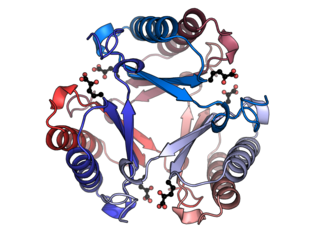
4-Oxalocrotonate tautomerase or 4-OT is an enzyme that converts 2-hydroxymuconate to the αβ-unsaturated ketone, 2-oxo-3-hexenedioate. This enzyme forms part of a bacterial metabolic pathway that oxidatively catabolizes toluene, o-xylene, 3-ethyltoluene, and 1,2,4-trimethylbenzene into intermediates of the citric acid cycle. With a monomer size of just 62 amino acid residues, the 4-Oxalocrotonate tautomerase is one of the smallest enzyme subunits known. However, in solution, the enzyme forms a hexamer of six identical subunits, so the active site may be formed by amino acid residues from several subunits. This enzyme is also unusual in that it uses a proline residue at the amino terminus as an active site residue.

<span class="mw-page-title-main">15-hydroxyprostaglandin dehydrogenase (NAD+)</span> Class of enzymes

Hydroxyprostaglandin dehydrogenase 15-(NAD) (the HUGO-approved symbol = HPGD; HGNC ID, HGNC:5154), also called 15-hydroxyprostaglandin dehydrogenase (NAD+), (EC 1.1.1.141), is an enzyme that catalyzes the following chemical reaction:

In enzymology, a 15-hydroxyprostaglandin dehydrogenase (NADP+) (EC 1.1.1.197) is an enzyme that catalyzes the chemical reaction

In enzymology, a 15-oxoprostaglandin 13-oxidase (EC 1.3.1.48) is an enzyme that catalyzes the chemical reaction

In enzymology, a 1-hydroxy-2-naphthoate 1,2-dioxygenase (EC 1.13.11.38) is an enzyme that catalyzes the chemical reaction

The enzyme D-serine ammonia-lyase (EC 4.3.1.18), with systematic name D-serine ammonia-lyase (pyruvate-forming), catalyzes the chemical reaction

The enzyme L-2-amino-4-chloropent-4-enoate dehydrochlorinase (EC 4.5.1.4) catalyzes the reaction

In enzymology, a 2,6-dioxo-6-phenylhexa-3-enoate hydrolase (EC 3.7.1.8) is an enzyme that catalyzes the chemical reaction

In enzymology, a 2-hydroxymuconate-semialdehyde hydrolase (EC 3.7.1.9) is an enzyme that catalyzes the chemical reaction

The enzyme 4-oxalocrotonate decarboxylase (EC 4.1.1.77) catalyzes the chemical reaction

<span class="mw-page-title-main">2-oxopent-4-enoate hydratase</span> InterPro Family

The enzyme 2-oxopent-4-enoate hydratase (EC 4.2.1.80) catalyzes the chemical reaction

The enzyme bile-acid 7α-dehydratase (EC 4.2.1.106) catalyzes the chemical reaction

<span class="mw-page-title-main">Lomevactone</span> Chemical compound

Lomevactone is a drug described as a psychostimulant and antidepressant which was synthesized and assayed in the 1980s, but was never marketed.

Acireductone synthase (EC number 3.1.3.77, E1, E-1 enolase-phosphatase) is an enzyme with systematic name 5-(methylsulfanyl)-2,3-dioxopentyl-phosphate phosphohydrolase (isomerizing). It catalyses the following reaction:

2-hydroxy-3-keto-5-methylthiopentenyl-1-phosphate phosphatase (EC 3.1.3.87, HK-MTPenyl-1-P phosphatase, MtnX, YkrX) is an enzyme with systematic name 2-hydroxy-5-(methylthio)-3-oxopent-1-enyl phosphate phosphohydrolase. This enzyme catalyses the following chemical reaction

OEH or Oeh may refer to:

2-hydroxychromene-2-carboxylate isomerase is an enzyme with systematic name 2-hydroxy-2H-chromene-2-carboxylate---(3E)-4-(2-hydroxyphenyl)-2-oxobut-3-enoate isomerase. This enzyme catalyses the following chemical reaction

<span class="mw-page-title-main">2-Oxopent-4-enoic acid</span> Chemical compound

2-Oxopent-4-enoic acid (2-oxopent-4-enoate) is formed by the dehydration of 4-hydroxy-2-oxopentanoate by 2-oxopent-4-enoate hydratase or by the hydrolysis of 2-hydroxymuconate semialdehyde by 2-hydroxymuconate-semialdehyde hydrolase.

The molecular formula C5H6O3 (molar mass: 114.10 g/mol, exact mass: 114.0317 u) may refer to:

References

  1. Kunz DA, Ribbons DW, Chapman PJ (1981). "Metabolism of allylglycine and cis-crotylglycine by Pseudomonas putida (arvilla) mt-2 harboring a TOL plasmid". J. Bacteriol. 148 (1): 72–82. doi:10.1128/JB.148.1.72-82.1981. PMC   216168 . PMID   7287632.