Aarhus Light Rail

Last updated
Aarhus Light Rail
Aarhus Letbane
Aarhus Letbane logo.png
Aarhus Letbanen 2018 01.jpg
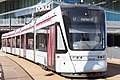
Tram at Aarhus Central Station in 2018
Aarhus Light Rail
Operation
Locale Aarhus area, Central Denmark Region, Denmark
Open21 December 2017 [1]
StatusOperational
Lines
  • L1
  • L2
Owner(s) Aarhus Municipality (50 %)
Central Denmark Region (50 %) [2]
Operator(s) Midttrafik
Keolis
Infrastructure
Track gauge 1,435 mm (4 ft 8+12 in) standard gauge
Propulsion system Overhead line
Electrification 750 V DC
Stock
Statistics
Track length (total) 110 kilometres (68 mi) [3]
Stops51 [4]
20194,788,295
BSicon exnCONTg.svg
former spur
to port
1
BSicon KBHFa grey.svg
BSicon exnSTR.svg
Grenaa
BSicon HST grey.svg
Trustrup
BSicon HST grey.svg
Hessel
BSicon HST grey.svg
Kolind
BSicon exCONTgq.svg
BSicon STR grey.svg
BSicon exSTRr.svg
to Randers
BSicon HST grey.svg
Ryomgård
BSicon HST grey.svg
Mørke
1
BSicon BHF grey.svg
Hornslet
BSicon HST grey.svg
Løgten
BSicon HST grey.svg
Skødstrup
BSicon HST grey.svg
Hjortshøj
BSicon eHST grey.svg
Hovmarken
2
BSicon BHF grey.svg
Lystrup
BSicon bSHI2lr grey.svg
Nye  [ da ]
BSicon HST grey.svg
BSicon STR grey.svg
Lisbjerg-Terp
BSicon HST grey.svg
BSicon STR grey.svg
Lisbjergskolen 2
BSicon KBHFaq grey.svg
BSicon ABZg+r grey.svg
BSicon STR grey.svg
Lisbjerg Bygade
BSicon HST grey.svg
BSicon STR grey.svg
Klokhøjen
BSicon HST grey.svg
BSicon STR grey.svg
Humlehuse
BSicon HST grey.svg
BSicon STR grey.svg
Gl. Skejby
BSicon HST grey.svg
BSicon STR grey.svg
Universitetshospitalet
BSicon HST grey.svg
BSicon HST grey.svg
Torsøvej
Olof Palmes Allé
BSicon HST grey.svg
BSicon STR grey.svg
Nehrus Allé
BSicon HST grey.svg
BSicon HST grey.svg
Vestre Strandallé
Vandtårnet (Ringvejen)
BSicon HST grey.svg
BSicon STR grey.svg
Stockholmsgade
BSicon HST grey.svg
BSicon HST grey.svg
Risskov Strandpark
Stjernepladsen
BSicon HST grey.svg
BSicon HST grey.svg
Østbanetorvet
Aarhus Universitet (Ringgaden)
BSicon HST grey.svg
BSicon STR grey.svg
Universitetsparken  [ da ]
BSicon HST grey.svg
BSicon STR grey.svg
Nørreport
BSicon HST grey.svg
BSicon STR grey.svg
BSicon ABZg+l grey.svg
BSicon STRr grey.svg
BSicon HST grey.svg
Skolebakken
BSicon HST grey.svg
Dokk1
BSicon STR grey.svg
BSicon nCONTg.svg
to port
12
BSicon BAHN.svg
BSicon BHF-L grey.svg
BSicon KBHFa-R.svg
BSicon nSTR.svg
Aarhus H
BSicon nCONT2.svg
BSicon nSTRc3.svg
BSicon STR grey.svg
BSicon STR.svg
BSicon nSTRc1.svg
BSicon lMKRZ2+4o.svg
BSicon STR grey.svg
BSicon nSTR2+4.svg
BSicon nSTRc3.svg
BSicon STR.svg
BSicon KDSTaq grey.svg
BSicon nSTRc1.svg
BSicon ABZgr grey.svg
BSicon ABZg+n4.svg
depot
BSicon MASK*.f.svg
BSicon hSTR2+1~FF.svg
BSicon STR2 grey.svg
BSicon hSTR3a.svg
BSicon hSTR+1e.svg
BSicon MASK*.g.svg
BSicon hSTR1+4~RR.svg
BSicon STR+4 grey.svg
to Aalborg
BSicon CONTgq.svg
BSicon ABZgr.svg
BSicon HST grey.svg
Kongsvang
BSicon BAHN.svg
BSicon HST-L.svg
BSicon HST-R grey.svg
Viby J
Fredericia–Aarhus line
to Fredericia
BSicon CONTgq.svg
BSicon SHI2c2 grey.svg
BSicon STRr.svg
BSicon SHI2r grey.svg
BSicon HST grey.svg
Rosenhøj  [ da ]
BSicon HST grey.svg
Øllegårdsvej  [ da ]
BSicon HST grey.svg
G Clausens Vej  [ da ]
BSicon HST grey.svg
Tranbjerg  [ da ]
BSicon HST grey.svg
Nørrevænget  [ da ]
BSicon HST grey.svg
Mølleparken
1
BSicon BHF grey.svg
Mårslet
BSicon HST grey.svg
Vilhelmsborg
BSicon HST grey.svg
Beder
BSicon HST grey.svg
Malling
BSicon HST grey.svg
Assedrup
BSicon HST grey.svg
Rude Havvej
2
BSicon KBHFe grey.svg
BSicon exSTR.svg
Odder
BSicon exCONTf.svg
to Hou, Horsens
DK 2021 Aarhus Letbane.png
Website https://www.midttrafik.dk/letbanen/in-english.aspx (operator)
http://www.letbanen.dk/ Aarhus Letbane (construction project)

The Aarhus Light Rail (Danish : Aarhus Letbane) is a light rail system with interurban characteristics serving the city of Aarhus and the surrounding region in Central Jutland, Denmark. It is operated by the local transport operator Midttrafik. [5] The first line opened in December 2017, service on the intercity section Odder to Lisbjergskolen in August 25, 2018, [5] and a third intercity line to Grenaa opened on 30 April 2019. More lines are being planned.

Contents

On 8 May 2012, the Danish Parliament approved the construction of the first line; work to build Phase 1 commenced during September 2013. [6] It was originally planned to open in August 2016, but this was delayed, in part due to legislative issues in relation to railway safety.

As of 2025, the system is composed of two converted railway branchlines: the Grenaa line running 69 km (43 mi) north to Grenaa railway station and the Odder line, running 26.5 km (16.5 mi) to Odder railway station combined with a 12 km (7.5 mi) urban tram section from Aarhus Central Station to Lystrup. Due to these mixed characteristics, two types of rolling stock were considered from the start, 70 km/h (43 mph) vehicles for the urban section, and 100 km/h (62 mph) vehicles for the regional routes. [6] Ultimately both types were supplied by the rail manufacturer Stadler. [7]

From its opening and until the opening of the Odense light rail in May 2022, [8] [9] the Aarhus light rail was the only operational light rail or tram system in Denmark. [1] [a] Denmark's third Light Rail project, the Greater Copenhagen Light Rail, opened its first section on 26 October 2025 [10] [11] with the rest of the first line currently under construction. [12] There were discussions for a light rail project in Aalborg, Denmark's fourth largest city, but as of 2026 those plans were abandoned and a Bus Rapid Transit line, which was inaugurated in 2023, was built instead (article in Danish-language Wikipedia). [13] [14] [15]

History

Background

The development of a light rail system around Aarhus, the second biggest city in Denmark, was originally proposed as early as 2006. [16] In response to rising interest in the concept, during January 2009, the Danish Parliament granted an allocation of DKK 500 million ($85 million) to support the light rail project as part of a wider green transport package. [16]

During October 2010, work commenced upon several studies. [16] According to transport authority Midttrafik, who later operated the completed network, the Aarhus light rail programme had drawn considerable inspiration from tram-train operations on the tram network in Kassel, Germany. In addition, consultancy firms COWI A/S and SYSTRA contributed their own studies and technical support for the project, including an initial feasibility study and development of tender documentation. [6] The project's Environmental Impact Assessment report was produced by C. F. Moller; it was estimated that establishing the light rail network would result in annual energy savings of 47 gigawatts and reduce carbon dioxide emissions by 73 tonnes (161,000 lb) during each year of operation. [16]

Various different approaches for the network were being considered at one stage, including the full electrification of the route, the procurement of a combination of 750 V DC trams and electro-diesel tram-trains. It was recognised that, if the option of full electrification was to be exercised, a catenary-free system may be chosen for the harbour-side element of Phase 1. [6] By late 2012, it had already been decided that Germany's BOStrab light rail regulations would be applied to the tentative network, while Lloyd's Register was appointed to serve as the independent safety assessor. By mid-2012, construction activity was scheduled to begin during June 2013, while the light rail network's opening was planned to occur during August 2016. [6]

On 8 May 2012, the Danish Parliament gave its approval for the construction of the Aarhus light rail line, which would be the first such modern line in Denmark, and granted the legal powers to proceed with the initiative. [6] As a consequence, the Aarhus Letbane joint venture between the local municipality, the Ministry of Transport and the Midtjylland region was formally established to promote and further the project during August 2012. [16] The construction of Phase 1 has been estimated to have cost DKK 2.4 billion ($408 million); financing was provided by the City of Aarhus (47.2 percent), the Danish central government (47 percent) and the Central Denmark Region (5.8 per cent). Additionally, the European Investment Bank provided DKK 14.2 million to the initiative as part of the European Commission’s European Local Energy Assistance programme (ELENA). [16] [17]

The competitive tendering process for the network's construction was launched shortly after the formation of the joint venture. [6] The contracts for the construction of Aarhus light rail line were awarded in three separate packages; these included a negotiated design-and-build contract that covered both the railway systems and rolling stock, valued at between €150 million and €180 million, along with a pair of lower value contracts to build the related civil works for the line. [6] During July 2014, a German-Italian consortium, comprising Stadler Rail and Ansaldo STS, was awarded the contract for the construction and outfitting of Phase 1 of the Aarhus light rail. Stadler supplied the rolling stock for the line while Ansaldo STS provided the associated infrastructure, such as the tracks, signalling systems, control centre, and maintenance facility. [16] [18]

Phase 1

Light rail construction around Lisbjerg, 2016 Construction of Aarhus Letbane 23.JPG
Light rail construction around Lisbjerg, 2016
Light rail bridge over the Egaa valley (between Klokhojen and Humelhuse stations), 2015 Letbanebro over Egadalen.jpg
Light rail bridge over the Egaa valley (between Klokhøjen and Humelhuse stations), 2015

Phase 1 is a 12 km (7.5 mi) double-track tramway running from Aarhus Central Station, via Skejby and Lisbjerg to Lystrup. [6] The line forms a loop spanning across Aarhus' city centre, linking into the existing regional railways running to Odder in the south and Grenaa in the northeast; to facilitate such operations, the existing Odder Line railway from Aarhus to Odder and Grenaa Line railway to Grenaa were modified to accommodate light rail services. [6] [16] The two existing local lines have been electrified and adapted in other ways to Phase 1, but their alignment was retained. Furthermore, the existing mainline rail station at Aarhus, along with existing park and ride facilities near major stops along the route were refurbished. [16]

Various pieces of infrastructure and civil works were performed during the construction phase of the project. [16] During October 2014, work commenced on the boring of a pair of tunnels to carry the tramway between Aarhus University and Aarhus University Hospital in Nørrebrogade.[ dubious discuss ] In the following year, both the Randers Way and Nørrebro Street had to be reduced in width in order to allocate space between the lanes for the installation of the new double-track line. [16] In total, eight bridges had to be constructed during Phase 1; of these, the bridge over the Egaa valley, possessing a length of 347 metres (1,138 ft), is the largest bridge to be built in the programme. [16] Overall, Phase 1 is to have a total of 110 kilometres (68 mi) long and serve 51 stops once upon completion. [19]

The opening of Phase 1 was originally scheduled to occur on 23 September 2017; [20] however, the event was cancelled only a few hours before the event as a result of missing security clearances from the Danish government authority. [21] Accordingly, the opening date was pushed back to the following month, [22] before being further delayed thereafter. It was said that both the government and the city were inexperienced with tramway operation, since no tramways existed in Denmark between 1972 and 2017, resulting in problems in interpreting the rules. Especially for the reused lines, it was unclear whether they could be grandfathered or must obey rules for new lines. On 20 December 2017, it was announced that approval for the new lines had finally been issued, allowing for services on the central tram section to commence during the following day. [1] [23] Traffic on the Odderbanen and to Lisbjergskolen was delayed more and started on 25 August 2018. Traffic to Grenaa opened on 30 April 2019. [24]

Future

Even prior to work commencing on Phase 1, several expansion plans had already been mooted. [6] During January 2018, it was publicly stated that options for the construction of two new branches, from Lisbjerg to Hinnerup (8 km (5.0 mi)) and from Aarhus to Brabrand (11 km (6.8 mi)), were in the detailed planning phase. [25] [26] [27] [28]

Rolling stock

From an early stage in the project, it became clear that two different types of rolling stock would be required; to service the city center areas, conventional trams capable of up to 70 km/h (43 mph) were recommended, while trams capable of a maximum speed of 100 km/h (62 mph) would be necessary to conduct the longer distance routes. [6] [7] Accordingly, contracts have been signed with Swiss rolling stock manufacturer Stadler for the delivery of two types of trams for the network: [29] [30]

Future

On 2 December 2025, Aarhus Letbane entered an agreement with Stadler for the supply of 8 Citylink trams in order to increase service frequency. The trams will have four segments and a capacity of 152 seated passengers and 180 standees, an increase of 80 over the current Stadler Tango trams. The trams are expected in 2029 and will be equipped with an onboard battery pack in order to enable operation in the event of overhead line icing. [31] [32]

Table

Rolling stock of the Aarhus Light Rail system
YearManufacturerModelImageQuantitySpeed (mph)CapacityRef.
2016 Stadler Tango Arhus--aarhus-aarhus-letbane-1156021.jpg 12100 km/h (62 mph)266 [30]
Variobahn Tram 1201 near Dokk1, Aarhus.jpg 1480 km/h (50 mph)224
2029 Stadler Citylink 8100 km/h (62 mph)332 [31]

Stations

Grenaa Line (L1)Central tramway (L2)Odder Line (L2)
  • Lystrup (connection to L1)
  • Nye
  • Lisbjerg - Terp
  • Lisbjergskolen
  • Lisbjerg Bygade
  • Klokhøjen
  • Humlehuse
  • Gl. Skejby
  • AU Hospital
  • Olof Palmes Allé
  • Nehrus Allé
  • Vandtårnet
  • Stockholmsgade
  • Stjernepladsen
  • Aarhus Universitet
  • Universitetsparken
  • Nørreport
  • Skolebakken (connection to L1)
  • Dokk1
  • Aarhus H (railway)

Ridership

Yearly and quarterly passenger numbers [33] [34]
Year1st Quarter2nd Quarter3rd Quarter4th QuarterYearly total
20191,155,7321,078,2501,195,4761,358,8374,788,295
20201,145,088672,821908,100907,5883,588,597
2021580,619970,4001,085,7551,341,8223,978,596
20221,228,4181,365,1311,512,1011,368,8715,474,521
20231,413,9061,301,6291,474,1861,572,3725,762,063
20241,590,3271,644,5881,532,7321,583,5656,351,212
20251,582,7721,469,812 [b] 1,469,5164,522,100 [b]

In June of 2024, and again in April of 2025, the local Århus Stiftstidende newspaper released the official passenger numbers for all stations on Aarhus Letbane for the first quarter of the respective year: [36] [37]

Individual station's passenger numbers for January, February and March of 2024 and 2025 [36] [37]
StationTotal passenger number

(1st quarter 2024)

Total passenger number

(1st quarter 2025)

Lines served
Grenaa 28,53228,936L1
Hessel 2,9043,847L1
Trustrup 4,0594,751L1
Kolind 9,60010,148L1
Ryomgård 21,95922,338L1
Thorsager 4,0094,588L1
Mørke 10,20010,227L1
Hornslet 25,00327,446L1
Løgten 12,03012,728L1
Skødstrup 23,82524,266L1
Hjortshøj 25,20426,128L1
Hovmarken 4,286N/A [c] L1
Lystrup 69,69474,121L1, L2
Torsøvej 33,22633,421L1
Vestre Strandallé 21,31021,718L1
Risskov Strandpark 7,4899,438L1
Østbanetorvet 22,94824,094L1
Nye 3,6454,016L2
Lisbjerg-Terp 2,4092,232L2
Lisbjergskolen 14,62218,812L2
Lisbjerg Bygade 12,19613,158L2
Klokhøjen 6,4896,692L2
Humlehuse 4,7214,451L2
Gl. Skejby (Agro Food Park) 9,9839,892L2
Universitetshospitalet 108,178101,419L2
Olof Palmes Allé 47,53745,433L2
Nehrus Allé 38,21237,378L2
Vandtårnet (Ringvejen) 51,01656,019L2
Stockholmsgade 36,13236,142L2
Stjernepladsen 52,85952,999L2
Aarhus Universitet (Ringgaden) 81,41774,078L2
Universitetsparken 26,72124,796L2
Nørreport 79,48977,142L2
Skolebakken 73,77176,427L1, L2
Dokk1 74,13376,750L1, L2
Aarhus H 340,893332,467L1, L2
Kongsvang 5,7365,195L2
Viby J 44,59244,176L2
Rosenhøj 21,05720,780L2
Øllegårdsvej 4,7186,781L2
Gunnar Clausens Vej 17,03614,513L2
Tranbjerg 21,40520,786L2
Nørrevænget 6,4006,442L2
Mølleparken 3,8183,701L2
Mårslet 25,59823,885L2
Vilhelmsborg 573857L2
Beder 7,8247,584L2
Malling 13,21512,148L2
Assedrup 941945L2
Rude Havvej 4,8574,907L2
Odder 21,88821,778L2


In February of 2023, Århus Stiftstidende released the official passenger numbers for all stations on Aarhus Letbane, except Trustrup. [38] These numbers are the daily average of passengers boarding at each respective station on weekdays from the 15th of August 2022 to the 18th of December 2022. See below for each station's passenger numbers.

Aarhus Light Rail average ridership per weekday by station, August – December 2022 [38]
StationAverage ridershipLines served
Grenaa 479L1
Hessel 39L1
Trustrup No dataL1
Kolind 148L1
Ryomgård 334L1
Thorsager 67L1
Mørke 140L1
Hornslet 386L1
Løgten 167L1
Skødstrup 295L1
Hjortshøj 319L1
Hovmarken 64L1
Lystrup 915L1, L2
Torsøvej 337L1
Vestre Strandallé 231L1
Risskov Strandpark 118L1
Østbanetorvet 274L1
Nye 43L2
Lisbjerg-Terp 30L2
Lisbjergskolen 106L2
Lisbjerg Bygade 136L2
Klokhøjen 71L2
Humlehuse 41L2
Gl. Skejby (Agro Food Park) 96L2
Universitetshospitalet 1233L2
Olof Palmes Allé 608L2
Nehrus Allé 442L2
Vandtårnet (Ringvejen) 631L2
Stockholmsgade 451L2
Stjernepladsen 627L2
Aarhus Universitet (Ringgaden) 1075L2
Universitetsparken 405L2
Nørreport 1055L2
Skolebakken 1079L1, L2
Dokk1 983L1, L2
Aarhus H 4409L1, L2
Kongsvang 81L2
Viby J 678L2
Rosenhøj 314L2
Øllegårdsvej 69L2
Gunnar Clausens Vej 244L2
Tranbjerg 339L2
Nørrevænget 92L2
Mølleparken 79L2
Mårslet 413L2
Vilhelmsborg 13L2
Beder 144L2
Malling 207L2
Assedrup 15L2
Rude Havvej 80L2
Odder 404L2

See also

Notes

  1. Excluding museum operations such as the Danish Tramway Museum
  2. 1 2 Due to an unusually large difference between the preliminary and adjusted passenger numbers for the 2nd quarter of 2025, Midttrafik have been asked to check that the adjusted passenger number, as shown in the table, is correct. [35]
  3. The station was closed in June 2024.

References

  1. 1 2 3 "Aarhus Letbane åbner torsdag den 21. december".
  2. "Organisation".
  3. "Om Letbanen". Aarhus Letbane (in Danish). Retrieved 2019-04-01.
  4. "Letbanen binder Aarhusområdet sammen". Archived from the original on 24 December 2016.
  5. 1 2 "Letbanen". Midttraffik. Retrieved 31 January 2017.
  6. 1 2 3 4 5 6 7 8 9 10 11 12 "Aarhus tram-train project gets the go-ahead". Railway Gazette International. 10 May 2012. Archived from the original on 1 March 2020. Retrieved 11 May 2012.
  7. 1 2 Barrow, Keith (2015-06-01). "Aarhus tram-train design revealed". International Railway Journal. Retrieved 2025-12-06.
  8. "Efter 6 store nedture: Nu kan du endelig hoppe på Odense Letbane". DR (in Danish). 2022-05-28. Retrieved 2022-05-31.
  9. "Celebrations as Odense tramway opens". Railway Gazette International. 2022-05-31. Retrieved 2022-05-31.
  10. https://www.urban-transport-magazine.com/en/copenhagens-new-light-rail-system-inaugurated/
  11. https://www.railwaygazette.com/light-rail-and-tram/k%C3%B8benhavn-tramway-opens-to-make-it-faster-and-more-comfortable-to-get-around/69840.article
  12. "Følg byggeriet". Hovedstadens Letbane (in Danish). Archived from the original on 2021-02-08. Retrieved 2022-05-31.
  13. https://www.tv2nord.dk/aalborg/radmand-lykkelig-for-skrottet-letbaneprojekt
  14. https://www.dr.dk/nyheder/indland/i-aalborg-priser-de-sig-lykkelige-de-undgik-letbane
  15. https://migogaalborg.dk/letbane-til-plusbus-aalborg/
  16. 1 2 3 4 5 6 7 8 9 10 11 12 "Aarhus Light Rail Project, Aarhus". Railway Technology. Retrieved 2025-12-06.
  17. "Energy efficiency: Trams gain traction in Denmark". European Investment Bank. Retrieved 2025-12-06.
  18. "Global Railway Review". Global Railway Review. Retrieved 2025-12-06.
  19. "Om Letbanen [About the Lightrail]". letbanen.dk (in Danish). Archived from the original on 11 April 2014. Retrieved 31 January 2017.
  20. "Aarhus light rail to open in September." metro-report.com, 3 May 2017.
  21. Hecklen, Alexander (22 September 2017). "Letbanedirektør har kendt til manglende godkendelse i tre dage". DR.dk. Retrieved 26 September 2017.
  22. "After embarrassing setback, Aarhus light rail gets new opening date… maybe". The Local. 27 September 2017. Retrieved 27 September 2017.
  23. "Aarhus opens Denmark’s first modern light rail line." Archived 2017-12-24 at the Wayback Machine metro-report.com, 21 December 2017.
  24. Aveo (2019-04-24). "Letbanen åbner for passagerdrift til Grenaa 30. april". Aarhus Letbane (in Danish). Retrieved 2025-12-06.
  25. "Planlægning af nye letbaneetaper - Aarhus Letbane". www.letbanen.dk (in Danish). Archived from the original on 2018-10-29. Retrieved 2025-12-06.
  26. "Idéoplæg til styrkelse af Århus letbaneprojekt" (PDF). www.letbaner.dk. Retrieved 2 December 2025.
  27. "Høringssvar om Århus letbane" (PDF). www.letbaner.dk. April 2010. Retrieved 2 December 2025.
  28. "Input til Aarhus letbane, etape Aarhus Ø – Brabrand" (PDF). www.letbaner.dk. Retrieved 2 December 2025.
  29. "#17 Togleverandør - Aarhus Letbane". www.letbanen.dk (in Danish). Archived from the original on 2017-07-31. Retrieved 2025-12-06.
  30. 1 2 "Stadler presents the first Variobahn for Aarhus (Denmark)." Archived 2017-05-27 at the Wayback Machine stadlerrail.com, Retrieved: 9 June 2018.
  31. 1 2 maja_bech (2025-12-02). "Flere tog på vej til Aarhus Letbane: Nu bliver der plads til flere afgange og passagerer". Aarhus Letbane (in Danish). Retrieved 2025-12-04.
  32. "Stadler to deliver eight CITYLINK Tram-Trains to Aarhus". www.stadlerrail.com. Retrieved 2025-12-04.
  33. maja_bech (2024-01-17). "Aarhus Letbane sætter ny passagerrekord". Aarhus Letbane (in Danish). Retrieved 2025-12-06.
  34. "Passagertal". Aarhus Letbane (in Danish). Retrieved 2025-12-06.
  35. "- Vi bløder passagerer: Letbanen halter bagefter sidste års rekord | stiften.dk". stiften.dk (in Danish). 2025-07-22. Retrieved 2025-07-22.
  36. 1 2 "Aflysninger har kostet passagerer i letbanen: Her er listen over de mest og mindst travle stationer | stiften.dk". stiften.dk (in Danish). 2025-04-25. Retrieved 2025-04-25.
  37. 1 2 "Passagererne strømmer ind i letbanetogene - her er listen over de mest og mindst travle stationer på Aarhus Letbane | stiften.dk". stiften.dk (in Danish). 2024-06-02. Retrieved 2024-06-03.
  38. 1 2 "Passagermangel var ved at lukke letbanestationer: Nu er der gået ni år, og det ser stadig slemt ud - se tallene | stiften.dk". stiften.dk (in Danish). 2023-02-26. Retrieved 2025-12-06.