This article needs additional citations for verification .(September 2014) |
Agroha | |
|---|---|
Town | |
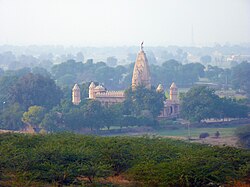
| Aerial view of Agroha town | |
| Coordinates: 29°20′N75°38′E / 29.33°N 75.63°E | |
| Country | |
| State | Haryana |
| District | Hisar |
| Founded by | Maharaja Agrasen |
| Population | |
• Total | 7,722 |
| Languages | |
| • Official | Hindi, English |
| • Regional | Bagri, Haryanavi, |
| Time zone | UTC+5:30 (IST) |
| Postal code | 125047 |
| Vehicle registration | HR |
| Website | haryana |
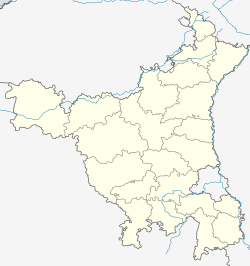
Agroha is a town near Hisar city, Hisar district in Haryana state of northern India, between Hisar city and Fatehabad on NH 09. Ancient structures, pot-shards, coins and seals have been found in archaeological excavations at the Agroha Mound.[ citation needed ]
Agroha is listed in the 16th century CE Ain-i-Akbari as a pargana under Hisar sarkar, producing a revenue of 1,743,970 dams for the imperial treasury and supplying a force of 2000 infantry and 200 cavalry. It appears with the note "Game of all kind abounds. Sport chiefly hawking." [1]
As of 2011 India census, Agroha had a population of 7722 in 1491 households. Males (4068) constitute 52.68% of the population and females (3654) 47.31%. Agroha has an average literacy (4522) rate of 58.55%, less than the national average of 74%: male literacy (2659) is 58.8%, and female literacy (1863) is 41.19%. In Agroha, 13.71% of the population is under 6 years of age (1059). [2]
Economy of Agroha subdivision largely depends on agriculture, also augmented by medical and healthcare (due to medical college), power generation (due to the large NPCIL township), religious and cultural tourism (due to Agroha Dham and Agroha Mound), education, and other services.
In 2023, a plan submitted by the Agarwal community to the Chief Minister of Haryana for the development of "Agroha Global City" in the 25 km radius by establishing 18 residential sectors named after 18 gotras of Agarwal community, construction of world's largest statue of Maharaja Agrasen, AYUSH Hospital, a university, ashrams and dharamshalas for pilgrims, modern busport, and railway station, etc. The development will be done by the agrawal community and the role of government will be limited to providing the legal approvals and helping the land acquisition. [3]