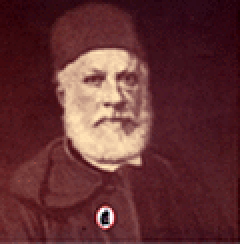
Ahmad Faris Shidyaq

Last updated

[1] [2] [3] [4] [5]

Ahmad Faris Shidyaq
Ahmad Faris Shidyaq.png
Ahmad Faris Shidyak
Born 1805
Ashqout, Lebanon
Died 20 September 1887
Kadıköy, Istanbul Vilayet, Ottoman Empire
Occupation Linguist, Writer, Journalist, translator
Spouse(s) Marie As-Souly
Children Two sons: Salim (1826–1906) and Fayiz (1828–1856)
Parent(s) Youssef Ash-Shidyaq, Marie Massaad

Ahmad Faris Shidyaq (1805 – 20 September 1887, known also as Fares Chidiac, Faris Al Chidiac, Arabic : أحمد فارس الشدياق) was a scholar, writer and journalist who grew up in present-day Lebanon. A Maronite Christian by birth, he later lived in major cities of the Arabic-speaking world, where he had his career. He converted to Protestantism during the nearly two decades that he lived and worked in Cairo, present-day Egypt, from 1825 to 1848. He also spent time on the island of Malta. Participating in an Arabic translation of the Bible in Great Britain that was published in 1857, Faris lived and worked there for 7 years, becoming a British citizen. He next moved to Paris, France for two years in the early 1850s, where he wrote and published some of his most important work.

Protestantism division within Christianity, originating from the Reformation in the 16th century against the Roman Catholic Church, that rejects the Roman Catholic doctrines of papal supremacy and sacraments

Protestantism is the second largest form of Christianity with collectively between 800 million and more than 900 million adherents worldwide or nearly 40% of all Christians. It originated with the 16th century Reformation, a movement against what its followers perceived to be errors in the Roman Catholic Church. Protestants reject the Roman Catholic doctrine of papal supremacy and sacraments, but disagree among themselves regarding the real presence of Christ in the Eucharist. They emphasize the priesthood of all believers, justification by faith alone rather than by good works, and the highest authority of the Bible alone in faith and morals. The "five solae" summarise basic theological differences in opposition to the Roman Catholic Church.
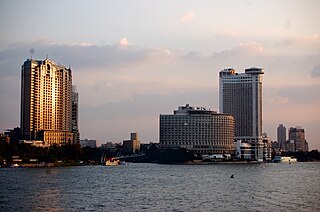
Cairo City in Egypt

Cairo is the capital of Egypt. The city's metropolitan area is one of the largest in Africa, the largest in the Middle East, and the 15th-largest in the world, and is associated with ancient Egypt, as the famous Giza pyramid complex and the ancient city of Memphis are located in its geographical area. Located near the Nile Delta, modern Cairo was founded in 969 CE by the Fatimid dynasty, but the land composing the present-day city was the site of ancient national capitals whose remnants remain visible in parts of Old Cairo. Cairo has long been a centre of the region's political and cultural life, and is titled "the city of a thousand minarets" for its preponderance of Islamic architecture. Cairo is considered a World City with a "Beta +" classification according to GaWC.

Malta island republic in Europe

Malta, officially known as the Republic of Malta, is a Southern European island country consisting of an archipelago in the Mediterranean Sea. It lies 80 km (50 mi) south of Italy, 284 km (176 mi) east of Tunisia, and 333 km (207 mi) north of Libya. With a population of about 475,000 over an area of 316 km2 (122 sq mi), Malta is the world's tenth smallest and fifth most densely-populated country. Its capital is Valletta, which is the smallest national capital in the European Union by area at 0.8 km.2 The official languages are Maltese and English, with Maltese officially recognised as the national language and the only Semitic language in the European Union.

Contents

Later in the 1850s Faris moved to Tunisia, where in 1860 he converted to Islam, taking the first name Ahmad. Moving to Istanbul later that year to work as a translator at the request of the Ottoman government, Faris also founded an Arabic-language newspaper. It was supported by the Ottomans, Egypt and Tunisia, publishing until the late 1880s.

Tunisia Country in Northern Africa

Tunisia (officially the Republic of Tunisia) is a country in the Maghreb region of North Africa, covering 165,000 square kilometres. Its northernmost point, Cape Angela, is the northernmost point on the African continent. It is bordered by Algeria to the west and southwest, Libya to the southeast, and the Mediterranean Sea to the north and east. Tunisia's population was 11.435 million in 2017. Tunisia's name is derived from its capital city, Tunis, which is located on its northeast coast.

Islam is an Abrahamic monotheistic religion teaching that there is only one God (Allah), and that Muhammad is the messenger of God. It is the world's second-largest religion with over 1.8 billion followers or 24% of the world's population, most commonly known as Muslims. Muslims make up a majority of the population in 50 countries. Islam teaches that God is merciful, all-powerful, unique and has guided humankind through prophets, revealed scriptures and natural signs. The primary scriptures of Islam are the Quran, viewed by Muslims as the verbatim word of God, and the teachings and normative example of Muhammad.

Istanbul Metropolitan municipality in Marmara, Turkey

Istanbul, formerly known as Byzantium and Constantinople, is the most populous city in Turkey and the country's economic, cultural and historic center. Istanbul is a transcontinental city in Eurasia, straddling the Bosporus strait between the Sea of Marmara and the Black Sea. Its commercial and historical center lies on the European side and about a third of its population lives in suburbs on the Asian side of the Bosporus. With a total population of around 15 million residents in its metropolitan area, Istanbul is one of the world's most populous cities, ranking as the world's fourth largest city proper and the largest European city. The city is the administrative center of the Istanbul Metropolitan Municipality. Istanbul is viewed as a bridge between the East and West.

Faris continued to promote Arabic language and culture, resisting the 19th-century "Turkization" pushed by the Ottomans based in present-day Turkey. Shidyaq is considered to be one of the founding fathers of modern Arabic literature; he wrote most of his fiction in his younger years.

Biography

Mystery shrouds the life of Ahmad Faris Shidyaq. While he has numerous autobiographical references in his writings, scholars have found it difficult to distinguish between romanticizing and reality.

Early life

Ahmad Faris Shidyaq was born in 1804 in Ashqout, a mountain village of the Keserwan District in the modern Mount Lebanon Governorate. At birth, his given name was Faris. His father's name was Youssef. His mother was of the Massaad family, from Ashqout. His family traced its roots to the Maronite muqaddam Ra'ad bin Khatir from Hasroun. His family was very well educated and its members worked as secretaries for the governors of Mount Lebanon. In 1805, the family was forced to leave Ashqout following a conflict with a local governor; Butrus al-Shidyaq, the paternal grandfather of Faris, was killed because of the politics.

Ashqout Municipality in Mount Lebanon, Lebanon

Ashqout is a town and municipality in the Keserwan District of the Mount Lebanon Governorate of Lebanon. It is located 31 kilometers north of Beirut. Ashqout's average elevation is 1,000 meters above sea level and its total land area is 588 hectares. Its inhabitants are predominantly Maronite Catholic, with Christians from other denominations in the minority.

Keserwan District District in Mount Lebanon, Lebanon

Keserwan District is a district (qadaa) in the Mount Lebanon Governorate, Lebanon, to the northeast of Lebanon's capital Beirut. The capital, Jounieh, is overwhelmingly Maronite Christian. The area is home to the Jabal Moussa Biosphere Reserve.

Mount Lebanon Governorate Place in Lebanon

Mount Lebanon Governorate is one of the eight governorates of Lebanon. Its capital is located in Baabda. An outright majority of the population is Christian, with minorities of Druze, Muslims of various sects.

The family settled in Hadath, in the suburbs of Beirut, at the service of a Shihabi prince. Faris joined his brothers, Tannous (1791–1861) and Assaad (1797–1830), and his maternal cousin Boulos Massaad (1806–1890), in Ayn Warqa school, one of the most prestigious Maronite schools of the 19th century. Again, a family conflict, in which the Shidyaq were at odds with the Prince Bashir Shihab II, obliged their father Youssef Ash-Shidyaq to take refuge in Damascus, where he died in 1820.

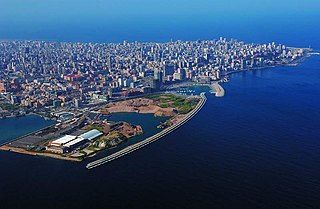
Beirut City in Lebanon

Beirut is the capital and largest city of Lebanon. No recent population census has been conducted, but 2007 estimates ranged from slightly more than 1 million to 2.2 million as part of Greater Beirut. Located on a peninsula at the midpoint of Lebanon's Mediterranean coast, Beirut is the country's largest and main seaport.

Paul Peter Massad Maronite Patriarch of Antioch

Paul I Peter Massad was the 70th Maronite Patriarch of Antioch from 1854 until his death in 1890.

Bashir Shihab II Emir of Lebanon

Bashir Shihab II was a Lebanese emir who ruled Lebanon in the first half of the 19th century. Born in a family who had converted from Sunni Islam, the religion of previous Shihabi Emirs, he was the only Maronite ruler of the Emirate of Mount Lebanon.

Faris left school and continued his studies under his older brothers Assaad and Tannous. He joined his brother Tannous as a copyist at the service of the Prince Haydar Shihab; their brother Assaad worked as the secretary of the Sheikh Ali Al-Emad in Kfarnabrakh, in the Chouf District. His brother Assaad's life had a major influence on the life and career of Faris.

Kfar Nabrakh in Mount Lebanon, Lebanon

Kfar Nabrakh is a municipality in the Chouf District of Mount Lebanon Governorate, Lebanon. It is located 50 kilometers southeast of Beirut. Cafrenbach's total land area consists of 941 hectares. Its average elevation is 1,010 meters above sea level. Its inhabitants are religiously mixed, with a Druze majority and a Melkite Christian minority. During the Lebanese Civil War, 64 residents of the village were killed in the violence.

Chouf District District in Mount Lebanon Governorate, Lebanon

Chouf is a historic region of Lebanon, as well as an administrative district in the governorate (muhafazat) of Mount Lebanon.

Expanded description

Around 1820, Assaad Shidyaq encountered Jonas King, a Protestant missionary of the American Board of Commissioners for Foreign Missions; eventually Assaad became Protestant. He was excommunicated under the automatic excommunication edict issued by the Maronite Patriarch Youssef Hobaish (1823–1845), who sought to prevent all dealings with the Protestant missionaries. Assaad was later detained for years in the Monastery of Qannoubine in the Qadisha valley, where he died in 1830. [6]

Jonas King was a Congregational clergyman from the United States who worked as a missionary, mainly in Greece. His activities in Greece were interrupted by a spell of religious persecution which was finally resolved through diplomatic negotiations between the United States' and Greek governments.

Missionary member of a religious group sent into an area to do evangelism

A missionary is a member of a religious group sent into an area to proselytize or perform ministries of service, such as education, literacy, social justice, health care, and economic development. The word "mission" originates from 1598 when the Jesuits sent members abroad, derived from the Latin missionem, meaning "act of sending" or mittere, meaning "to send". The word was used in light of its biblical usage; in the Latin translation of the Bible, Christ uses the word when sending the disciples to preach The gospel in his name. The term is most commonly used for Christian missions, but can be used for any creed or ideology.

American Board of Commissioners for Foreign Missions

The American Board of Commissioners for Foreign Missions (ABCFM) was among the first American Christian missionary organizations. It was created in 1810 by recent graduates of Williams College. In the 19th century it was the largest and most important of American missionary organizations and consisted of participants from Reformed traditions such as Presbyterians, Congregationalists, and German Reformed churches.

By 1825, Faris had left Lebanon for Egypt, as he was tormented by his brother's ordeals. Assaad's death permanently affected the younger man's choices and his career. He never forgave his brother Tannous and his cousin Boulos Massaad (who later became the Maronite Patriarch (1854–1890)) for what he considered their role in the events that led to the death of Assaad.

In 1826, Faris married Marie As-Souly, daughter of a wealthy Christian family, who were originally from Syria. They had two sons: Faris (1826–1906) and Fayiz (1828–1856). From 1825 to 1848, Faris divided his time in living in Cairo and on the island of Malta. He was the editor-in-chief of an Egyptian newspaper, Al Waqa'eh Al Masriah. In Malta, he was the director of the printing press of American missionaries. He also studied Fiqh in Al-Azhar University in Cairo. Faris is believed to have converted to Protestantism during this period in Egypt, an extended time of relative solitude and study.

In 1848 he was invited to Cambridge, England by the Orientalist Samuel Lee (1783–1852) to participate in the Arabic translation of the Bible. This translation of the Bible was published in 1857, after the death of Samuel Lee. This translation is still considered one of the best Arabic translations of the Bible.

Faris stayed in England with his family for almost 7 years. He settled first in Barley, Hertfordshire and then moved to Cambridge. At the end of his English stay, he moved to Oxford, where he became naturalized as a British citizen, but tried in vain to secure a teaching post. Disappointed by England and its academics, he moved to Paris, France around 1855.

Faris stayed in Paris till 1857. It was one of his most prolific periods in thinking and writing, but also in having an intense social nightlife. In Paris he wrote and published his major works. It is also in Paris that he was introduced to Socialism and where he became a Socialist. A keen admirer of Shakespeare, Faris argued that Othello suggests a detailed knowledge of Arabic culture. Faris suggested that Shakespeare may have had an Arabic background, his original name being "Shaykh Zubayr". This theory was later developed in all seriousness by Safa Khulusi. [7]

His wife died in 1857. He later married an English woman, Safia, who had embraced Islam. They had one daughter together, Rosalinde Faris. [8]

The couple moved to Tunisia, at the invitation to Faris by the Bey of Tunis. He was appointed as editor-in-chief of the newspaper Al Ra'ed, and supervisor of the Education Directorate. While in Tunisia, Faris e converted to Islam from the Congregational church. [9] in 1860 and took the name Ahmad. He soon afterwards left Tunis for Istanbul, Turkey, being invited by the Ottoman Sultan Abdel Majid I.

Ahmad Faris spent the last part of his life in Istanbul where, in addition to his position as an official translator, he founded in 1861 an Arabic newspaper Al Jawa'eb. It was supported financially by the Ottomans, as well as by the Egyptian and Tunisian rulers. It was modeled on the modern Western newspapers and continued publication until 1884.

Ahmad Faris strongly defended use of the Arabic language and its heritage and Arabic culture against the Turkization attempts of the Turkish reformers of the 19th century. Ahmad Faris Ash-Shidyaq is considered one of the founding fathers of modern Arabic literature and journalism.

Death and afterward

Ahmad Faris Shidyaq died on 20 September 1887 in Kadikoy, Turkey. He was buried in Lebanon on 5 October 1887. Many of his works remain unpublished and some manuscripts are lost.

Philosophical and/or political views

Since 2001, scholars around the world seem to have rediscovered Ahmad Faris Shidyaq. Several books have been published about his life, thought and unpublished works. Shidyaq's major works were dedicated to the modernization of the Arabic language, the promotion of the Arab culture in opposition to the turkization movement of the 19th century Ottoman Empire, and the modernization of the Arab societies.

Among the publication of his fictional works, in 2014, New York University Press published Humphrey Davies's English translation of Saq 'ala al-saq as Leg over Leg. This lengthy, digressive novel can be seen as in the tradition of Sterne's Tristram Shandy.

Works

Since 1980, a number of books containing unpublished works of Shidyaq have been published. Selected works also on his life and thought include:

Published works

See also

Related Research Articles

Abdel Rahman Munif was a Saudi novelist. His novels include strong political elements as well as mockeries of the Middle Eastern elite classes. His work so offended the rulers of Saudi Arabia that many of his books were banned and his Saudi citizenship revoked.

Muhammad ibn Ahmad ibn Juzayy al-Kalbi al-Gharnati was a scholar, writer of poetry, history, and law from Al-Andalus. He is mainly known as the writer to whom Ibn Battuta dictated an account of his travels. He is also the author of the tafsir al-Tashil li Ulum al-Tanzil . Ibn Juzayy was the son of Abú-l-Qásim Muhammad Ibn Juzayy who died in the Battle of Rio Salado in 1340.

Yāqūt Shihāb al-Dīn ibn-'Abdullāh al-Rūmī al-Hamawī (1179–1229) was an Arab biographer and geographer of Greek origin, renowned for his encyclopedic writings on the Muslim world. The nisba "al-Rumi" refers to his Greek (Byzantine) descent; "al-Hamawi" is taken after his master's name; and ibn-Abdullah is a reference to his father's name, Abdullah. The word yāqūt means ruby or hyacinth.

Mohammed Berrada, also transliterated Muhammad Baradah, is a Moroccan novelist, literary critic and translator writing in Arabic. He is considered one of Morocco's most important modern authors.

Mohammed ibn al-Tayyib al-Qadiri (1712–1773) was a Moroccan historian and author of Nashir al-Mathani. This work is a biographical dictionary of 18th-century Morocco, but each year is usually accompanied by a summary of events. In this sense, the form of the book tends toward being both that of a biographical dictionary and a chronicle. Mohammed al-Qadiri is the grandson of the genealogist Abd as-Salam al-Qadiri.

Istifan al-Duwayhi Maronite Patriarch, Historian

Istifan al-Duwayhi was the 57th Patriarch of the Maronite Church, serving from 1670 until his death. He was born in Ehden, Lebanon. He is considered one of the major Lebanese historians of the 17th century and was known as “The Father of Maronite History”, “Pillar of the Maronite Church”, “The Second Chrysostom”, “Splendor of the Maronite Nation”, “The Glory of Lebanon and the Maronites”. He was declared Servant of God by the Congregation for the Causes of Saints under Protocol number 2145. On July 3, 2008, Pope Benedict XVI authorised the Congregation for the Causes of Saints to draw up a decree on the heroic virtues of Patriarch al-Duwayhi, who will be referred to as Venerable from the moment of publication of the decree. This is an important step in the ongoing beatification process.

Ibn Zamrak or Abu Abduallah Muhammad ibn Yusuf ibn Muhammad ibn Ahmad ibn Muhammad ibn Yusuf al-Surayhi, (1333–1393) was an Arab Andalusian poet and statesman from Granada, Al-Andalus. Some his poems still decorate the fountains and palaces of Alhambra in Granada.

Bashir Qamari is a well known Moroccan literary critic, novelist and playwright. He was born in Nador in 1951. He studied Arabic literature in Rabat. He was professor at the faculty of literature in Kenitra and teaches contemporary literature at the University of Rabat.

Kamel Riahi Tunisian writer

Kamel Riahi, born 1974 in Manafikh, Tunisia), is a Tunisian writer. He teaches in Algeria. Excerpts from two of his novels have been translated into English: The Scalpel and Gorilla. Riahi has been translated into English, French, Italian and Hebrew. He was one of the 39 Arab writers under 40 years who were selected for the anthology Beirut39.

Hilmi M. Zawati, D.C.L., Ph.D., is an international criminal law and human rights jurist and the current Chair of the International Centre for Legal Accountability and Justice (ICLAJ).

Al-Suyuti writer, religious scholar

Abū al-Faḍl ‘Abd al-Raḥmān ibn Abī Bakr ibn Muḥammad Jalāl al-Dīn al-Khuḍayrī al-Suyūṭī was an Egyptian religious scholar, juristic expert and teacher, and one of the most prolific writers of the Middle Ages whose works deal with Islamic theology. From a family of Persian origin, he was appointed to a chair in the mosque of Baybars in Cairo in 1486. He adhered to the Shafii madhhab and is one of the latter-day authorities of the Hambali School, considered to be one of the Ashabun-Nazzar (Assessors) whose degree of ijtihad is agreed upon. An alternative spelling of his name is Jalaluddin.


Husayn Fawzi Al Najjar was an Egyptian Historian, Political Scientist, Strategist, and Islamic scholar who made major contributions to the fields of history, political science, and strategy of the Middle East, having written more than 55 books on the subjects above.

‘Abd Allāh ibn ‘Abbās ibn Ṣiddīq al-Ḥanafī al-Makkī was the penultimate Hanafi Mufti of Mecca.

Raif Khoury (1913–1967) was a Lebanese writer, poet, essayist, novelist and playwright who was born in Nabay, Lebanon towards the beginning of the twentieth century. He went to school in the neighboring town of Brummana to Broummana High School, where he started writing poetry at a very early age. He joined the American University of Beirut as an Arabic literature and history major and graduated with a BA in 1932. Even before he graduated, he started writing in literary magazines and papers such as al-Barq and al-Adeeb which were issued in Beirut at the time. During his lifetime, Khoury wrote more than 20 books and numerous articles in many of the literary magazines and journals as well as daily newspapers of his time.

Ḥasan ibn Qatādah ibn Idrīs al-Ḥasanī was the Emir of Mecca from 1220 to 1222.

Jammāz ibn al-Ḥasan ibn Qatādah ibn Idrīs al-Ḥasanī was Emir of Mecca for a few months from 1253 to 1254.

Idrīs ibn Qatādah ibn Idrīs al-Ḥasanī was Emir of Mecca from 1254 to 1270, with interruptions. The majority of his reign was in partnership with his grandnephew Abu Numayy ibn Abi Sa'd ibn Ali.

Issam Abdel-Masih Mahfouz was a Lebanese playwright, poet, journalist, author, translator, and critic. His literary works include dozens of books on politics, culture, and theater, as well as “dialogues” - imagined exchanges with historical figures. During his lifetime he was also well known as a Professor of Dramatic Arts at the Lebanese University and for his writing in the Lebanese newspaper al-Nahār, particularly its culture section.

House of al-Dahdah

The House of al-Dahdah is a noble Maronite Christian family originating from the village of Aqoura in Mount Lebanon, and whose line of descent is attested since the 14th century. It traces back in continuous lineage to Girgis al-Dahdah, the son-in-law of Ghazal al-Qaysi, Muqaddam of Aqoura, who died in 1375 without male issue.

Taissier Ahmad Khalaf, , is a Syrian-Palestinian novelist, critic and researcher. He has written over 30 books including the 2017 International Prize for Arabic Fiction nominee novel The Slaughter of the Philosophers.

References

  1. Sawaie, Mohammed (1990). "An Aspect of 19th Century Arabic Lexicography: The modernizing role and contribution of (Ahmad) Faris al-Shidyaq (1804?-1887)". History and Historiography of Linguistics: International Conference on the History of the Language Sciences IV: 157-171, H-J Niederehe and Konrad Koerner (eds.). Amsterdam and Philadelphia: Benjamins Publishers.
  2. Sawaie, Mohammed (1998). "Ahmad Faris al-Shidyaq wa al-Muṣṭalaḥ al-Lughawi. (Ahmad Faris al-Shidyaq and the Coining of Arabic Terminology)). (In Arabic)". Majallat Majmac al-Lugha al-cArabiyya bi Dimashq (Arabic Language Academy, Damascus), Vo173 (1): 89-100.
  3. Mohammed, Sawaie (2002). "Nazra fi mawqif Ahmad Faris al-Shidyaq min Taṭwīr al-Macājim al-cArabiyya (An Examination of Ahmad Faris al-Shidyaq's Views on Arabic Dictionaries). (In Arabic). In Bulletin d'Etudes Orientales, LIII-LIV: 515-538". Bulletins des Etudes Orientales.
  4. Mohammed, Sawaie (2003). "Ahmad Faris al-Shidyaq wa 'Arā'uhu fī Bacḍ al-Mustashriqīn fi al-cArabiyya wa Mashākil al-Tarjama (Ahmad Faris al-Shidyaq and his Views in Some Orientalists and Problems of Translation)". Majallat Majmac al-Lugha al-cArabiyya bi Dimashq (Arabic Language Academy) Damascus, 2003, volume 78, no. 1.
  5. Sawaie, Mohammed (2013). Al-Ḥadātha wa Muṣṭalḥāt al-Nahḍa al-cArabiyya fī al-Qarn al-Tāsic cAshar "Modernity and Nineteenth Century Arabic Lexicography: A Case Study of Ahmad Faris al-Shidyaq" (in Arabic). Beirut: al-Mu’assassa al-Arabiyya li al-Dirasat wa al-Nashr.
  6. For more information, see Shidyāq, A., & Bird, I. (1833). Brief Memoir of Asaad Esh Shidiak: An Arab Young Man, of the Maronite Roman Catholic Church. Boston: Crocker & Brewster, printers. and Bustānī, B. i. B., & Shidyāq, A. i. Y. (1992). Qiṣṣat Asʻad al-Shidyāq: munāẓarah wa-ḥawār multahab ḥawla ḥurrīyat al-ḍamīr. Rāʼs Bayrūt: Dār al-Ḥamrāʼ.
  7. Ferial J. Ghazoul, "The Arabization of Othello", Comparative Literature, Vol. 50, No. 1, Winter, 1998, p.9
  8. Rosalinde married Brigadier General Reginald Francis Legge, and they had 4 children. They later divorced in London around 1921–1924. Information on the children from this marriage is unavailable and is being traced. One son, Rupert Maximilian Faris Legge, married Sheila Chetwynd Inglis and had one child Douglas Robin Legge, aka Robin Blyth. They divorced in the same year in 1934 and gave away their child for adoption. Both Rosalinde and her son, Rupert, are untraceable. Safia Ahmed Faris died in 1915 at her home 5 Ashburn Place. Her remains were moved to Paris, where she rests at the Père Lachaise Cemetery in her family's vault. This was the last trace of Rosalinde and Safia.
  9. The Holy Cities, the Pilgrimage and the World of Islām: A History from the Earliest Traditions until 1925 (1344H), pg. 310, by Ghālib ibn ʻAwaḍ Quʻayṭī (al-Sulṭān.), Sultan Ghalib al-Qu'aiti