Related Research Articles

Lacus Somniorum is a basaltic plain located in the northeastern part of the Moon's near side. It is located at selenographic coordinates 37.56° N, 30.8° E, and has a diameter of 424.76 kilometers. The name is Latin for Lake of Dreams, a title given to this feature by Giovanni Riccioli. It is the largest of the lunar features designated Lacus.

Lacus Doloris is a small lunar mare located in the Terra Nivium region at 16.8° N, 8.6° E. It is 103 km in diameter.
Lacus Lenitatis is a small lunar mare in the Terra Nivium region on the Moon. It is located at 14.3° N, 12.1° E and is 78 km in diameter.

Lacus Gaudii is a small lunar mare in the Terra Nivium region of the Moon. It is located at 16.3° N, 12.3° E and is 89 km in diameter.

Lacus Spei is a small lunar mare that is located in the northeastern part of the Moon's near side. It was named by the IAU in 1976.

Lacus Solitudinis is a small lunar mare on the far side of the Moon. The selenographic coordinates of the lake are 27.8° S, 104.3° E, and it lies within a diameter of 139 km. It forms an arcing feature with the concave side oriented to the northwest. The eastern edge is relatively continuous, while the west is more irregular and disrupted by small craters.

Lacus Bonitatis is a small lunar mare that lies to the northwest of the prominent crater Macrobius. Further to the north of Lacus Bonitatis is the Montes Taurus mountain range.

Jingpo Lacus is a lake in the north polar region of Titan, the planet Saturn's largest moon. It and similarly sized Ontario Lacus are the largest known bodies of liquid on Titan after the three maria. It is composed of liquid hydrocarbons. It is west of Kraken Mare at 73° N, 336° W, roughly 240 km long, similar to the length of Lake Onega on Earth. Its namesake is Jingpo Lake, a lake in China.
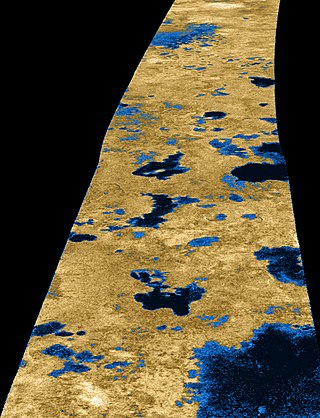
Mackay Lacus is the seventh largest of a number of hydrocarbon seas and lakes found on Saturn's largest moon, Titan. The lake is composed of liquid methane and ethane, and was detected by the Cassini space probe.

Abaya Lacus is one of a number of hydrocarbon lakes found on Saturn's largest moon, Titan.

Bolsena Lacus is one of a number of hydrocarbon lakes found on Saturn's largest moon, Titan.
Neagh Lacus is one of a number of hydrocarbon lakes found on Saturn's largest moon, Titan. The lake is composed of liquid methane and ethane, and was detected by the Cassini space probe.
Sotonera Lacus is one of a number of hydrocarbon lakes found on Saturn's largest moon, Titan.

Hammar Lacus is one of a number of hydrocarbon seas and lakes found on Saturn's largest moon, Titan.

Feia Lacus is one of a number of hydrocarbon seas and lakes found on Saturn's largest moon, Titan. It was named in 2007 on the basis of data taken by the space probe Cassini.
Koitere Lacus is one of a number of hydrocarbon lakes found on Saturn's largest moon, Titan. The lake is composed of liquid methane and ethane, and was detected by the space probe Cassini.
Müggel Lacus is one of a number of hydrocarbon seas and lakes found on Saturn's largest moon, Titan.
Ladoga Lacus is a geographical feature on Saturn's largest moon, Titan, named after Lake Ladoga, Russia. It is one of a number of "methane lakes" found in Titan's north polar region.
Sionascaig Lacus is one of a number of hydrocarbon seas and lakes found on Saturn's largest moon, Titan. The lake is located at latitude 41.52°S and longitude 278.12°W on Titan's globe, and is composed of liquid methane and ethane. The feature is named for the Earth lake, Loch Sionascaig, in Scotland.
References
- ↑ "Planetary Names". planetarynames.wr.usgs.gov. Retrieved 14 April 2024.

 | This article about the planet Saturn, its moons, their geology or related features is a stub. You can help Wikipedia by expanding it. |