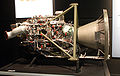
Alcor (also known as Zebra or 30-KS-8000) was a solid rocket engine, originally developed by Aerojet for the US Air Force as the third stage of the Athena test vehicle. [1] [2] [3] Its main appeal was a high mass fraction due to the Aerowrap chamber fabrication process. However, production issues with joint sections limited its use. Alcor engines were used from 1960 to 1977. [1]
The original version was used on a series of rockets: Blue Scout Jr, Blue Scout Junior, Astrobee 200, Blue Scout Jr SLV-1C, RAM B, Blue Scout Jr SLV-1B(m), Athena RTV, Strypi VI and Strypi VIIAR. [1]

Initially produced with polyurethane propellant, it transitioned to polybutadiene, leading to the Alcor 1A (23KS-11000) variant. [1] [4] [5] This variant featured improved nozzle, chamber insulation, and expansion ratio, increasing the mass fraction from 0.886 to 0.906. Both Alcor 1 and 1A were used in Astrobee 500 and 1500 vehicles. [1] Alcor 1A was used on the Athena H. [4] [6]
Another improvement occurred late in 1965, with the introduction of an all welded titanium chamber, resulting in the Alcor 1B variant. [1] [7] [8] Alcor 1B was used on the Strypi VIIR. [7]