
Wittering is a village and civil parish in the City of Peterborough unitary authority area in the ceremonial county of Cambridgeshire, England. The village is about 3 miles (5 km) south of the market town of Stamford in neighbouring Lincolnshire and about 9 miles (14 km) west of Peterborough's urban sprawl.

Winterslow is a civil parish with a population of around 2,000, about 6 miles (10 km) northeast of Salisbury in Wiltshire, England, and lying south of the A30 London Road. It is sited on the Roman road between Old Sarum and Winchester.
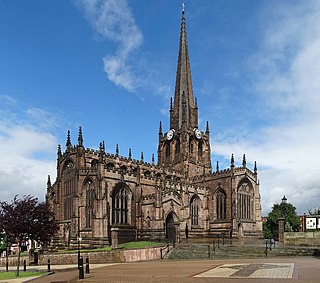
The Minster Church of All Saints or Rotherham Minster is the Anglican minster church of Rotherham, South Yorkshire, England. The Minster is a prominent example of Perpendicular Gothic architecture and various architectural historians have rated it highly. Nikolaus Pevsner describes it as "one of the largest and stateliest churches in Yorkshire", Simon Jenkins states it is "the best work in the county", and Alec Clifton-Taylor calls it the "glory of Rotherham". With its tall spire, it is Rotherham's most predominant landmark, and amongst the tallest churches in Yorkshire.

Wigginton is a village and civil parish about 6 miles (10 km) southwest of Banbury in Oxfordshire. The village is beside the River Swere, which forms the southern boundary of the parish. A Channel Four documentary, Hitler's British Girl, investigated the possibility that Unity Mitford gave birth to the son of Adolf Hitler in Hill View Cottage, Wigginton.

The Church of All Saints is the Church of England parish church for the large village of Wrington, Somerset, England. There has been a church here since the 13th century, though much of the present building dates from the 15th century. Historic England have designated it a Grade I listed building.

Winsley is a large village and civil parish about 2 miles (3 km) west of Bradford on Avon in Wiltshire, England.

The Church of St Mary Magdalene is the Church of England parish church for the village of Ditcheat, Somerset, England. There has been a church on the site since 824, and the present building owes much of its grandeur to the Abbots of Glastonbury. Historic England have designated it a Grade I listed building.

The Church of St Mary in Bruton, Somerset, England was largely built in the 14th century. Like many Somerset churches, it has a very fine tower; less usually it has a second one as well. Simon Jenkins has called Bruton's tower "Somerset architecture at its most powerful." It has been designated a Grade I listed building.

The Church of St Peter and St Paul is the Church of England parish church for the village of South Petherton, Somerset, England. The present church is a large and imposing cruciform-shaped structure constructed on the site of an earlier Saxon Minster, with the majority of the building dating from the 13th to 15th centuries; consequently, the building is Grade I listed.

St Bene't's Church is a Church of England parish church in central Cambridge, England. Parts of the church, most notably the tower, are Anglo-Saxon, and it is the oldest church in Cambridgeshire as well as the oldest building in Cambridge.

South Newton is a village and civil parish about 4 miles (6.4 km) north-west of Salisbury in Wiltshire, England. Topologically it lies between chalk downs to the north-east, and downland with Grovely Wood to the southwest. The village straddles the A36 road and is on the left bank of the River Wylye, which defines much of the western boundary of the parish; the eastern boundary follows the A360 Salisbury-Devizes road.
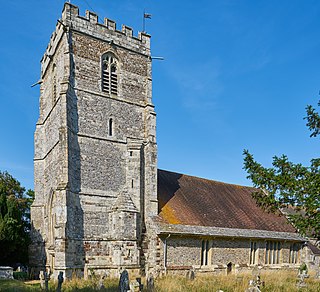
Cranborne Priory is a former priory church in the village of Cranborne, Dorset, England. Founded in 980 as Cranborne Abbey, it became a priory in 1102, remaining that way until it was dissolved in 1540. The tower, nave and aisles from the priory survive to from the Church of St Mary and St Bartholomew, the parish church of Cranborne. The building, which has fragments from the 12th century, is designated a Grade I listed building.

St Mary's Church is the main Church of England parish church for the areas of Portsea and Fratton, both located in the city of Portsmouth, Hampshire. Standing on the oldest church site on Portsea Island, the present building, amongst the largest parish churches in the country, has been described as the "finest Victorian building in Hampshire". It is at least the third church on the site and has been designated a Grade II* listed building by Historic England. Former regular worshippers here have included Charles Dickens, Isambard Kingdom Brunel, and Cosmo Lang.

The Church of St James is the parish church for the village of Kingston, located on the Isle of Purbeck in Dorset. The church is a notable example of the Gothic Revival style and is a Grade I listed building.

All Saints’ Church, Glossop is a Grade II listed parish church in the Church of England in Glossop, Derbyshire, England.

St James's Church is the main Church of England parish church for the town of Trowbridge, Wiltshire, England. The 15th-century Grade I listed building is the town's most prominent landmark.
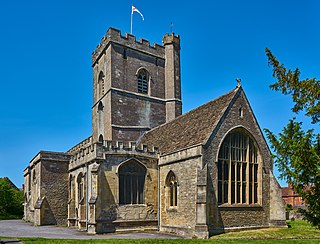
The Church of All Saints is the main Church of England parish church in Westbury, Wiltshire, England. There has been a church on the site since Saxon times, and the current church, largely rebuilt around 1437, is a Grade I listed building.

The Church of St Michael and All Angels is the main Church of England parish church for the suburb of Heavitree, located in the city of Exeter, Devon. The present building is a large and imposing Gothic Revival structure dating back to the 19th century but there has been a church on the site since Saxon times. Designated as a Grade II* listed building by Historic England, the church is notable for its Victorian architecture, tall tower and proximity to the 'Heavitree Yew', an ancient common yew tree within the churchyard amongst the oldest in the county.
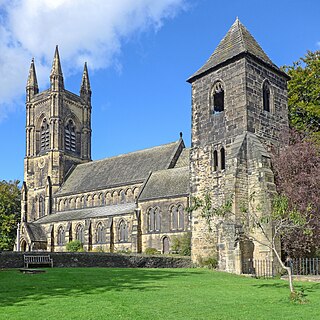
St Mary's Church is the parish church of the town of Mirfield in West Yorkshire, England. The current building is a large Gothic Revival structure designed by Sir George Gilbert Scott, replacing an older structure, the tower of which still survives a short distance from the present building. These structures form Mirfield's most prominent landmark and both are listed for preservation by Historic England, the old church tower as Grade II and the present building as Grade II*.

The Church of St Laurence is the main Church of England parish church for the village of Downton, Wiltshire, England. An unusually long building for a village church, the present structure dates from 1147. Continually altered and enlarged until the mid-19th century, the church displays every style of architecture from the Norman to Victorian eras, and has been designated a Grade I listed building.


